 Jan, 22 2026
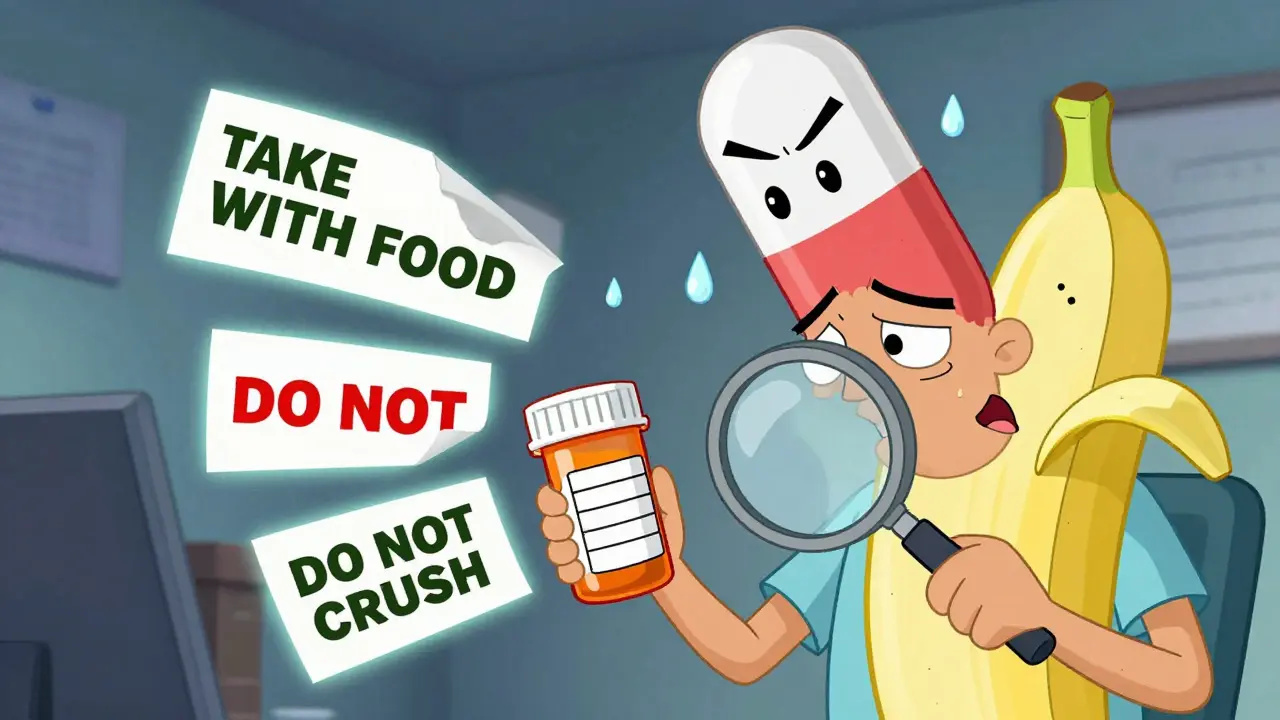
Every time you pick up a prescription, there’s a small label on the bottle with tiny print that could mean the difference between your medicine working as it should-or causing serious harm. These aren’t just reminders like ‘take twice daily.’ They’re special instructions-specific, life-critical directions that tell you exactly how, when, and under what conditions to take your medication. And yet, nearly half of all patients misunderstand them.
What Are Special Instructions, Really?
Special instructions on prescription labels go beyond basic dosage. They’re not suggestions. They’re medical requirements. Things like ‘take with food,’ ‘avoid sunlight,’ ‘shake well before use,’ or ‘do not crush’ aren’t there to fill space. Each one exists because skipping it could make the drug less effective, cause dangerous side effects, or even lead to hospitalization. For example, if you’re on an antibiotic that says ‘take on empty stomach,’ eating even a small snack right before can cut its absorption by up to 60%. If you’re on a blood thinner that says ‘avoid grapefruit,’ consuming it might cause your blood to thin too much-risking internal bleeding. These aren’t hypothetical risks. They’re documented, real, and preventable. According to a 2008 study by Dr. Terry C. Davis, nearly 49% of patients misinterpret these instructions. That’s almost one in two people. And the consequences? Medication errors cost the U.S. healthcare system $42 billion a year.Where to Find These Instructions (They’re Not Always Where You Think)
You might assume all the important details are right on the main label. But that’s not always true. Special instructions appear in three places:- On the primary label (32% of cases)
- On a small sticker stuck to the bottle (47% of cases)
- In a separate printed sheet from the pharmacy (21% of cases)
Common Instructions-and How People Misunderstand Them
Some phrases sound simple. But they’re often misread. Here’s what patients actually think versus what doctors mean:- ‘Take with food’: 41% think it means ‘with the first bite,’ 33% think ‘during the meal,’ and 26% think ‘within 30 minutes.’ The correct meaning? Usually, ‘with a full meal’-not a handful of crackers.
- ‘Take on empty stomach’: 287 patients on HealthUnlocked reported taking this with snacks or coffee, thinking it was ‘fine.’ But coffee, juice, or even water can interfere with absorption for some drugs.
- ‘Every 12 hours’: 53% of patients take doses too close together, often because they think ‘morning and night’ means 8 a.m. and 8 p.m. But 12 hours apart means 8 a.m. and 8 p.m., not 7 a.m. and 7 p.m. That’s why many people overdose accidentally.
- ‘Shake well before use’: This is critical for liquid antibiotics or suspensions. If you don’t shake, you might get a dose with no medicine at all-or way too much.
Who’s Most at Risk-and Why
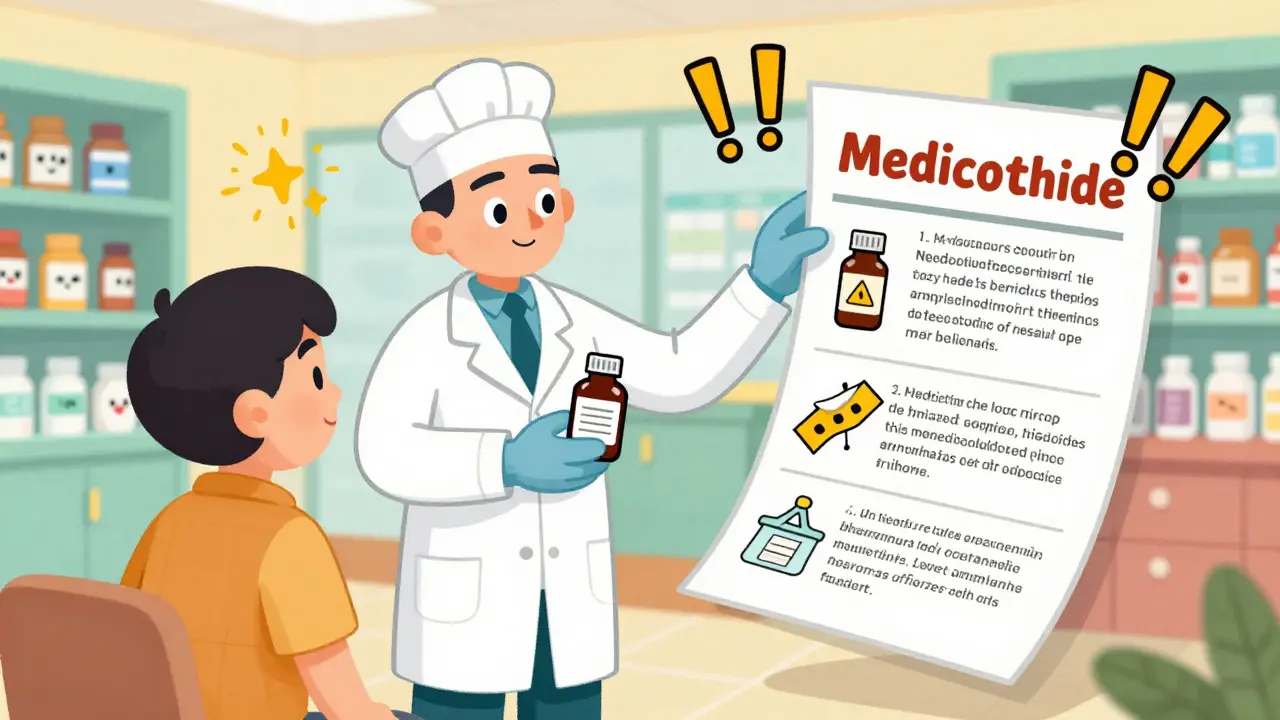
It’s not just about being forgetful. Health literacy plays a huge role. In the U.S., 36% of adults have basic or below-basic health literacy, meaning they struggle to read and understand medical information. Among this group, 62% misinterpret special instructions. That’s more than double the rate of those with proficient literacy. Language barriers make it worse. Spanish-speaking patients misinterpret ‘take with food’ instructions 3.2 times more often than English speakers. Older adults, people with vision problems, and those managing multiple medications are also at higher risk. The FDA requires Medication Guides for 250 high-risk drugs-about 12% of all prescriptions. These are full pamphlets explaining side effects, risks, and special instructions in plain language. But many patients never open them. One patient in Florida told her pharmacist she didn’t read the guide because ‘it looked like a legal document.’What You Can Do to Stay Safe
You don’t have to guess. Here’s what actually works:- Check all three places. Look at the bottle, the sticker, and the paper insert. Don’t assume one has everything.
- Ask the pharmacist to explain. Say: ‘Can you walk me through the special instructions?’ Most pharmacists will do it-89% of positive pharmacy reviews mention this as a key reason patients trust them.
- Clarify vague terms. If it says ‘with food,’ ask: ‘Does a banana count? What about yogurt?’
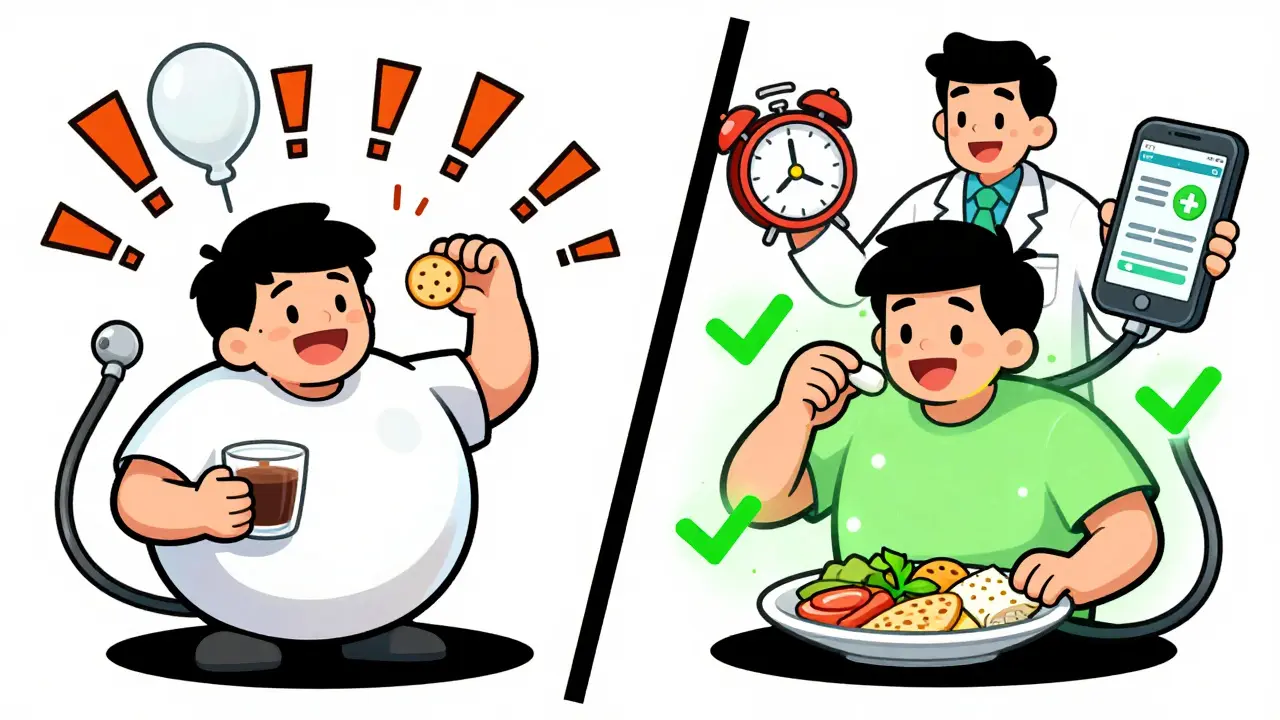
- Use a pill organizer. One with time slots (morning, afternoon, evening) reduces timing errors by 47%, according to Mayo Clinic.
- Turn on reminders. Apps like Medisafe or MyTherapy help track doses and send alerts. 62% of users say it improved their adherence.
- Request large-print labels. 94% of U.S. pharmacies offer them for free. If you’re struggling to read the text, ask.
What’s Changing-and What’s Coming
The system is slowly improving. In 2023, the FDA proposed a new rule to standardize 12 key phrases across all prescription labels by 2026. Instead of ‘take with food,’ labels might say ‘take during a meal.’ Instead of ‘every 12 hours,’ they’ll say ‘take every 12 hours, exactly.’ Some pharmacies are testing AI-driven labels that adjust wording based on your health literacy level. Others are piloting augmented reality labels: scan the bottle with your phone, and a video plays showing how to take the medicine. In 2023, the American Medical Association introduced a new billing code (99444) so doctors can be paid $27.63 for a 5-minute session explaining medication instructions. That’s a big step-it means providers are finally being incentivized to talk, not just prescribe.Why This Matters More Than You Think
This isn’t just about remembering to take your pill. Misunderstanding special instructions leads to preventable hospitalizations. The Medicare Rights Center reported 12,450 complaints in 2023 alone-43% of them tied to label confusion. That’s $1.2 billion spent on hospital stays that could have been avoided. A 2019 Johns Hopkins study found that clear special instructions reduce medication errors by 38%. That’s a huge number. But it only works if patients understand them. The bottom line? Your prescription label isn’t just paperwork. It’s a safety tool. And like any tool, it only works if you know how to use it.What does ‘take with food’ really mean on a prescription label?
‘Take with food’ means you should take your medication during or right after a full meal-not a snack, not a sip of coffee, and not just a few bites. A full meal typically includes protein, carbs, and fat, like eggs and toast, or chicken and rice. Taking it on an empty stomach or with just a cracker can reduce how well your body absorbs the drug. Always ask your pharmacist what counts as ‘food’ for your specific medicine.
Why do some prescriptions have instructions on stickers instead of the main label?
Pharmacies often use stickers because the original label doesn’t have enough space, or the instructions were added after the bottle was printed. It’s also common when a doctor changes your dosage or adds a new warning after you’ve already picked up the prescription. But this makes it easy to miss. Always check for any extra stickers-even if they look small or worn.
Can I crush my pills if they’re hard to swallow?
Never crush a pill unless the label or your pharmacist says it’s safe. Many medications-especially extended-release ones-are designed to release slowly over time. Crushing them can cause the entire dose to flood into your system at once, which can be dangerous or even deadly. If swallowing is hard, ask your doctor or pharmacist for a liquid version or a different form.
What should I do if I don’t understand the instructions?
Call your pharmacy or ask your pharmacist when you pick up the prescription. Say: ‘I’m not sure what this means.’ They’re trained to explain these things. Don’t guess. Don’t rely on internet searches. Misunderstanding a single instruction can lead to serious side effects or hospitalization. It’s always better to ask twice than risk taking it wrong once.
Are there tools to help me remember how to take my meds?
Yes. Pill organizers with time slots (morning, afternoon, night) reduce timing errors by nearly half. Medication reminder apps like Medisafe or MyTherapy send alerts and track your doses. You can also ask your pharmacy for large-print labels or audio instructions. Some pharmacies even offer home delivery with pre-sorted doses. Ask what’s available-most services are free.
Why do some medications come with a separate Medication Guide?
The FDA requires Medication Guides for about 250 high-risk drugs-those with serious side effects or complex usage rules. These guides explain risks, what to watch for, and exactly how to take the medicine. They’re not optional. Even if it looks like fine print, read it. If you’re unsure, bring it to your pharmacist. They can walk you through it in plain language.
Phil Maxwell
January 23, 2026 AT 11:16Been taking my blood pressure med for years and never realized the sticker had the 'take with food' note. Peeling off like a bad tattoo. Learned the hard way when I ended up dizzy at work. Now I check every bottle like it's a treasure map. Small things matter.
Also, the pharmacy I use switched to bigger font last year. Asked for it. Free. Do it.
Also also - don't trust the front label. Always flip the bottle.
Dolores Rider
January 24, 2026 AT 05:43THEY’RE LYING TO US. 🤡
Why do they put the important stuff on a sticker that peels off? Why not just PRINT IT? This is all a scam to make us sick so they can sell us more drugs. I read a forum where someone said the FDA gets kickbacks from pharma giants to keep instructions confusing. I’m not paranoid - I’m PREPARED.
Also, I don’t trust pharmacists. They’re all paid by the corporations. I take my pills with vodka now. Works better. #PharmaFree
venkatesh karumanchi
January 24, 2026 AT 16:36In India, we don’t have fancy stickers or inserts - the pharmacist just tells you face to face. No label? No problem. They say, ‘Beta, take after roti, not before chai.’ Simple. Human.
Maybe the problem isn’t the label - it’s that we’ve forgotten how to talk to each other. In the US, you get a bottle and a 12-page pamphlet and no one says ‘Hey, this matters.’
Just ask. Always ask. Even if you feel dumb. I asked my aunt how to take her diabetes med. She said, ‘With the first bite of dal.’ That’s all you need.
Kat Peterson
January 26, 2026 AT 01:49OMG I CRIED READING THIS. 💔
Like, I’m a PH.D. student and I thought ‘take on empty stomach’ meant ‘don’t eat after’ - not ‘don’t eat before.’ I took my antidepressant with a Pop-Tart for SIX MONTHS. My therapist said I was ‘non-compliant.’ I thought I was just… lazy.
Now I have a laminated card taped to my fridge with every med and what it means. I even made a color-coded system. Red = NO GRAPEFRUIT. Blue = FULL MEAL. Gold = SHAKES WELL. I’m basically a pharmacist now. #MedicationQueen
blackbelt security
January 27, 2026 AT 12:52People think meds are like coffee - ‘close enough.’ Nope. It’s not a suggestion. It’s a protocol. You wouldn’t fly a plane without checking the fuel gauge. Why treat your body like it’s a suggestion box?
Use a pill organizer. Set alarms. Ask the pharmacist. That’s it. No magic. No conspiracy. Just discipline.
And if you can’t read the label? Ask for large print. They’re not gonna charge you. It’s not a favor. It’s your right.
Patrick Gornik
January 28, 2026 AT 16:01Let’s deconstruct the epistemological crisis of pharmaceutical semiotics. The label is not a signifier of compliance - it’s a neoliberal artifact of fragmented care, commodified by corporate pharmacopeia to externalize liability onto the patient-consumer.
‘Take with food’ is a linguistic trap - a Foucauldian disciplinary mechanism disguised as guidance. The body becomes a site of bureaucratic surveillance. The sticker? A postmodern glitch in the system - a symptom of capitalist inefficiency.
Meanwhile, the pharmacist, caught between insurance protocols and patient ignorance, becomes the tragic hero of a broken healthcare dystopia.
And yet - the solution isn’t better labels. It’s the abolition of the pharmaceutical-industrial complex. Until then, we’re all just walking pharmacokinetic experiments.
Also, I take my meds with kombucha. It’s probiotic. It’s holistic. It’s rebellion.
Tommy Sandri
January 29, 2026 AT 06:56The issue of prescription label comprehension is a global public health concern, not merely a U.S.-centric problem. In countries with centralized healthcare systems, standardized labeling protocols are mandated by national health authorities, reducing variability. The absence of such standardization in the U.S. reflects broader systemic fragmentation.
It is also worth noting that multilingual labeling, while legally required in some jurisdictions, remains inconsistently implemented. The cultural and linguistic diversity of the U.S. population demands a more robust, inclusive approach to health communication.
Recommendations such as pharmacist consultation and pill organizers are sound, but they are band-aids on a structural wound. Policy reform, not individual vigilance, is the necessary path forward.
Luke Davidson
January 29, 2026 AT 19:01I used to think ‘every 12 hours’ meant morning and night - until my buddy had a seizure because he took his seizure med at 8 a.m. and then again at 9 p.m. He didn’t even know the difference.
Now I set two alarms on my phone - one for 8 a.m., one for 8 p.m. - and I tell my mom when I take it. She calls me like a boss.
Also - I asked my pharmacist what ‘with food’ meant for my cholesterol pill. She said, ‘Think breakfast, not a granola bar.’ I felt like an idiot. But I’m alive. So worth it.
Pharmacists are angels in white coats. Talk to them. They’ve seen everything. They won’t judge. I promise.
Karen Conlin
January 29, 2026 AT 22:57My grandma took 14 meds. She didn’t read anything. I made her a color-coded chart - red for morning, blue for night, green for ‘with food.’ We taped it to her fridge next to the cat photo.
She still forgets. But now she says, ‘Which one’s the red one?’ and I say, ‘The one that keeps you from falling.’ She laughs. Then takes it.
Don’t assume people know. Don’t assume they care. Teach them. Show them. Make it stupid simple. That’s how you save lives.
And if you’re the one taking meds? Don’t be proud. Ask. Again. And again. You’re not stupid - the system is broken. You’re just trying to survive it.
asa MNG
January 31, 2026 AT 00:29bro i took my antibiotic with a burrito and i thought it was fine?? like i had a full meal right?? 🤡
then i got the worst stomach cramps and my girlfriend made me go to urgent care and they were like ‘you’re lucky you didn’t die’
now i have a note on my phone that says ‘NO BURRITOS FOR ANTIBIOTICS’ 😭
also i use the mytherapy app and it beeps at me like a mom. i love it. it’s my little robot nurse 🤖💊
Sushrita Chakraborty
January 31, 2026 AT 11:00While the article presents a compelling case for improved pharmaceutical communication, it is imperative to acknowledge the cultural and socioeconomic disparities that underpin this issue. In India, where literacy rates vary widely, verbal instruction from a trained pharmacist remains the primary mode of communication. This is not a deficiency - it is an adaptation.
Moreover, the reliance on printed materials assumes universal access to vision, literacy, and stable housing - conditions not universally met. Digital solutions, while innovative, may exclude elderly or low-income populations.
A holistic approach must include: trained community health workers, audio instructions in local languages, and mandatory pharmacist counseling - not just better labels.
Josh McEvoy
February 1, 2026 AT 07:06my pharmacist gave me a sticker that said ‘shake well’ and i thought it was a joke 😂
so i didn’t shake it. and then i took it. and nothing happened. like, i felt nothing. no effect. so i took another one. and then another.
turns out the whole bottle was just water with food coloring. i almost overdosed on nothing.
now i shake every bottle like i’m making a cocktail. and i take pics of the labels. and i send them to my sister. she’s my med sheriff. 🤠💊
Heather McCubbin
February 1, 2026 AT 22:37People think this is about reading. It’s not. It’s about accountability. You’re not a victim of bad labeling - you’re a victim of your own laziness.
If you can’t read the tiny print, get glasses. If you can’t remember, use an app. If you don’t know what ‘with food’ means, you don’t deserve to be alive.
My cousin died because she thought ‘every 6 hours’ meant ‘when I wake up, when I go to bed, and when I’m hungry.’ She was 32.
Stop making excuses. This isn’t complicated. It’s life or death. And you’re choosing death.
Phil Maxwell
February 2, 2026 AT 14:50^^^ I get where you're coming from - but not everyone has the privilege of time, money, or health literacy. My aunt has glaucoma. She can’t read the label even with glasses. She relies on her grandson to read it. That’s not laziness. That’s systemic failure.
And if you’re gonna judge, at least offer a solution. I didn’t just complain - I asked for large print. Free. Done.
Be the change. Not the critic.