 Mar, 8 2026
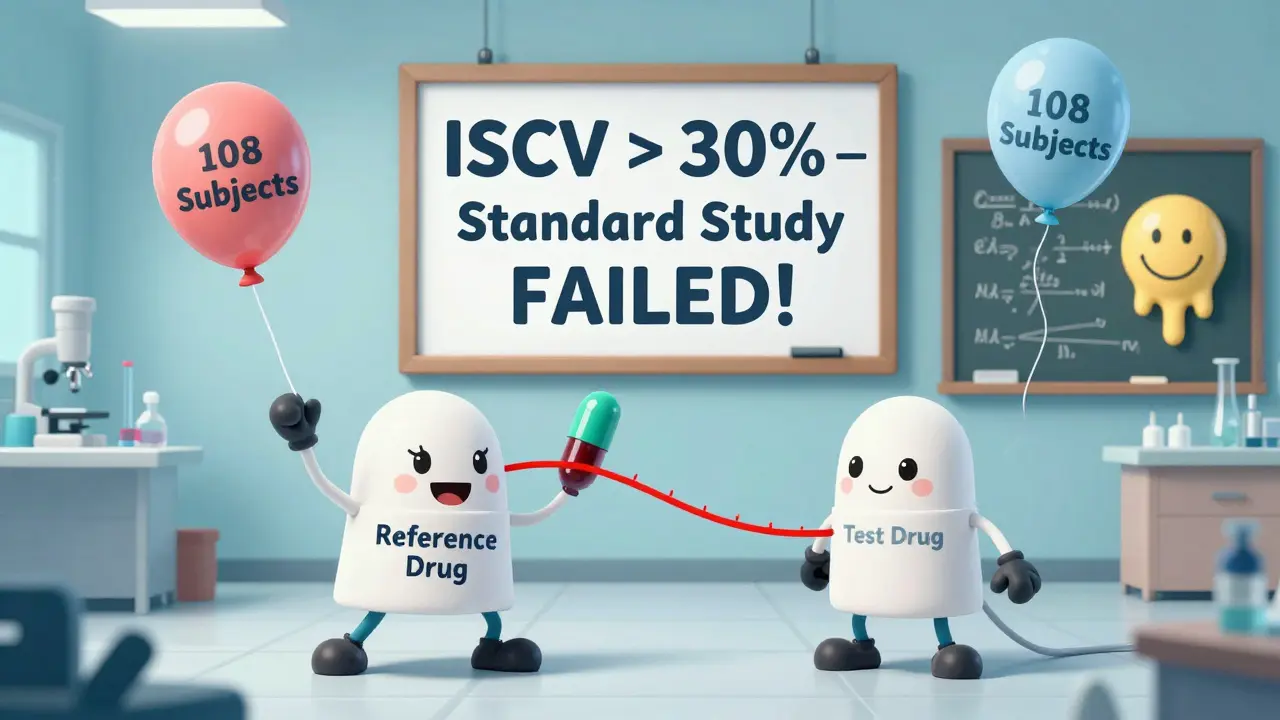
When a drug is highly variable - meaning its effects differ significantly from person to person - standard bioequivalence (BE) studies often fail. That’s where replicate study designs come in. These aren’t just fancy tweaks to old methods. They’re the only reliable way to prove that a generic drug works as well as the brand-name version when the original drug itself is unpredictable. Without them, thousands of generic medications wouldn’t reach patients at all.
Why Standard Designs Fall Short
For decades, the go-to method for BE studies was the two-period, two-sequence crossover: one group gets the test drug then the reference, another gets them in reverse. Simple. Clean. But it doesn’t work for drugs with high within-subject variability (ISCV). When the reference drug’s blood levels vary by more than 30% across doses in the same person, the study’s ability to detect true equivalence collapses. You end up needing 80, 100, even 120 subjects just to get a shot at passing. Most sites can’t recruit that many. And even if they do, the cost and time make it impractical.
Take levothyroxine, for example. Its ISCV hovers around 40-50%. A 2x2 study trying to prove bioequivalence for this drug would need over 100 subjects to reach 80% power. But with a replicate design? Just 42. And that’s not an outlier - it’s the norm for HVDs (highly variable drugs). The FDA saw this problem in the early 2000s and started allowing reference-scaled average bioequivalence (RSABE). The EMA followed with similar rules in 2010. Both agencies now require replicate designs when ISCV exceeds 30%.
The Three Types of Replicate Designs
Not all replicate designs are the same. There are three main types, each with trade-offs in data quality, cost, and regulatory acceptance.
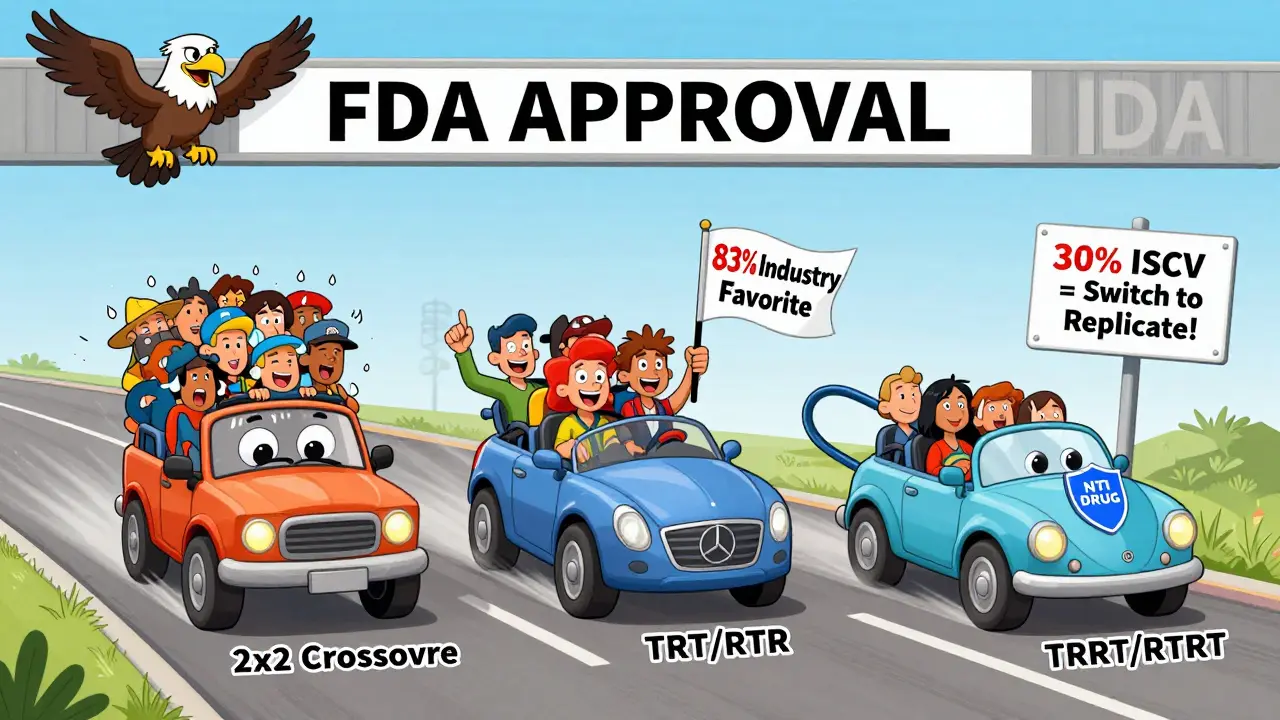
- Full replicate (four-period): Subjects get all four sequences: TRRT, RTRT, or similar. This gives you data on both the test (CVwT) and reference (CVwR) variability. It’s the gold standard - especially for narrow therapeutic index (NTI) drugs like warfarin or phenytoin. The FDA mandates this for NTI drugs. It’s also the most robust for drugs with ISCV over 50%.
- Full replicate (three-period): Sequences like TRT and RTR. Each subject gets the test drug once and the reference twice (or vice versa). This lets you estimate CVwR reliably and gives some insight into CVwT. It’s the sweet spot for most HVDs with ISCV between 30% and 50%. Industry surveys show 83% of CROs prefer this design for its balance of power and feasibility.
- Partial replicate: Only three sequences: TRR, RTR, RRT. You only get CVwR, not CVwT. It’s cheaper and faster than full replicate, and the FDA accepts it for RSABE. But the EMA doesn’t. If you’re targeting global markets, this design limits your approval options.
Why does this matter? Because the statistical model you use depends on the design. If you use a partial replicate but try to estimate CVwT, you’re building on sand. The FDA’s 2023 guidance on warfarin sodium explicitly requires a four-period full replicate because even small differences in absorption can lead to dangerous bleeding or clotting events. Precision isn’t optional here.
How Replicate Designs Cut Sample Size - Dramatically
Here’s the real win: replicate designs slash the number of subjects you need. Let’s break it down with real numbers.
For a drug with ISCV = 40% and a 10% formulation difference:
- Standard 2x2 crossover: 108 subjects needed for 80% power.
- Three-period full replicate (TRT/RTR): 28 subjects.
That’s a 74% reduction. For a drug with ISCV = 50%, the difference is even starker: 120 subjects vs. 32. The math doesn’t lie. And it’s not theoretical. In 2023, a clinical operations manager reported their levothyroxine study passed on the first try using 42 subjects in a TRT/RTR design. Previous attempts with 98 subjects in a 2x2 design had failed.
But it’s not just about saving money. It’s about feasibility. Many HVDs have long half-lives - 12, 18, even 24 hours. A four-period study could stretch over 60 days. If you’re recruiting 120 subjects, you’re looking at a 12-month study. With replicate designs? You can finish in 4-5 months. That’s the difference between a project that gets approved and one that gets shelved.
Statistical Complexity: The Hidden Cost
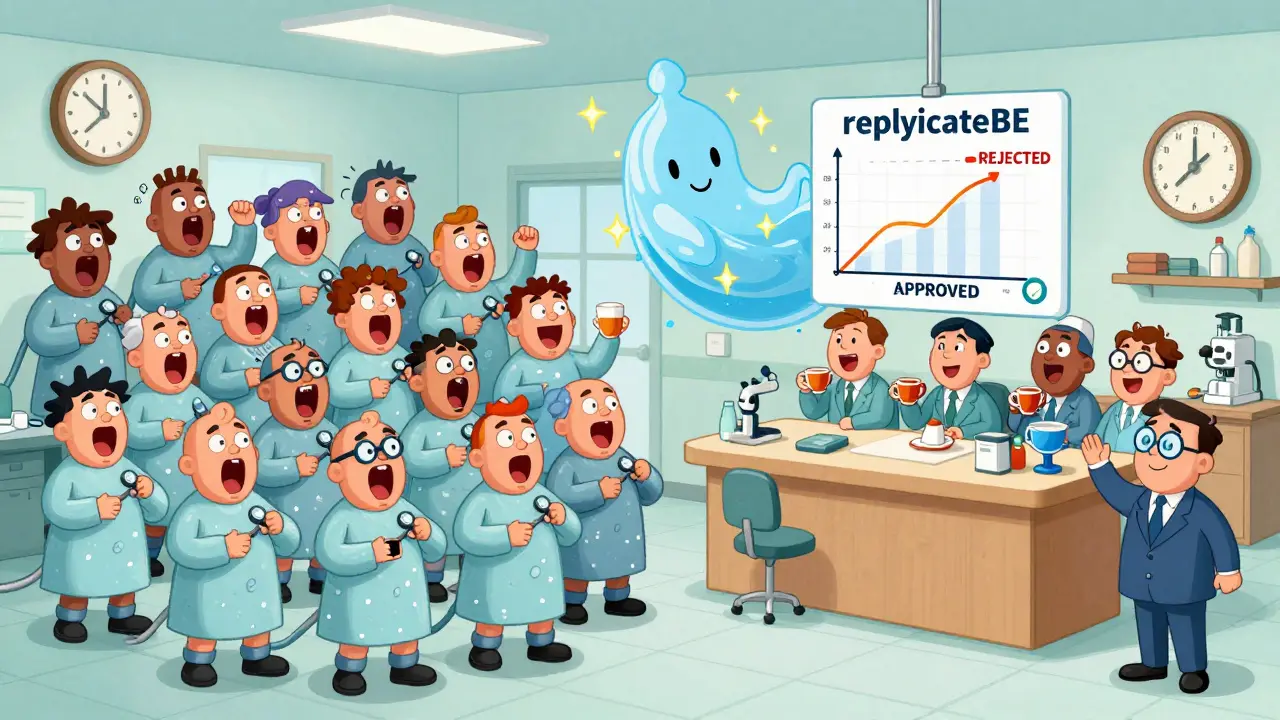
Replicate designs aren’t plug-and-play. They demand advanced statistical skills. You can’t just run a t-test. You need mixed-effects models, reference-scaling, and a deep understanding of regulatory guidelines.
The industry standard tool? The R package replicateBE (version 0.12.1, CRAN 2023). It’s open-source, free, and handles everything from RSABE calculations to power analysis. In Q1 2024 alone, it had 1,247 downloads - a sign of how widely adopted it is. But learning it takes time. A 2022 AAPS workshop found analysts needed 80-120 hours of focused training to use it competently.
And the models are finicky. If you don’t specify the correct random effects - like whether to treat subject as random or fixed - your results can be invalid. A statistician on Reddit reported a 30% dropout rate in a four-period study for a long-half-life drug. That forced them to over-recruit by 30% and spend an extra $187,000. It wasn’t the design’s fault - it was poor planning.
Common pitfalls? Inadequate washout periods, not accounting for carryover effects, and using the wrong statistical model. The FDA’s 2023 GDUFA report shows that 41% of HVD submissions using non-replicate designs were rejected. But for properly executed replicate studies? Approval rates hit 79%.
Regulatory Differences Matter
The FDA and EMA agree on the need for replicate designs - but they don’t agree on the details.
The FDA allows partial replicate designs (TRR/RTR/RRT) for RSABE. The EMA does not. The EMA requires full replicate designs with at least 12 subjects in the RTR arm to validate CVwR. And while the FDA accepts Bayesian methods in some cases (as noted in Controlled Correspondence #CC-2023-0271), the EMA still prefers frequentist approaches.
That creates a headache for global developers. A study designed for the U.S. market might get rejected in Europe. A 2023 analysis by the International Pharmaceutical Regulators Programme found that submissions using FDA-preferred designs had a 23% higher rejection rate at the EMA. Harmonization is coming - the ICH is working on an E14/S6(R1) addendum due in late 2024 - but for now, you need to design for the target market.
What to Do: A Practical Guide
So how do you pick the right design? Here’s a simple decision tree:
- If your reference drug’s ISCV is below 30%? Use a standard 2x2 crossover. No need to overcomplicate it.
- If ISCV is between 30% and 50%? Go with a three-period full replicate (TRT/RTR). It’s the most balanced choice - strong power, manageable duration, and accepted by both FDA and EMA.
- If ISCV is above 50%? Use a four-period full replicate (TRRT/RTRT). Especially if it’s an NTI drug. You need the extra data to prove safety.
- If you’re targeting only the U.S. market and want to cut costs? A partial replicate (TRR/RTR/RRT) is acceptable - but know you’re limiting your global options.
And always over-recruit. Industry data shows dropout rates of 15-25% in multi-period studies. Plan for 20-30% extra subjects. A 42-subject study? Recruit 54. A 36-subject study? Recruit 48. It’s cheaper than delaying by months.
The Future: Adaptive Designs and AI
Replicate designs aren’t static. The next wave is adaptive designs. Imagine starting with a replicate study, but if early data shows lower-than-expected variability, you switch to a simpler 2x2 design mid-study. The FDA’s 2022 draft guidance supports this. It’s not approved yet, but it’s coming.
Pfizer’s 2023 proof-of-concept used machine learning to predict sample size needs based on historical BE data. It was 89% accurate. That kind of tool could cut planning time in half.
But the core truth remains: for HVDs, replicate designs are non-negotiable. They’re not a trend. They’re the standard. And if you’re developing a generic for a highly variable drug, your path to approval runs through them.
What is a replicate study design in bioequivalence?
A replicate study design is a bioequivalence study where subjects receive the test and reference products more than once across multiple treatment periods. This allows researchers to estimate within-subject variability for both products, which is critical for highly variable drugs. Common types include three-period (TRT/RTR) and four-period (TRRT/RTRT) designs. Unlike standard two-period crossover studies, replicate designs enable reference-scaling of bioequivalence limits, making approval feasible for drugs with high variability.
When is a replicate design required for bioequivalence studies?
A replicate design is required when the within-subject coefficient of variation (ISCV) of the reference drug exceeds 30%. This threshold is set by both the U.S. FDA and the European EMA. For drugs with ISCV above 30%, standard two-period crossover studies lack statistical power and become impractical due to unreasonably large sample size requirements. Replicate designs are mandatory for narrow therapeutic index drugs regardless of variability, due to safety concerns.
What’s the difference between full and partial replicate designs?
A full replicate design (e.g., TRT/RTR or TRRT/RTRT) provides data on both the test and reference product’s within-subject variability (CVwT and CVwR). A partial replicate (e.g., TRR/RTR/RRT) only estimates CVwR. Full designs are preferred for global submissions and NTI drugs because they offer more robust data. Partial designs are accepted by the FDA for HVDs but not by the EMA, limiting their use in international markets.
How many subjects are needed for a replicate BE study?
For HVDs with ISCV between 30% and 50%, a three-period full replicate design typically requires 24-48 subjects. For ISCV above 50%, a four-period full replicate design may need 32-72 subjects. This is far fewer than the 80-120 subjects often needed for standard 2x2 designs. Always plan for 20-30% over-recruitment to account for dropouts, especially in longer studies.
What software is used to analyze replicate BE studies?
The R package replicateBE (version 0.12.1) is the industry standard for analyzing replicate BE data. It supports reference-scaled average bioequivalence (RSABE) and is used by regulatory agencies and CROs worldwide. Other tools include Phoenix WinNonlin and SAS with specialized macros. However, replicateBE is free, open-source, and has become the de facto benchmark due to its transparency and alignment with FDA and EMA guidance.
Why do replicate studies have higher approval rates?
Replicate studies have higher approval rates because they account for high variability using reference-scaling, which adjusts bioequivalence limits based on the reference drug’s actual variability. This prevents false rejections of safe and effective generics. In 2023, the FDA approved 79% of properly conducted replicate studies for HVDs, compared to just 52% for non-replicate attempts. The design’s ability to reduce sample size while maintaining statistical rigor makes it more reliable and less prone to Type II errors.
Janelle Pearl
March 9, 2026 AT 18:30Erica Santos
March 10, 2026 AT 22:05Ray Foret Jr.
March 12, 2026 AT 03:50Peter Kovac
March 13, 2026 AT 13:28Scott Easterling
March 14, 2026 AT 18:20Katy Shamitz
March 16, 2026 AT 11:22Neeti Rustagi
March 17, 2026 AT 16:22Melba Miller
March 18, 2026 AT 20:18George Vou
March 19, 2026 AT 03:03Mantooth Lehto
March 19, 2026 AT 13:20Dan Mayer
March 20, 2026 AT 22:53