 Dec, 15 2025
Blurred vision isn’t just annoying-it’s a sign your eye isn’t focusing light the way it should. This is called a refractive error, and it’s one of the most common vision problems in the world. Around 54% of people between 40 and 69 in the UK have one, according to UK Biobank data. You might not realize it, but if you squint to read street signs, get headaches after screen time, or struggle to see clearly at night, you could be dealing with myopia, hyperopia, or astigmatism. The good news? These aren’t diseases. They’re optical quirks-and they’re fixable.
What Exactly Is a Refractive Error?
Your eye works like a camera. Light enters through the cornea, passes through the lens, and lands on the retina at the back. If everything’s shaped right, the image is sharp. But if your eyeball is too long, too short, or your cornea is uneven, light lands in the wrong spot. That’s when things get blurry. There are three main types:- Myopia (nearsightedness): Distant objects look fuzzy. Close-up stuff? Clear.
- Hyperopia (farsightedness): Close objects are hard to focus on. Distant ones might look okay-at least at first.
- Astigmatism: Everything looks distorted, like you’re seeing through a funhouse mirror. It can mess with both near and far vision at the same time.
It’s not just about age. Myopia often starts around age 10 and gets worse through the teens. Hyperopia can be present from birth but shows up later, especially after 40. Astigmatism? It’s common-up to 60% of people have some degree of it. And it doesn’t go away on its own.
Why Your Eye Shape Matters
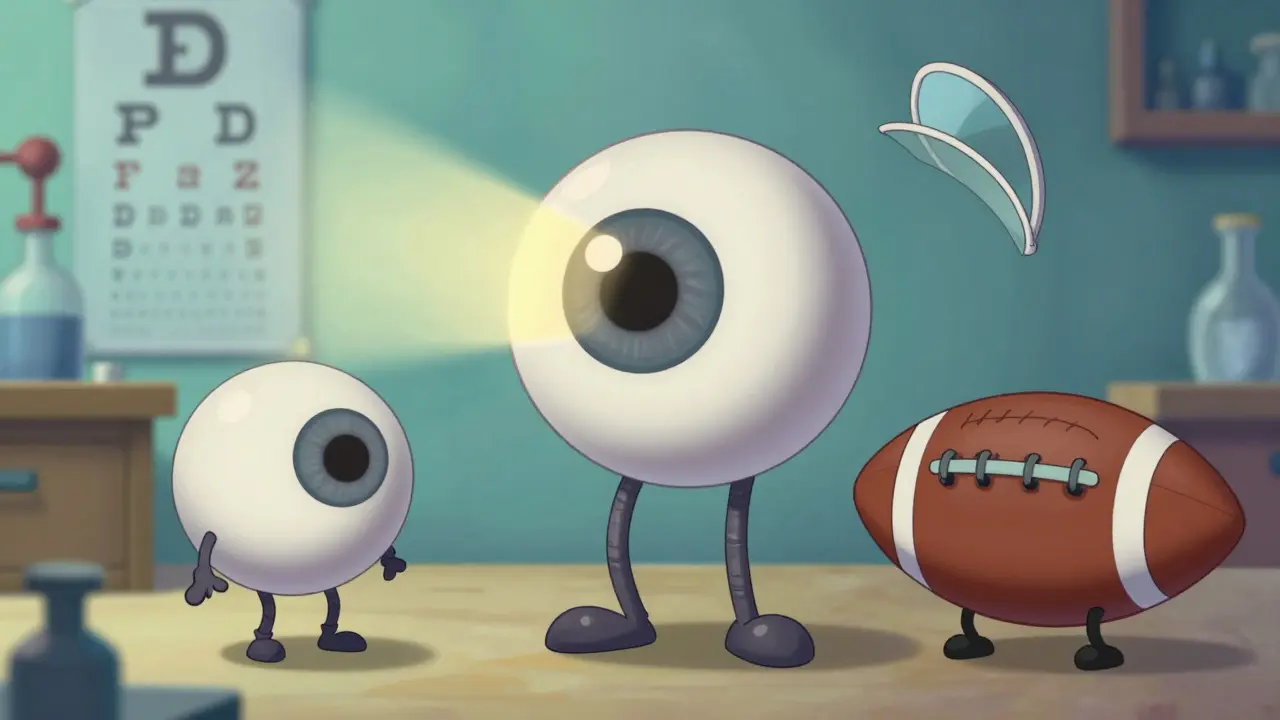
It’s all about measurements. Think of your eye like a balloon.- For myopia, the balloon is stretched too long-over 24mm in adults. Or the front surface (cornea) is too curved, over 43 diopters. Light hits the retina too soon, so distant objects blur.
- For hyperopia, the balloon is too short-under 22mm. The cornea is too flat, under 40 diopters. Light lands behind the retina. Close-up work feels like a chore.
- For astigmatism, the balloon isn’t round-it’s more like a football. The cornea or lens has two different curves. Light splits into two focus points, making edges look smeared or doubled.
These aren’t guesses. They’re measured in diopters during an eye exam. A -2.00 prescription means you’re mildly nearsighted. A +1.50 means you’re slightly farsighted. Astigmatism is written with two numbers: the power (like -1.25) and the axis (like 175°). That axis? It’s the exact angle where the cornea is steepest. Get it wrong, and everything looks wobbly.
How Glasses Fix Your Vision
Glasses are the simplest fix. They bend light before it hits your eye, so it lands right on the retina.- Myopia needs minus (-) lenses. They’re thinner in the middle, thicker at the edges. They push light back so it focuses farther.
- Hyperopia needs plus (+) lenses. Thicker in the middle, thinner at the edges. They bend light inward to reach the retina.
- Astigmatism needs cylinder lenses. These aren’t flat-they’re curved in one direction only. The axis marking tells the optician exactly how to position the curve.
Most people adjust to glasses in a few days. But astigmatism corrections? Some users report taking up to three weeks. One Reddit user said their new lenses had an axis at 175°-and everything looked like water until they got used to it. That’s normal. Your brain needs time to relearn what sharp looks like.
And don’t underestimate the power of choice. Kids who help pick their frames wear them longer. Adults who choose lightweight, anti-reflective coatings report fewer headaches. It’s not just about the prescription-it’s about comfort.
Contact Lenses: Convenience With Risks
Contacts sit directly on your eye. They move with your gaze, giving you a wider field of view than glasses. No more foggy lenses after a cold day. No more slipping down your nose during sports.But they come with trade-offs.
- People with astigmatism need toric lenses-special contacts with weighted edges to stay in place. They cost more and can rotate, causing temporary blurriness.
- Over 3-4% of contact wearers develop microbial keratitis-an infection that can permanently damage vision.
- One user on Reddit said their eyes burned after eight hours of wear. That’s common. Dryness is the #1 complaint.
Modern daily disposables reduce risk, but you still need to wash your hands, never sleep in them, and replace them on schedule. If you’re active, travel often, or hate the feel of glasses, contacts are great. But if you forget routines or have dry eyes, they’re not worth the hassle.

Surgery: Permanent Correction
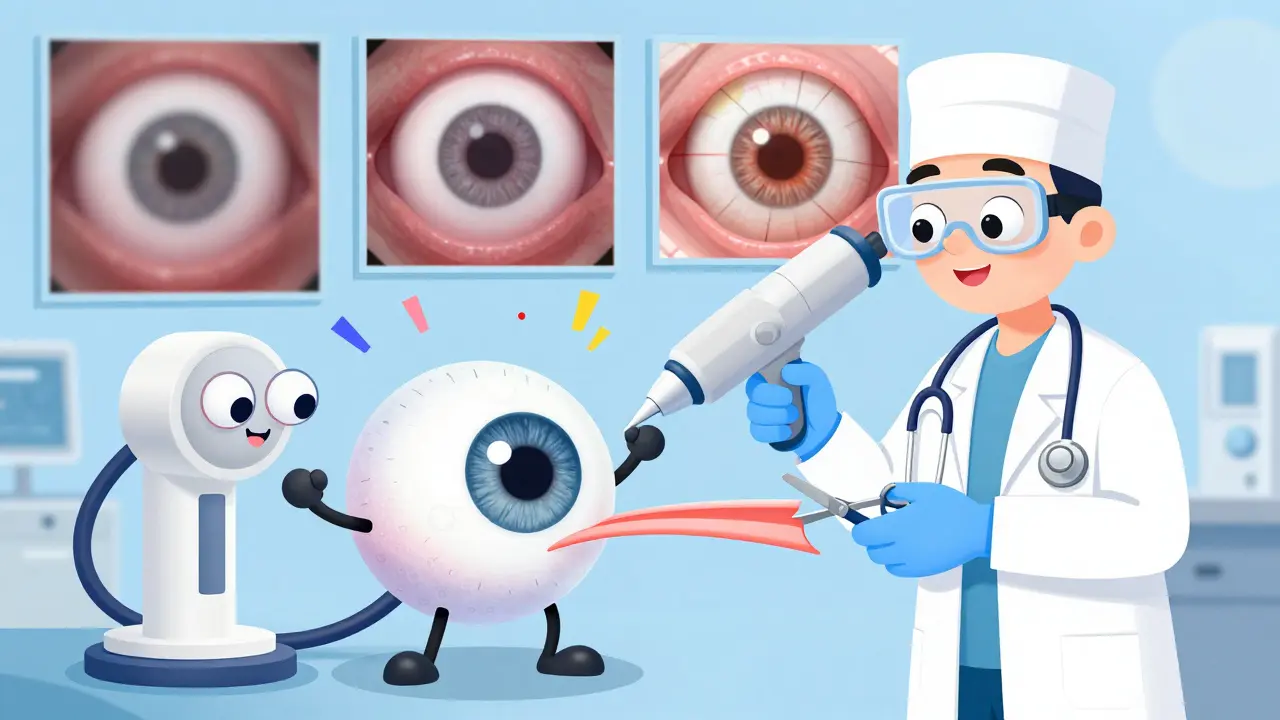
If you’re tired of glasses and contacts, surgery is an option. LASIK, PRK, and SMILE all use lasers to reshape your cornea.- LASIK: A flap is created on the cornea, the laser reshapes the tissue underneath, then the flap is replaced. Recovery is fast-most see clearly within 24 hours.
- PRK: No flap. The surface layer is removed, then the laser works directly. Longer healing time (weeks), but better for thin corneas.
- SMILE: A tiny incision, no flap. A small lens-shaped piece of cornea is removed. Less dry eye than LASIK. It’s growing fast-expected to rise 15% yearly through 2028.
Modern lasers are precise to within 0.25 diopters. That’s like hitting a target the size of a pinhead from 10 feet away. But you’re not a candidate if:
- Your prescription changed in the last year
- Your cornea is thinner than 500 microns
- You’re under 18
- You have autoimmune disease or severe dry eyes
Side effects? About 20-40% of LASIK patients get dry eyes at first. Night glare or halos around lights happen in 5-10%. Most fade in 3-6 months. Satisfaction rates? Around 4.5/5 on review sites like Trustpilot. People say, “I didn’t realize how blurry my world was until I saw it clear.”
Myopia Control: Slowing It Down in Kids
Myopia isn’t just a nuisance-it’s climbing. In East Asia, 80-90% of young adults are nearsighted. In the UK and US, it’s 30-40%. Experts warn that by 2050, half the world’s population could be myopic.And high myopia-over -6.00 diopters-raises your risk of retinal detachment and degeneration by 5 to 10 times.
That’s why new methods focus on slowing progression in children:
- Ortho-K lenses: Hard contact lenses worn overnight. They gently reshape the cornea while you sleep. Studies show they reduce myopia progression by 36-56%.
- Low-dose atropine drops: 0.01% to 0.05% concentration. Used nightly. Clinical trials show 50-80% reduction in worsening over two years. Minimal side effects.
- More time outdoors: The National Eye Institute says kids who spend 2+ hours outside daily develop myopia slower. Sunlight triggers dopamine release in the retina, which may stop the eye from elongating.
These aren’t cures-but they’re powerful tools. If your child is nearsighted and their prescription is rising each year, talk to your optometrist about these options.
What’s the Best Option for You?
There’s no single answer. It depends on your life, your eyes, and your goals.| Method | Best For | Recovery Time | Long-Term Risks | Cost (UK Estimate) |
|---|---|---|---|---|
| Glasses | All ages, low risk tolerance | 1-3 days | Nearly none | £50-£300 |
| Contact Lenses | Athletes, those who dislike glasses | 5-7 days to learn | Infection, dryness | £100-£500/year |
| LASIK | Stable prescription, healthy corneas | 24-48 hours | Dry eyes, night glare | £1,500-£3,000 per eye |
| SMILE | Thin corneas, active lifestyles | 1-3 days | Lower dry eye risk than LASIK | £2,000-£3,500 per eye |
| Ortho-K | Children, myopia progression | 1-2 weeks to stabilize | Corneal irritation, infection risk | £800-£1,500/year |
If you’re under 18, glasses or Ortho-K are your safest bets. If you’re 25+, have a stable prescription, and hate wearing lenses, surgery makes sense. If you’re over 40 and suddenly struggling to read menus? That’s presbyopia-different issue. But if you’ve had blurry vision since childhood, the fix is likely already here.
When to See a Professional
Don’t wait for symptoms to get worse. If you notice:- Blurry vision at any distance
- Headaches after screen time
- Squinting to see clearly
- Double vision or distorted lines
It’s time for a full eye exam. Optometrists can measure your prescription in minutes. Ophthalmologists can check for underlying issues like glaucoma or retinal thinning-especially important if you have high myopia.
Children should have their first eye check by age 3, and again before starting school. Many schools in the UK offer basic screenings, but they’re not enough. A comprehensive exam with dilation is the gold standard.
What’s Next for Vision Correction?
The future is personalized. Wavefront-guided LASIK now maps your eye’s unique imperfections-down to the tiniest aberration. Custom lenses are being designed using AI to match individual corneal shapes. And research into gene therapy for myopia is just beginning.But for now, the best tools are still the ones we’ve had for decades: glasses, contacts, and surgery-used wisely. The key isn’t finding the most advanced tech. It’s finding the right fix for your life.
Whether you’re a parent worried about your child’s worsening glasses, a student tired of foggy lenses, or someone ready to ditch contacts for good-there’s a solution. You just need to start with the right exam.
Can refractive errors get worse over time?
Yes, especially myopia in children and teens. It often progresses until the late teens or early 20s as the eye grows. Hyperopia can improve slightly with age, but presbyopia (age-related focusing loss) usually appears after 40. Astigmatism tends to stay stable unless there’s an eye injury or disease like keratoconus. Regular eye checks every 1-2 years are essential to track changes.
Is LASIK safe for people with astigmatism?
Absolutely. Modern LASIK and SMILE procedures are designed to correct astigmatism. Wavefront-guided technology maps the irregular curvature of your cornea and adjusts the laser precisely. Studies show over 95% of patients with astigmatism achieve 20/20 vision or better after surgery. The key is choosing a surgeon experienced in treating complex cases.
Why do some people still have blurry vision after getting new glasses?
It’s often not the prescription-it’s the fit. If the lenses aren’t centered over your pupils, or if the frame is crooked, vision will be distorted. For astigmatism, even a 5-degree error in the axis can cause headaches and blurred edges. If blurriness lasts more than two weeks, go back to your optician. They can check the alignment, lens centration, and verify the prescription was filled correctly.
Can you outgrow a refractive error?
Rarely. Most people don’t outgrow myopia or astigmatism. Hyperopia can improve slightly in childhood as the eye grows, but in adults, it usually stays the same or gets worse with age. Presbyopia, which affects near vision after 40, isn’t a refractive error-it’s a natural aging change in the lens. You can’t outgrow that either. Correction is lifelong unless you opt for surgery.
Are there natural ways to fix refractive errors?
No. Eye exercises, supplements, or vision therapy won’t change the shape of your cornea or eyeball. While spending time outdoors helps slow myopia progression in kids, it doesn’t reverse it. The only proven methods are corrective lenses (glasses or contacts) or refractive surgery. Be wary of claims about “curing” myopia without lenses or surgery-they’re not backed by science.
What to Do Next
If you’ve been putting off an eye exam, now’s the time. Even if you think your vision is “fine,” small changes add up. Blurry vision leads to eye strain, headaches, and even reduced productivity. In children, uncorrected myopia can affect learning and development.Start by booking a comprehensive eye check with a qualified optometrist. Ask about:
- Whether your prescription has changed
- If you’re a candidate for myopia control (if under 18)
- What lens coatings (anti-glare, blue light, transition) might help
- Whether surgery is worth considering
Don’t let blurry vision become your normal. Clear vision isn’t a luxury-it’s a basic part of living well. And with today’s options, fixing it is easier than ever.
Dwayne hiers
December 15, 2025 AT 03:48Refractive errors are fundamentally optical misalignments resulting from axial length discrepancies or corneal asphericity deviations. Myopia manifests when the axial length exceeds 24mm, causing paraxial rays to focus anterior to the retina. Hyperopia, conversely, arises from axial shortening below 22mm, leading to posterior focal planes. Astigmatism involves non-spherical corneal curvature, producing two orthogonal focal lines. Correction via spherical or cylindrical lenses compensates via dioptric power modulation, aligning the principal meridians with retinal conjugacy. Modern wavefront-guided ablation achieves sub-0.25D precision, effectively eliminating higher-order aberrations.
Thomas Anderson
December 15, 2025 AT 05:50Man, I used to hate my glasses until I got the anti-glare coating. Now I can stare at screens all day without my eyes feeling like they’re on fire. Seriously, if you’re on the computer a lot, spend the extra cash for that. Worth every penny.
Sarthak Jain
December 16, 2025 AT 17:24so i got my first pair of glasses last year n i was like wow this is insane how blurry everything was. like i thought i saw ok but turns out i was squinting at everything. astigmatism was the worst, everything looked kinda wobbly for like 2 weeks. my optician said its normal but i was scared lmao. now i cant imagine life without em.
Rich Robertson
December 18, 2025 AT 06:16Interesting how the East Asian myopia rates are so high. In Japan and South Korea, it’s almost cultural-kids spend 12+ hours a day indoors studying, under fluorescent lights, no sunlight. The dopamine theory makes sense. My cousin in Seoul got Ortho-K lenses at 10. Now at 18, his prescription hasn’t changed in 8 years. Meanwhile, here in the US, we’re still telling kids to ‘just wear glasses’ like it’s no big deal. We’re ignoring the epidemic.
Rulich Pretorius
December 18, 2025 AT 13:12There’s a quiet irony in how we treat vision. We accept blurred vision as normal until it becomes inconvenient. We treat the symptom-glasses, contacts, surgery-but rarely question the environment that exacerbates it. The eye is not a camera. It’s a biological organ shaped by evolution, not engineering. We force it into artificial conditions: screens, artificial light, confined spaces. And then we marvel that it breaks. Perhaps the real correction isn’t in lenses or lasers, but in how we live.
Alexis Wright
December 19, 2025 AT 00:40Let’s be real-LASIK is a scam designed by Big Optometry and Big Tech to make you pay $3,000 for what you could get for $50 in glasses. And don’t even get me started on the dry eye epidemic. 40% of patients? That’s not a side effect-that’s a warranty void. People wake up thinking they’re free, then spend the next decade buying artificial tears like they’re going out of style. You think your cornea regenerates like skin? It doesn’t. You’re permanently altering a delicate structure for vanity. Wake up.
Daniel Thompson
December 19, 2025 AT 21:31I appreciate the thoroughness of this post, but I must point out that the data on myopia progression in children is not universally applicable. The UK Biobank sample is skewed toward urban populations with high screen exposure. In rural communities, especially in the American Midwest, myopia rates remain below 20%. The correlation between screen time and myopia is correlational, not causal. Environmental factors like near-work duration, lighting intensity, and outdoor exposure are confounded in most studies. A more nuanced approach is needed.
Tim Bartik
December 20, 2025 AT 05:32Y’all are overcomplicatin’ this. My kid’s got -3.5 and I told him to go outside and play. No glasses. No contacts. No laser. Just dirt, sun, and baseball. Two years later? He’s at -2.75. No magic pills. No fancy lenses. Just fresh air and not staring at a phone for 12 hours a day. If you’re spending thousands on surgery, you’re not trying hard enough. Go outside, ya’ll.
Natalie Koeber
December 21, 2025 AT 18:53Wait… so you’re telling me the government doesn’t want us to know that glasses are just the beginning? That LASIK is a gateway to neural tracking implants? I read a study-well, a forum post-that said the FDA approved SMILE because it leaves a micro-chip residue in the cornea. They’re mapping our eye movements to predict behavior. That’s why they push ‘natural correction’ so hard-so we don’t notice the surveillance. My optometrist gave me a weird look when I asked about ‘axis alignment.’ Coincidence? I think not.
Wade Mercer
December 23, 2025 AT 10:17It’s irresponsible to promote surgery as a ‘solution’ without emphasizing personal responsibility. If you’re spending hours on your phone at night, staring at a blue-lit screen in a dark room, then blaming your cornea? That’s not a refractive error-that’s negligence. You chose the lifestyle. Now you want a quick fix? No. The fix is discipline. Reduce screen time. Get sunlight. Sleep. Stop expecting technology to undo your bad habits.
Edward Stevens
December 23, 2025 AT 20:16Wow. So after reading this whole thing, I now know that if I squint, I’m probably nearsighted. Groundbreaking. I mean, who knew? Next you’ll tell me the sky is blue and water is wet. I’m just glad I didn’t pay $3,000 for this wisdom.