 Jan, 20 2026
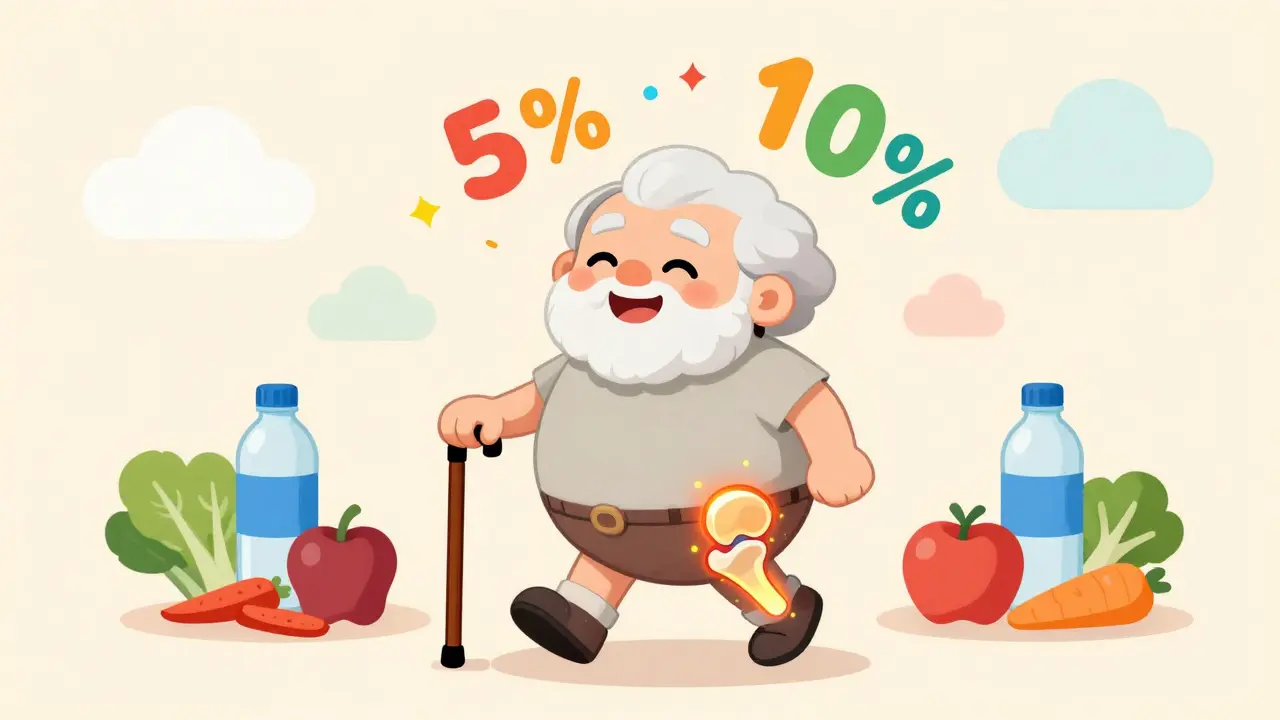
When your hip starts to ache with every step, it’s not just discomfort-it’s your body screaming that something’s off. For millions of people over 50, especially those carrying extra weight, that pain often comes from osteoarthritis of the hip. Unlike the more familiar knee OA, hip osteoarthritis doesn’t always respond the same way to common advice like "just lose weight." But here’s the truth: if you’re overweight and your hip hurts, losing weight isn’t just a nice idea-it might be the most effective non-surgical move you can make.
What Exactly Is Hip Osteoarthritis?
Hip osteoarthritis isn’t just "wear and tear." It’s a slow breakdown of the cartilage that cushions the ball-and-socket joint where your thigh bone meets your pelvis. As that cushion wears thin, bone rubs against bone. Inflammation kicks in. Bone spurs form. Pain gets worse, especially when you stand, walk, or climb stairs. Stiffness in the morning or after sitting too long is common. And over time, your ability to move freely-whether it’s playing with your grandkids or just getting out of a chair-starts to slip away.
The Johns Hopkins Arthritis Center calls it the most common joint disorder worldwide. And while it affects both hips and knees, the way your body reacts to weight loss is different for each. That’s where things get confusing.
Why Weight Loss Matters-Even for Your Hip
For years, doctors told people with knee OA: "Lose weight, and your pain will drop." And the science backed it up. But when it came to the hip, the message got muddy. Some studies said weight loss barely helped. Others said it was a game-changer. In 2023, NEJM Journal Watch outright claimed, "Osteoarthritis of the Hips Is Unaffected by Weight Loss." That sent ripples through the medical community. Was the advice wrong?
Not quite.
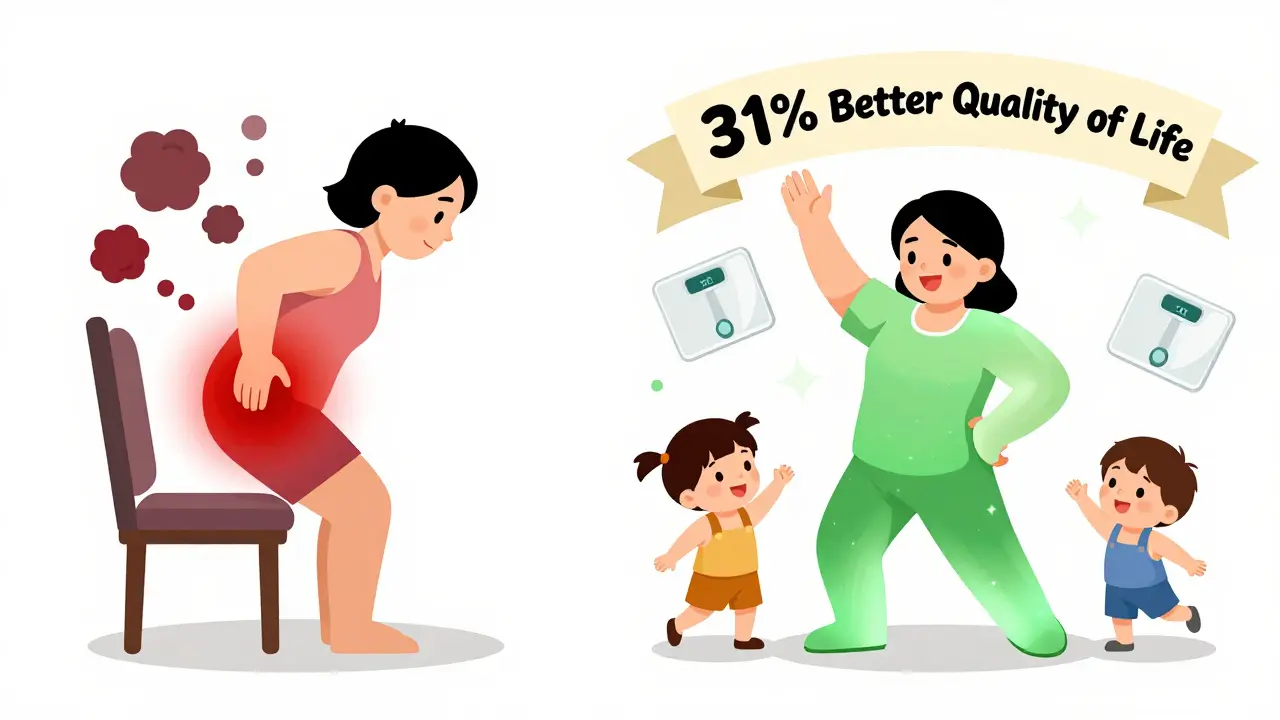
A major 2024 study published in Nature looked at 65-year-old adults with hip OA and obesity (BMI ≥30). The results were clear: those who lost more than 10% of their body weight saw dramatic improvements-not just in pain, but in quality of life, mobility, and daily function. The biggest jump? A 31% improvement in hip-related quality of life. That’s not a fluke. That’s a measurable, meaningful change.
And here’s the kicker: losing 5% helped. Losing 7% helped more. But losing 10% or more? That’s where you start seeing real, clinically significant results. The same study showed improvements across all parts of the HOOS scale-pain, stiffness, sports function, and daily activities. This wasn’t just a small nudge. It was a shift.
The Hip vs. Knee Difference: Why It’s Not the Same
Why does weight loss work better for knees than hips? It comes down to mechanics.
Your knee is a hinge joint. Every step you take puts three to six times your body weight through it. Lose 10 pounds, and you’re removing 30 to 60 pounds of pressure with every stride. Your hip, though, is a ball-and-socket joint. It carries your weight more evenly, even when standing still. So the mechanical load reduction isn’t as dramatic.
But here’s what most people miss: weight loss isn’t just about reducing pressure. It’s also about reducing inflammation.
Fat tissue isn’t just storage. It’s an active organ that pumps out inflammatory chemicals. More fat = more inflammation = more joint damage. That’s true whether it’s your knee or your hip. So even if the mechanical benefit is smaller for your hip, the anti-inflammatory effect is just as powerful.
That’s why a 2023 clinical trial found no big difference in hip pain at six months for people on a very-low-calorie diet versus exercise alone. But at 12 months? The group that lost more weight showed better pain scores, better function, and higher overall improvement. The benefits were delayed-but they came.
What Does Real Weight Loss Look Like for Hip OA?
Forget quick fixes. This isn’t about a 10-day cleanse. This is about sustainable change.
The Osteoarthritis Healthy Weight For Life (OAHWFL) program, developed in Australia and New Zealand, gives us the clearest roadmap. It’s a structured 18-week plan focused on losing 7-10% of body weight through a mix of diet and movement. For someone weighing 200 pounds, that’s 14 to 20 pounds. Not easy. But doable.
Here’s what works:
- Calorie control without starvation: Focus on whole foods-vegetables, lean proteins, legumes, whole grains. Cut out sugary drinks, processed snacks, and refined carbs. A low-carb approach has shown strong results in studies, but you don’t need to go keto. Just reduce the junk.
- Exercise that protects your hip: Walking, swimming, cycling, and water aerobics are your best friends. Avoid high-impact activities like running or jumping. Strength training for your glutes and core? Essential. Stronger muscles around the hip = better joint support.
- Consistency over intensity: One hour of movement five days a week beats two hours once a week. Find what you can stick with.
A 2012 study of 35 people with hip OA who followed an 8-month program of diet and exercise saw a 32.6% improvement in physical function. That’s not theory. That’s real-life results.
When Weight Loss Isn’t Enough-What Else Helps?
Weight loss isn’t a magic bullet. But it’s the most powerful tool you have before surgery. Still, you need to combine it with other strategies:
- Physical therapy: A therapist can teach you how to move in ways that reduce hip stress. They’ll give you exercises tailored to your pain level.
- Assistive devices: A cane in the hand opposite your bad hip can reduce pressure by up to 20%. Simple. Cheap. Effective.
- Pain management: Acetaminophen and topical NSAIDs are first-line. Oral NSAIDs work but carry risks if used long-term. Always talk to your doctor.
- Medications for weight loss: If you have a BMI over 30 and haven’t responded to lifestyle changes after six months, your doctor might consider FDA-approved weight loss drugs like semaglutide or tirzepatide. These aren’t shortcuts-they’re tools to help you stick to a plan.
The American College of Rheumatology conditionally recommends weight loss for anyone with hip OA who’s overweight or obese. That’s not a suggestion. It’s a guideline backed by decades of data.
Can Weight Loss Actually Preserve Your Joint?
This is the big question: Does losing weight stop the damage-or just make it hurt less?
Studies can’t yet prove that weight loss reverses cartilage loss on an MRI. But they can show something even more important: slower progression.
People who lose weight and stay off the scale tend to delay the need for hip replacement by years. One study estimated that if obese men dropped into the overweight range, their risk of knee OA would drop by 21.5%. For women? A 33% drop. While hip OA data isn’t as clear, the same logic applies: less fat = less inflammation = less joint stress = slower degeneration.
Think of it like this: if your car’s suspension is worn out, you don’t just replace it-you stop driving over potholes. Weight loss is your way of avoiding the potholes.
What If You Can’t Lose Weight?
Some people try everything-diet, exercise, apps, coaches-and still can’t hit the 10% goal. That doesn’t mean you’re out of options.
Even losing 3-5% can help. Every pound matters. And if you’re struggling, it’s not your fault. Chronic pain makes movement harder. Pain meds can make hunger signals confusing. Depression and sleep issues can sabotage your efforts.
That’s why support matters. Telehealth programs, group coaching, and even one-on-one counseling with a dietitian who specializes in arthritis can make all the difference. The people who succeed in weight loss programs for hip OA aren’t the ones with the most willpower-they’re the ones with the most support.
The Bottom Line: What You Need to Do Now
If you have hip osteoarthritis and your BMI is over 25, here’s your action plan:
- Get your weight and BMI checked by your doctor.
- Set a realistic goal: aim for 5% weight loss in the first 3 months. Then 10% by 6 months.
- Start walking 20-30 minutes a day, five days a week. Use a cane if it helps.
- Cut out sugary drinks and snacks. Swap them for water, vegetables, nuts, or plain yogurt.
- Ask your doctor about physical therapy or a structured program like OAHWFL.
- Don’t wait for pain to get worse. Start now.
Weight loss won’t erase your hip OA. But it can turn a life of constant discomfort into a life where you still walk, climb stairs, and play with your grandkids-without needing surgery anytime soon.
This isn’t about being thin. It’s about being strong enough to live the life you want.
Can losing weight really help hip osteoarthritis, or is it just for knees?
Yes, it can. While the effect is stronger for knee OA, studies show that losing 10% or more of your body weight leads to significant improvements in hip pain, stiffness, and daily function. The 2024 Nature study found the biggest gains were in quality of life and mobility, not just pain. It’s not a cure, but it’s one of the most effective non-surgical treatments available.
How much weight do I need to lose to see results for my hip?
Losing 5% of your body weight can help reduce symptoms. But for meaningful, long-lasting improvement, aim for 7-10%. People who lost 10% or more saw the greatest gains in pain, function, and quality of life. Even if you don’t hit 10%, every pound helps-especially if you keep it off.
What’s the best diet for hip osteoarthritis and weight loss?
There’s no single "best" diet, but the most effective ones focus on whole, unprocessed foods: vegetables, lean proteins, legumes, nuts, and whole grains. Cutting out sugary drinks, refined carbs, and ultra-processed snacks makes a bigger difference than any fad diet. Low-carb approaches have shown strong results in studies, but the key is sustainability-choose a plan you can stick with for life.
Should I avoid exercise if my hip hurts?
No-avoiding movement makes things worse. Low-impact activities like walking, swimming, cycling, and water aerobics reduce pain and improve joint function. Strength training for your glutes and core helps stabilize your hip. Start slow. Use a cane if needed. A physical therapist can design a safe routine for your specific pain level.
Are weight loss medications an option for hip OA?
Yes, if your BMI is over 30 (or over 27 with other health risks) and lifestyle changes haven’t worked after six months. Medications like semaglutide or tirzepatide can help you lose weight and keep it off, making it easier to stick to your plan. They’re not magic pills-they’re tools to support long-term change. Always discuss them with your doctor.
Can weight loss delay or prevent hip replacement surgery?
Absolutely. While it won’t reverse cartilage damage, losing weight reduces inflammation and joint stress, which slows the progression of osteoarthritis. Many people who lose weight and stay active delay hip replacement by years-or avoid it entirely. Surgery is still an option later, but weight loss gives you more time and better outcomes when you do need it.
Rod Wheatley
January 21, 2026 AT 04:35This is the most practical, life-changing advice I’ve seen in years. I lost 18% of my body weight over 10 months, and my hip pain? Gone. Not just reduced-GONE. I walk without a cane now. I play with my grandkids without wincing. I didn’t believe it at first either-but the science? It’s real. Start small. Walk. Cut soda. Sleep better. You don’t need to be perfect-just consistent.
Stephen Rock
January 22, 2026 AT 17:47Roisin Kelly
January 22, 2026 AT 23:14Malvina Tomja
January 23, 2026 AT 08:25Samuel Mendoza
January 23, 2026 AT 22:37Glenda Marínez Granados
January 25, 2026 AT 07:16MARILYN ONEILL
January 25, 2026 AT 07:34Steve Hesketh
January 27, 2026 AT 04:46Brother, I’m from Nigeria, and I’ve seen too many elders suffer in silence because they think pain is just part of aging. But listen-your body is not your enemy. It’s trying to tell you something. I lost 22 kilos after my hip started locking up. Walked with a stick. Now I dance at weddings. It’s not about being thin. It’s about being free. You don’t need a miracle. Just a first step. And maybe a friend to walk with you. I’m here if you need one.
shubham rathee
January 27, 2026 AT 13:13MAHENDRA MEGHWAL
January 27, 2026 AT 13:40It is imperative to acknowledge that the physiological mechanisms underlying osteoarthritis progression are multifactorial. While weight reduction may mitigate mechanical stress and systemic inflammation, it should not be considered a panacea. A comprehensive, multidisciplinary approach-including physical rehabilitation, pharmacological intervention, and psychological support-is essential for optimal outcomes.
Dee Monroe
January 27, 2026 AT 18:18I used to think weight loss was just about looking good. Then I started having trouble getting out of my car. I was 320 pounds at 58. I didn’t want to be a burden. So I started with one apple a day. Then I walked to the mailbox. Then I walked to the corner store. I didn’t count calories. I didn’t buy fancy shakes. I just moved. And I stopped eating like I was trying to win a contest. Two years later, I’m down 110 pounds. My hip doesn’t scream anymore. It just whispers. And I’m okay with that. I’m alive. I’m here. I’m walking. And I didn’t need surgery. I just needed to stop fighting my body and start listening to it. It’s not about perfection. It’s about presence. And if you’re reading this and you’re hurting? You’re not alone. I was you. And I’m still here. So can you.
Melanie Pearson
January 28, 2026 AT 20:26Jerry Rodrigues
January 29, 2026 AT 01:17Uju Megafu
January 30, 2026 AT 19:30Barbara Mahone
January 31, 2026 AT 18:39My mother had hip OA. She lost 12% of her weight through gentle walking and eating more beans and greens. She never had surgery. At 82, she still gardens. I’ve seen what consistency looks like. It’s quiet. It’s unglamorous. It doesn’t make headlines. But it changes lives.