 Feb, 26 2026
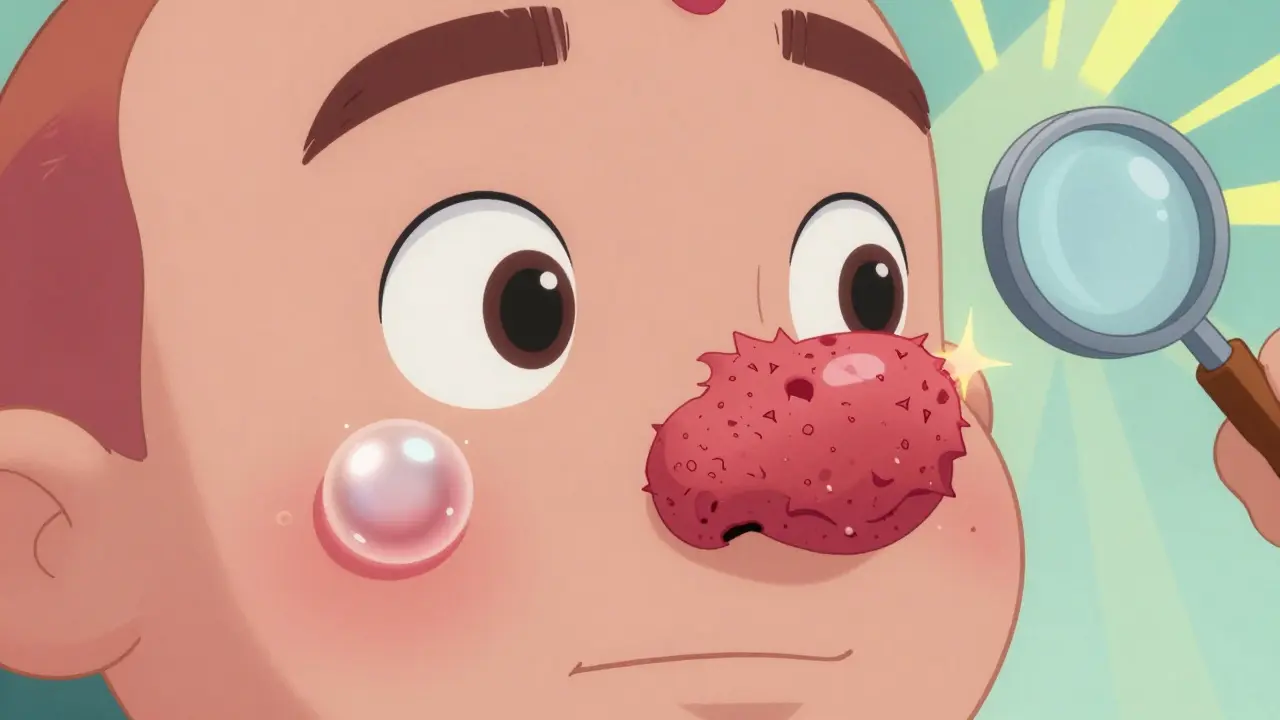
More than 5.4 million cases of nonmelanoma skin cancer are diagnosed in the U.S. every year. Two types make up nearly all of them: basal cell carcinoma (BCC) and squamous cell carcinoma (SCC). They’re not the same. One grows slowly and rarely spreads. The other grows faster and can turn deadly if ignored. Knowing the difference isn’t just helpful-it can save your life.
Where They Come From
Your skin has layers. The top layer, the epidermis, is made of cells that constantly renew themselves. At the very bottom are basal cells the lowest layer of skin cells that divide to create new skin cells. As these cells move up, they flatten out and become squamous cells flattened skin cells that form the outermost layer of the epidermis. BCC starts in the basal layer. SCC starts in the squamous layer. That tiny difference in origin leads to big differences in how they behave.
What They Look Like
It’s hard to tell them apart just by glancing. But there are patterns.
Basal cell carcinoma often shows up as a shiny, pearly bump-like a tiny pearl under the skin. About 70% of cases look like this. Other common signs include open sores that won’t heal, even after weeks, or flat, scar-like patches that feel firm. These usually appear on the face, ears, or neck. They don’t always hurt. Many people ignore them because they don’t bleed much or itch.
Squamous cell carcinoma looks different. It often appears as a rough, scaly red patch that might flake or crust. About 45% of cases are firm, dome-shaped bumps. Others look like warts or persistent sores that bleed easily. Unlike BCC, SCC lesions often feel tender or sore. They’re more likely to grow quickly and change shape over weeks, not months.
Who Gets Them
Most cases happen after age 50. In fact, 85% of all nonmelanoma skin cancers are found in people over 50. But that doesn’t mean younger people are safe. Fair skin, frequent sunburns, and years of sun exposure raise your risk. People with blue eyes, red or blond hair, and who burn easily are at highest risk.
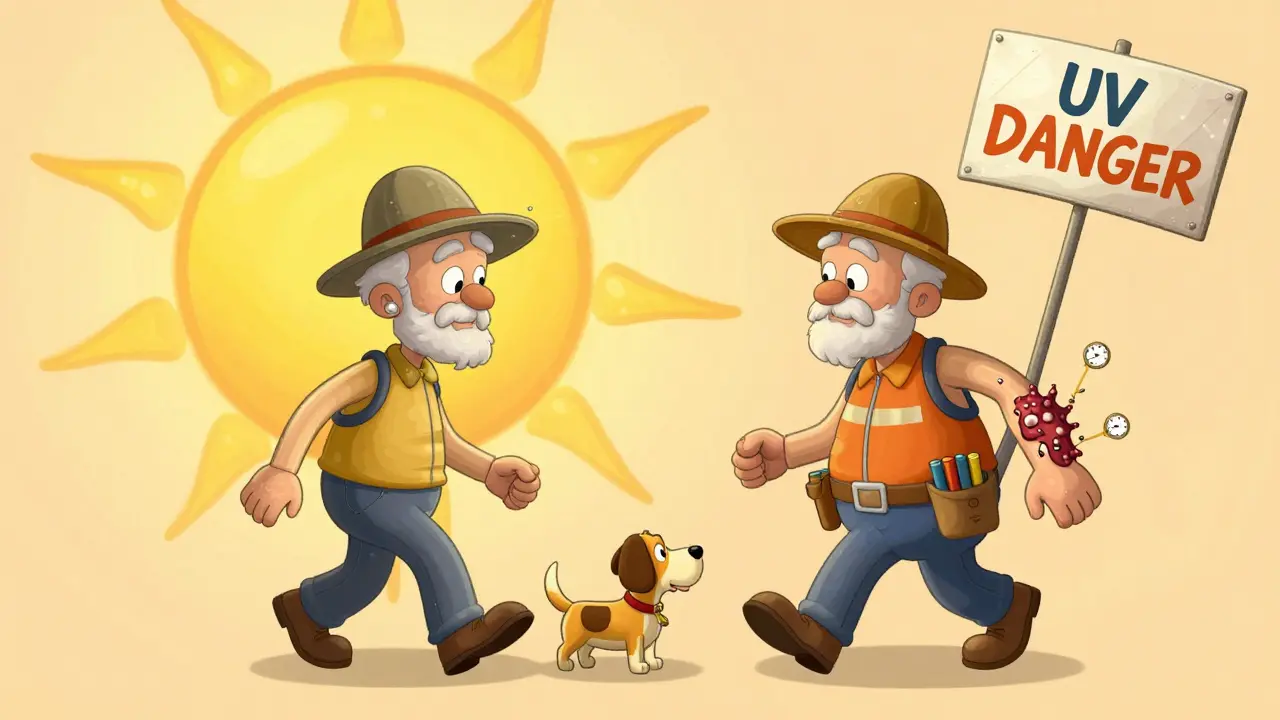
There’s a gender difference, too. BCC affects men and women almost equally-about 55% male, 45% female. But SCC? Around 65% of cases are in men. Why? More men work outdoors-construction, farming, roofing-leading to decades of UV exposure. Women are more likely to get BCC on the face from casual sun exposure, like walking the dog or sitting by a window.
How Fast They Grow
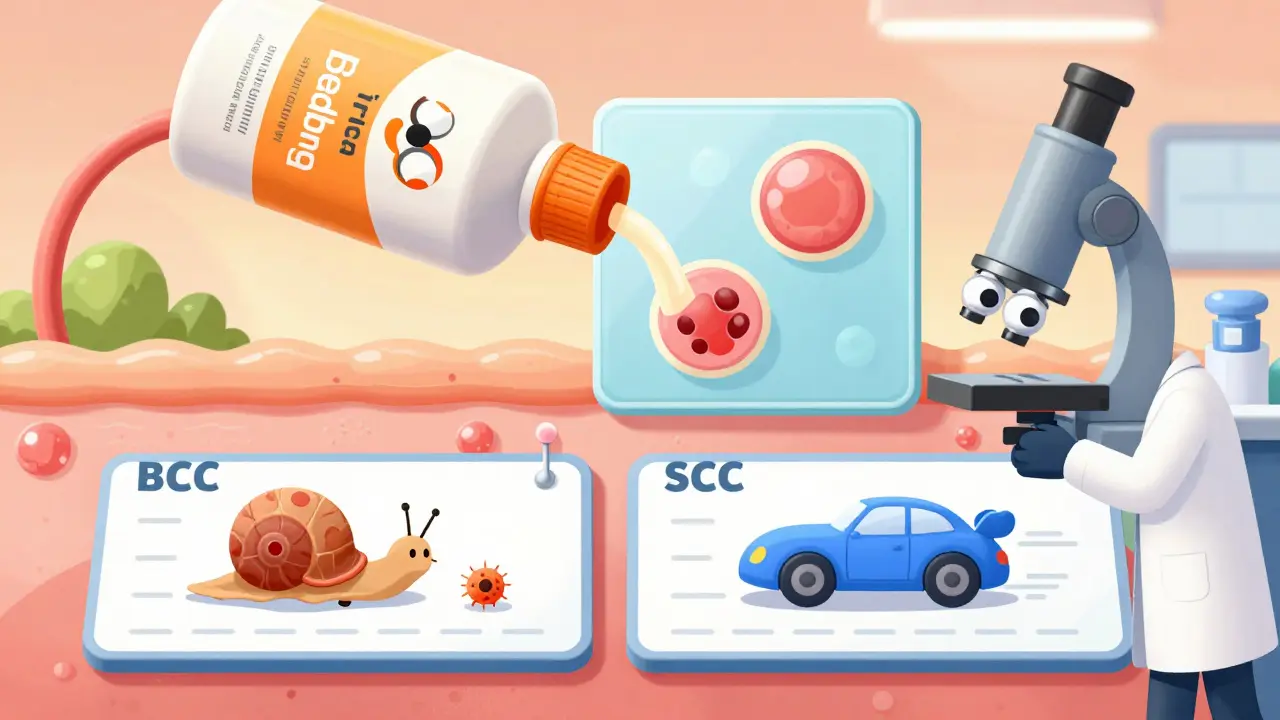
BCC is slow. Really slow. On average, it grows about 0.5 to 1.0 cm per year. It might take two years before it starts to damage deeper tissue. That’s why people often delay seeing a doctor.
SCC? It’s faster. It grows 1.5 to 2.0 cm per year. Aggressive forms can double in size in just 4 to 6 weeks. If you notice a spot changing quickly-getting thicker, bleeding, or forming a crust-it’s not something to wait on.
How Dangerous They Are
Here’s the big difference: BCC almost never spreads. Fewer than 0.1% of cases metastasize. That’s why doctors call it "the least dangerous" skin cancer. But don’t mistake that for harmless. Left untreated, BCC can eat through skin, cartilage, and even bone. On the nose or ear, it can destroy structure. Cosmetic damage is common.
SCC is more serious. About 2% to 5% of cases spread to lymph nodes or other organs. That number jumps to 14% if it’s on the lip, 9% on the ear, or 7% on the genitals. When SCC spreads, survival rates drop from 95% to under 30%. That’s why doctors treat it more aggressively.
Treatment Differences
Both can be cured if caught early. But how they’re treated isn’t the same.
BCC often responds to simple methods. Topical creams like imiquimod or 5-fluorouracil work for small, shallow lesions-clearing up to 70% of cases. For deeper or larger spots, doctors use curettage and electrodesiccation (scraping and burning) or standard surgical removal. Mohs surgery-a precise technique that removes layers one at a time-has a 99% success rate for BCC.
SCC rarely responds to creams. Topical treatments clear only about 45% of cases. Surgery is almost always needed. Mohs surgery works here too, but with a 97% success rate-slightly lower than for BCC. Why? SCC tends to grow deeper and has more unpredictable borders. Surgeons often need wider margins. In high-risk cases, radiation or immunotherapy (like cemiplimab) may be used. In 2018, the FDA approved cemiplimab for advanced SCC, a major breakthrough.
Prevention and Monitoring
Both cancers are caused by UV exposure. But they respond differently to protection.
Daily sunscreen reduces BCC risk by 40%. For SCC? It cuts risk by 50%. That’s because SCC is more tied to lifelong, cumulative sun exposure. BCC is more linked to intense, occasional burns-like a bad day at the beach.
If you’ve had one skin cancer, you’re at higher risk for another. BCC patients usually need checkups every 12 to 18 months. SCC patients? Every 6 to 12 months. Why? 73% of recurrent SCC cases show up within a year. For BCC, it’s usually 18 months.
People with weakened immune systems-like organ transplant recipients-are at extreme risk. They’re 250 times more likely to get SCC than the average person. For BCC? Only 10 times higher. That’s why transplant patients often get skin exams every 3 months.
What Patients Say
Real-world experiences back up the data.
On patient forums, BCC users often say, "I didn’t think it was serious." Many describe their lesions as "annoying" or "ugly," but not painful. Treatment is usually quick and simple.
SCC patients report more anxiety. One Reddit user wrote, "It grew so fast I was terrified it was going to spread." Another said, "They took out half my ear. I didn’t know it could do that." SCC patients are more likely to need reconstructive surgery and more follow-up visits. On average, they have 2.3 times more doctor appointments than BCC patients.
What’s New in 2026
Research is moving fast. In 2023, scientists found that 90% of SCCs have a mutation in the TP53 gene-called the "guardian of the genome." BCCs have it too, but only about half. This explains why SCC is more aggressive.
AI tools are now helping dermatologists spot the difference. New dermoscopy apps can distinguish BCC from SCC with 94% accuracy-better than most human eyes. That means earlier detection.
And there’s hope for advanced cases. Immunotherapy, once only for melanoma, is now helping SCC patients. Clinical trials are testing vaccines and targeted drugs for SCC. BCC has hedgehog inhibitors like vismodegib. SCC doesn’t have an equivalent yet-but researchers are working on it.
Bottom Line
BCC is common. SCC is dangerous. Both are preventable. Both are curable-if you catch them early.
If you see a spot that:
- doesn’t heal after 4 weeks
- bleeds easily
- grows fast
- looks scaly or crusty
Don’t wait. See a dermatologist. Don’t assume it’s just a pimple or a scar. Skin cancer doesn’t always look scary. Sometimes, it looks like nothing at all.
Can basal cell carcinoma turn into squamous cell carcinoma?
No. BCC and SCC are separate cancers that start from different skin cells. One does not turn into the other. But having one increases your risk of developing the other, since both are caused by sun damage. If you’ve had BCC, you’re more likely to get SCC later-especially if you keep getting sun exposure.
Is squamous cell carcinoma more serious than basal cell carcinoma?
Yes, in terms of risk. While BCC is far more common, SCC has a much higher chance of spreading to other parts of the body. About 2-5% of SCC cases metastasize, compared to less than 0.1% for BCC. When SCC spreads, it becomes harder to treat and can be life-threatening. That’s why doctors treat SCC more aggressively, even when it’s small.
Do I need a biopsy to tell the difference?
Yes. While dermatologists can often guess based on appearance, a biopsy is the only way to confirm. A small sample of the skin is taken and looked at under a microscope. This tells exactly which type of cancer you have and how deep it’s grown. Skipping this step risks under-treating SCC or over-treating BCC.
Can sunscreen prevent both types?
Yes, but it works better for SCC. Daily use of broad-spectrum SPF 30+ reduces SCC risk by about 50% and BCC risk by 40%. That’s because SCC is more linked to long-term sun exposure, while BCC is often tied to occasional intense burns. Still, sunscreen is your best defense against both.
How often should I get checked if I’ve had skin cancer?
If you’ve had BCC, get checked every 12-18 months. If you’ve had SCC, every 6-12 months. SCC comes back more often and faster. High-risk patients-like organ transplant recipients-should be seen every 3 months. Early detection is the key to avoiding major surgery or spread.
Remember: skin cancer doesn’t always hurt. It doesn’t always look scary. But it can be deadly if you ignore it. Check your skin. Know the signs. Protect yourself. And if something looks off-get it checked.
Martin Halpin
February 26, 2026 AT 14:22Okay so let me get this straight - you’re telling me that a shiny bump on my nose is "the least dangerous" cancer? That’s like saying a rattlesnake is the least dangerous snake because it doesn’t spit venom. It still bites. And if you ignore it long enough, it eats through your cartilage like a slow-motion zombie movie. I had a BCC on my ear that looked like a pimple for 18 months. My dermatologist said "eh, it’s fine." Turns out it had already invaded the cartilage. I needed reconstructive surgery. So yeah, "least dangerous" doesn’t mean "ignore it." It means "it’ll ruin your face before it kills you."
Eimear Gilroy
February 26, 2026 AT 23:07Interesting breakdown. I’ve been reading up on this since my mom had SCC last year. One thing that stood out: the 250x higher risk for transplant patients. That’s wild. I didn’t realize immunosuppressants made such a difference. My mom’s on cyclosporine - she gets skin checks every 3 months now. She’s paranoid about sun exposure, even in winter. Honestly, it’s scary how much the body’s defenses matter. I never thought sunscreen was a life-or-death thing until now.
Ashley Johnson
February 28, 2026 AT 01:33Wait - AI tools can tell BCC from SCC with 94% accuracy? That’s not possible. The FDA doesn’t regulate these apps. They’re probably trained on biased data from dermatologists who only see rich white people. I read a study that said Black patients get diagnosed 3x later because doctors don’t look for SCC on darker skin. And now you’re saying AI is the solution? What if the AI was trained on photos of only light-skinned patients? That’s how people die. They don’t check for cancer on brown skin. This is systemic. And nobody’s talking about it.
tia novialiswati
February 28, 2026 AT 03:52OMG this is so helpful!! 🙌 I just found a weird scaly patch on my cheek and was about to ignore it like I do with "dry skin" - but now I’m booking a dermatologist appointment ASAP! You’re right - it doesn’t have to hurt to be dangerous. Thank you for making this so clear!! 💖 I’m telling all my friends to check their skin! You’re a lifesaver!!
Nerina Devi
March 1, 2026 AT 08:53As someone from India, I’ve seen so many people here dismiss skin spots because "it’s just a sunburn." But with our intense UV exposure and increasing outdoor workforces, this is a ticking time bomb. My uncle had SCC on his hand - ignored it for 2 years. Now he’s losing fingers. Prevention isn’t just about sunscreen - it’s about awareness. We need community health workers to teach this in villages. Not just in the U.S. This isn’t a rich-country problem. It’s a human problem.
Gabrielle Conroy
March 1, 2026 AT 23:27Just wanted to add: I’m a nurse, and I’ve seen both types up close. BCC? Often looks like a pimple that won’t pop. SCC? More like a scab that keeps reopening. Both are sneaky. But the biggest mistake I see? People think "I don’t go outside much," so they’re safe. Nope. UV penetrates windows. I’ve had patients with BCC on their left cheek - from driving. And SCC on their hands - from gardening. Sunscreen isn’t optional. It’s like brushing your teeth. Do it daily. Even if it’s cloudy. Even if you’re indoors. Even if you’re 80. It matters.
Natanya Green
March 3, 2026 AT 15:05Okay so I just Googled "SCC on ear" because my cousin had it and I was like HOLY CRAP it looked like a volcano erupted on his ear lobe?? Like, half his ear was GONE?? And they had to reconstruct it with skin from his chest?? I’m crying just thinking about it. And I thought it was just a weird wart?? I’m telling everyone I know: if it doesn’t heal in 3 weeks, GO. TO. A. DOCTOR. I’m not joking. This is not a "maybe later" thing. This is a "your face is going to melt" thing. 😭
Steven Pam
March 4, 2026 AT 03:11Love this breakdown. Honestly, I used to think skin cancer was just for beach bums. Then I got my first BCC at 32 from walking my dog in the morning. No sunburn. Just years of incidental exposure. Now I wear a hat every day. No exceptions. Rain or shine. I even got my kids into the habit. My 7-year-old asks if she needs sunscreen before going to the playground. That’s the win. Prevention isn’t about fear. It’s about routine. Make it as normal as brushing your teeth. And if you’ve had one - get checked. No excuses.