 Apr, 19 2026
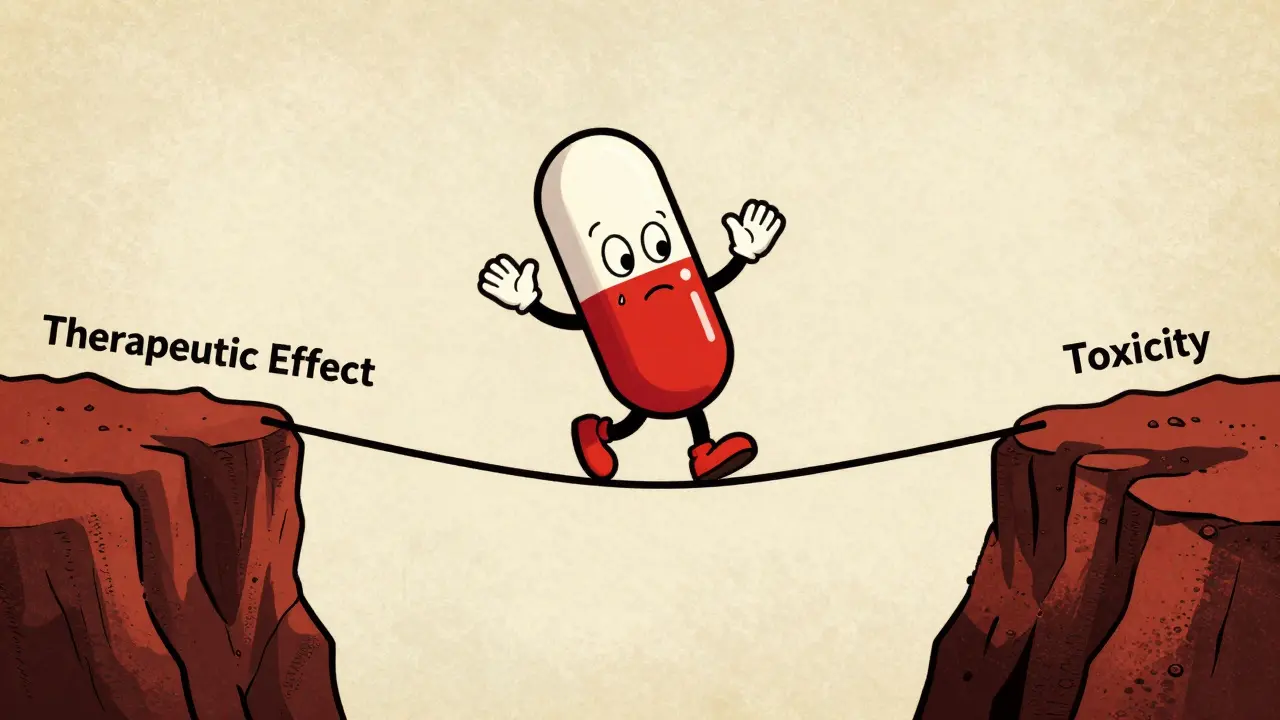
Imagine taking a medication where a tiny shift in the dose-something as small as a few micrograms-could be the difference between feeling healthy and ending up in the emergency room. For most medicines, your body can handle a bit of variation in how a drug is absorbed. But for Narrow Therapeutic Index drugs (NTI drugs), that luxury doesn't exist. Because the gap between a dose that works and a dose that is toxic is so slim, regulators can't use the same "one size fits all" rules for their generic versions.
When a pharmacy swaps a brand-name drug for a generic, they rely on bioequivalence standards to ensure the patient gets the same result. For standard drugs, the industry accepts a range of 80% to 125%. But for NTI drugs, that window is far too wide. A 20% difference in a drug like warfarin could lead to dangerous bleeding or a failed blood clot treatment. This is why agencies like the FDA and EMA have stepped in with much tighter requirements to keep patients safe.
What Exactly Makes a Drug "Narrow Therapeutic Index"?
A drug is classified as NTI when small differences in blood concentration lead to serious therapeutic failure or adverse reactions. To put a number on it, the FDA recently suggested that a therapeutic index of 3 or less is a reasonable cutoff for this classification. In simpler terms, if the dose required to cause toxicity is less than three times the dose required for the drug to work, it's an NTI drug.
These aren't rare medications; they are pillars of modern medicine. We're talking about Digoxin for heart failure, Levothyroxine for thyroid issues, and Phenytoin for seizures. These drugs represent roughly $45 billion in annual U.S. sales, meaning millions of people rely on them every day. Because the stakes are so high, the "close enough" approach to generics simply doesn't work here.
The Strict Rules for Generic NTI Drugs
To get a generic NTI drug approved, manufacturers have to jump through significantly more hoops than they would for a standard headache pill. The goal is to prove that the generic version is nearly identical to the brand-name reference product in how it enters the bloodstream.
The FDA uses a complex three-pronged approach. First, they use Reference Scaled Average Bioequivalence (RSABE), which adjusts the allowed limits based on how much the brand-name drug varies from person to person. Second, they perform a variability comparison; the generic drug cannot be significantly more variable than the brand. Finally, it must still fit within the standard 80-125% average bioequivalence range.
Quality control is also tighter. While most generics have a potency range of 90-110%, generic NTI drugs are held to a stricter 95-105% limit. This means the actual amount of active ingredient in the pill must be almost exactly what is listed on the label.
| Regulatory Agency | Acceptance Interval / Criteria | Approach Type |
|---|---|---|
| FDA (USA) | RSABE + Variability Check + 80-125% ABE | Dynamic (Reference-Scaled) |
| EMA (European Union) | 90% - 111% | Fixed Tightened Interval |
| Health Canada | 90.0% - 112.0% (AUC) | Fixed Tightened Interval |
The Cost of Precision: Why NTI Generics are Harder to Make
You might wonder why some NTI drugs don't have generic versions, or why they take longer to hit the market. The answer is largely financial and logistical. Testing for NTI bioequivalence is expensive. A standard generic study might cost between $300,000 and $700,000, but an NTI study can easily soar to $1 million.
Why the price jump? For one, the sample sizes are larger. While a standard study might only need 24 to 36 participants, NTI studies often require 36 to 54 people to get the statistical power needed to prove the tighter limits. Additionally, the study designs are more complex. For example, the FDA's guidance on Warfarin requires a fully replicated 4-period crossover design. That's a lot of extra blood draws, monitoring, and administrative overhead.
Some critics, like Dr. Lawrence Lesko, have argued that these rules are *too* strict. The worry is that if the barrier to entry is too high, fewer companies will make generic NTI drugs, which actually keeps prices high for patients. However, the medical consensus-supported by experts like Dr. Leslie Benet-is that the safety risk of a "sub-par" NTI generic is far worse than the economic risk of slightly slower generic competition.
Real-World Proof: Do These Strict Rules Actually Work?
The big question is whether these tighter regulatory hurdles translate to better patient outcomes. The evidence suggests they do. A 2017 study published in the American Journal of Transplantation looked at Tacrolimus, a drug used to prevent organ transplant rejection. The study found that generic versions meeting the tightened criteria were therapeutically equivalent to the brand name in stable patients.
Similarly, a 2019 study in Circulation showed no significant difference in clinical outcomes for patients using generic versus brand-name warfarin. This tells us that when the science is applied correctly, patients can safely switch to generics without worrying about their health destabilizing. The tight bioequivalence windows act as a safety net, ensuring that the switch is virtually invisible to the patient's biochemistry.

Looking Ahead: A More Unified Global Standard
Right now, if a company wants to sell an NTI generic globally, they have to deal with a patchwork of rules. The FDA's reference-scaled approach is the most scientifically rigorous, while the EMA prefers a fixed tightened interval. This lack of harmony makes development slower and more expensive.
There is movement toward a solution. The FDA is moving away from a case-by-case approach and developing a systematic way to classify NTI drugs based on quantitative calculations. Industry analysts predict that by 2026, we will see better harmonization between the US, EU, and Canada. If agencies can agree on a standardized study design, it could slash development costs by 15-20%, potentially bringing more affordable versions of these critical drugs to the public.
Why can't NTI drugs use the standard 80-125% bioequivalence range?
Standard drugs have a wider therapeutic window, meaning a small change in absorption won't cause a crisis. However, for NTI drugs, a 20% difference could push a patient into toxicity or cause the drug to stop working entirely, leading to serious health risks like seizures or organ failure.
Which drugs are typically classified as NTI?
Common NTI drugs include warfarin (blood thinner), levothyroxine (thyroid hormone), digoxin (heart failure), phenytoin (anti-seizure), and tacrolimus (immunosuppressant). Other examples include lithium carbonate and theophylline.
What is RSABE and why is it used?
RSABE stands for Reference Scaled Average Bioequivalence. It is used by the FDA to adjust the bioequivalence limits based on the variability of the brand-name drug itself. If the brand drug is very consistent, the limits for the generic are tightened further to ensure maximum precision.
Are generic NTI drugs as safe as brand-name ones?
Yes, provided they have passed the stricter bioequivalence tests. Real-world studies on drugs like warfarin and tacrolimus have shown no significant difference in clinical outcomes between brand-name and generic versions when tighter standards are applied.
Does the FDA have a master list of all NTI drugs?
No, the FDA does not maintain one single official list. Instead, they provide product-specific guidance documents for individual drugs. However, they are currently working on a more systematic, quantitative approach to classify these drugs.
Next Steps for Patients and Providers
If you are a patient taking an NTI medication, the best approach is consistency. Avoid switching between different generic manufacturers frequently, as even a tiny difference between two "approved" generics can occasionally impact your stability. Always inform your doctor if your pharmacy changes the brand or manufacturer of your medication.
For healthcare providers, monitoring remains key. While generic NTI drugs are scientifically equivalent, the transition period from brand to generic is the best time to increase therapeutic drug monitoring (TDM). Checking blood levels shortly after a switch can confirm that the new version is performing exactly as expected for that specific patient.
Cynthia Didion
April 21, 2026 AT 11:57FDA standards are obviously superior. The RSABE approach is just better science than what the EU is doing with those fixed intervals.
Aaron McGrath
April 22, 2026 AT 09:23Let's crush the inefficiency! We need to optimize the pharmacokinetic/pharmacodynamic (PK/PD) modeling to slash those $1M study costs! If we leverage more adaptive designs and tighten the Cmax and AUC variance, we can scale these generics way faster! Let's go!
Shalika Jain
April 23, 2026 AT 16:28Honestly, the drama of 'medical consensus' is so boring. Everyone just pretends the generic is the same, but then you feel a tiny bit off and suddenly it's a 'biochemical invisibility' issue. Please.
Lynn Smith
April 25, 2026 AT 14:01I totally agree that staying with one manufacturer is the way to go. It just feels safer for everyone involved.
Don Drapper
April 25, 2026 AT 19:33The sheer audacity of suggesting that a 15-20% reduction in development costs constitutes a significant victory is profoundly laughable. We are discussing the precarious precipice of toxicity versus efficacy, yet the narrative shifts toward the banal logistics of corporate expenditure. It is a tragic comedy of errors where the sanctity of the therapeutic index is sacrificed at the altar of global harmonization. One must wonder if the regulatory bodies are merely playing a game of statistical musical chairs while patients gamble with their lives. The systemic failure to implement a unified gold standard immediately is nothing short of a dereliction of duty. The industry's fixation on 'cost-effective' studies is a symptom of a decaying intellectual rigor. We are witnessing the commoditization of critical care, where the precision of a microgram is weighed against the quarterly profits of a generic manufacturer. This is not progress; it is a descent into mediocrity. The apathetic acceptance of these 'patchwork' rules is a stain on modern pharmacology. Only a fool would believe that a few percentage points in a bioequivalence window are a mere 'logistical' hurdle. It is a matter of biological survival. The intellectual vacuum in which these decisions are made is staggering. Truly, a masterpiece of inefficiency.
Ms. Sara
April 26, 2026 AT 13:01It's really important that we support patients who might be scared to switch to generics. Knowing that the science is there to back these tighter rules can give them so much peace of mind.
Mike Beattie
April 26, 2026 AT 18:35The titration of these NTI agents is a nightmare when you're dealing with substandard bioavailability. You can't just rely on the AUC data; you need to see the actual clinical trough levels in the blood.
Venkatesh Venky
April 28, 2026 AT 01:58Using RSABE sounds like a smart way to balance things out. It's cool that they are trying to make it more systematic for everyone.
Valorie Darling
April 29, 2026 AT 06:06who cares about the cost of the study lol just make the drug work or dont
Bob Collins
May 1, 2026 AT 00:15Fair point on the monitoring. Just keep an eye on things during the switch and it's usually a breeze.
Tokunbo Elegbe
May 2, 2026 AT 23:22I strongly encourage everyone... to be very transparent with their pharmacists... regarding any manufacturer changes!!!
aman motamedi
May 3, 2026 AT 15:18The detailed explanation regarding the potency range of 95-105% is quite illuminating.
Lucy Kuo
May 5, 2026 AT 01:00It is a truly noble endeavor to harmonize these global standards for the betterment of all humanity, ensuring that a patient in London receives the same precision as one in New York!