 Jan, 4 2026
Metformin Dosing Calculator
Recommended Metformin Dose
Enter your eGFR value to see your recommended dose
Monitoring: Regular eGFR checks are essential for safe metformin use.
Metformin is the most commonly prescribed diabetes medication in the U.S., used by millions because it lowers blood sugar, helps with weight, and protects the heart. But many people stop taking it when their kidney numbers drop - and that’s often a mistake. The truth? Metformin doesn’t damage your kidneys. It just leaves your body through them. That’s why you need to watch your kidney function closely - not to avoid the drug, but to use it safely.
Why Kidney Function Matters for Metformin
Metformin is cleared from your body almost entirely by your kidneys. If your kidneys aren’t working well, the drug can build up in your blood. That raises the risk of a rare but serious condition called lactic acidosis, where lactic acid builds up and your blood becomes too acidic. But here’s the key: this almost never happens in people who are monitored properly. Studies show the rate of lactic acidosis in people taking metformin is only about 3.3 cases per 100,000 patient-years. Most of those cases involve people who were already sick - with infections, heart failure, or dehydration - not just because of the metformin. The real danger isn’t the drug itself. It’s not checking your kidney function or ignoring warning signs.What Is eGFR? And Why It’s Better Than Creatinine
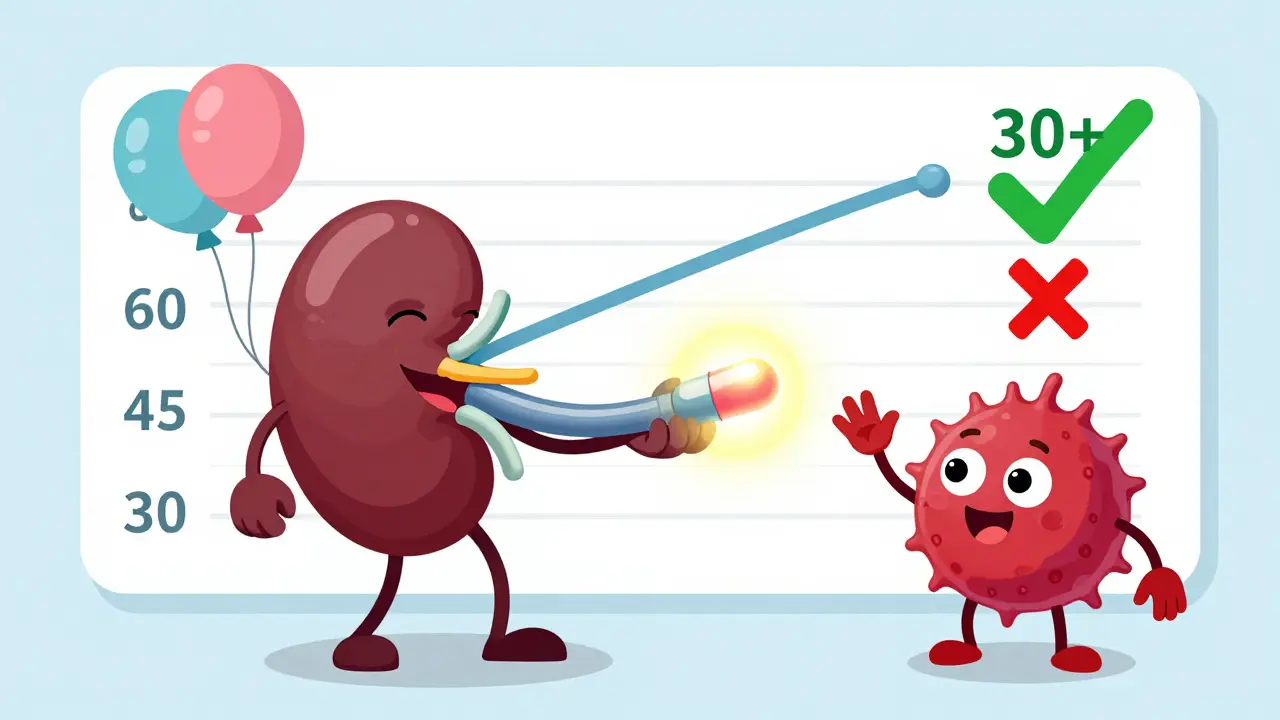
For years, doctors used serum creatinine levels to decide if someone could take metformin. Men with creatinine over 1.5 mg/dL or women over 1.4 mg/dL were told to stop. But creatinine doesn’t tell the full story. It’s affected by muscle mass, age, and diet. A muscular 70-year-old might have a normal creatinine but poor kidney function. An older, frail person might have low creatinine but very weak kidneys. That’s why in 2016, the FDA switched to using eGFR - estimated glomerular filtration rate. This number estimates how well your kidneys are filtering waste. It’s calculated using your age, sex, race, and blood creatinine. It’s more accurate. And it changed everything. Now, metformin isn’t automatically off-limits just because you have kidney disease. You can still take it - as long as your eGFR is above 30 mL/min/1.73 m².Dosing Based on eGFR: The Exact Numbers
Here’s what the current guidelines say about metformin doses based on kidney function:- eGFR ≥60 mL/min/1.73 m²: Full dose allowed - up to 2,550 mg per day. Check kidney function every 6 to 12 months.
- eGFR 45-59 mL/min/1.73 m²: Max dose is 2,000 mg per day. Check kidney function every 3 to 6 months.
- eGFR 30-44 mL/min/1.73 m²: Max dose is 1,000 mg per day. Check kidney function every 3 months.
- eGFR <30 mL/min/1.73 m²: Metformin is contraindicated. Do not start. Do not continue.
When to Hold Metformin: Contrast Scans and Illness
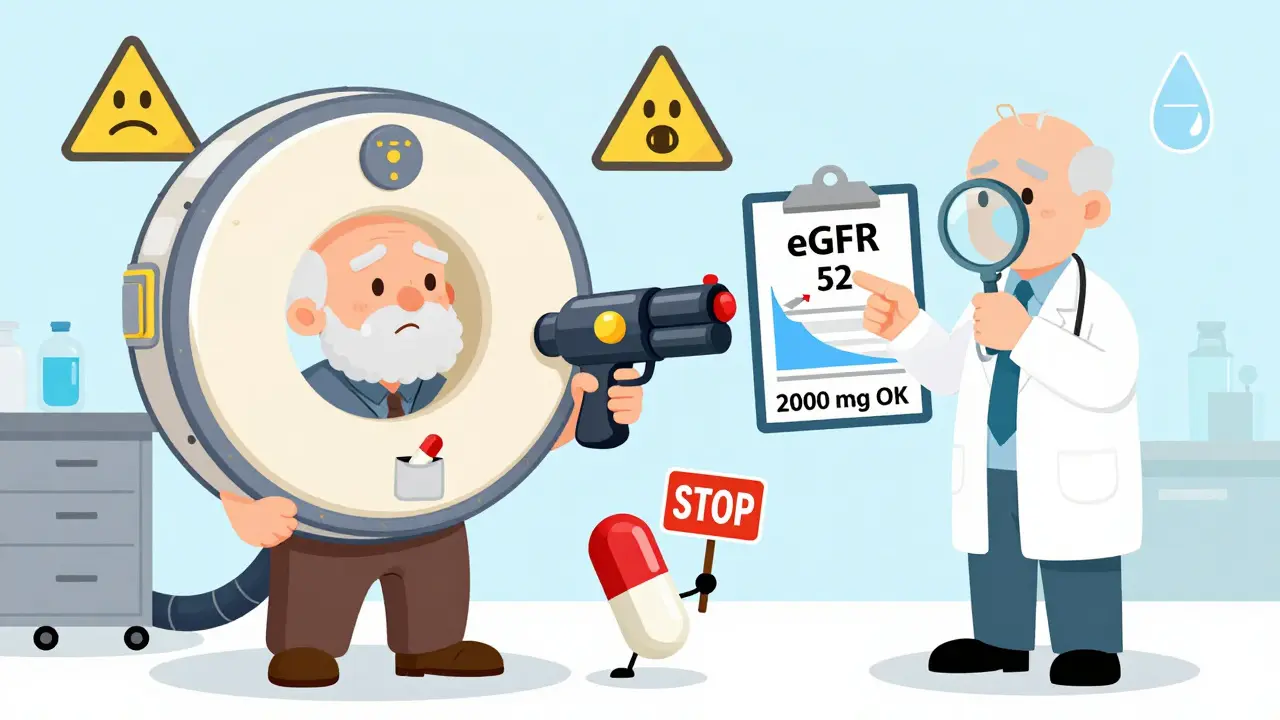
Even if your eGFR is in the safe range, you still need to pause metformin in certain situations:- Before and after iodinated contrast imaging (like CT scans with dye). If your eGFR is below 60, stop metformin 48 hours before the scan and don’t restart until 48 hours after - and only after checking your kidney function again.
- During acute illness - like severe infection, heart failure, or dehydration. Your kidneys can suddenly slow down. If you’re vomiting, not eating, or feeling weak, hold metformin until you’re stable.
- If you’re taking NSAIDs (like ibuprofen or naproxen) and your eGFR is below 60. These drugs can reduce kidney blood flow and raise your risk of damage.
Common Myths - and Why They’re Dangerous
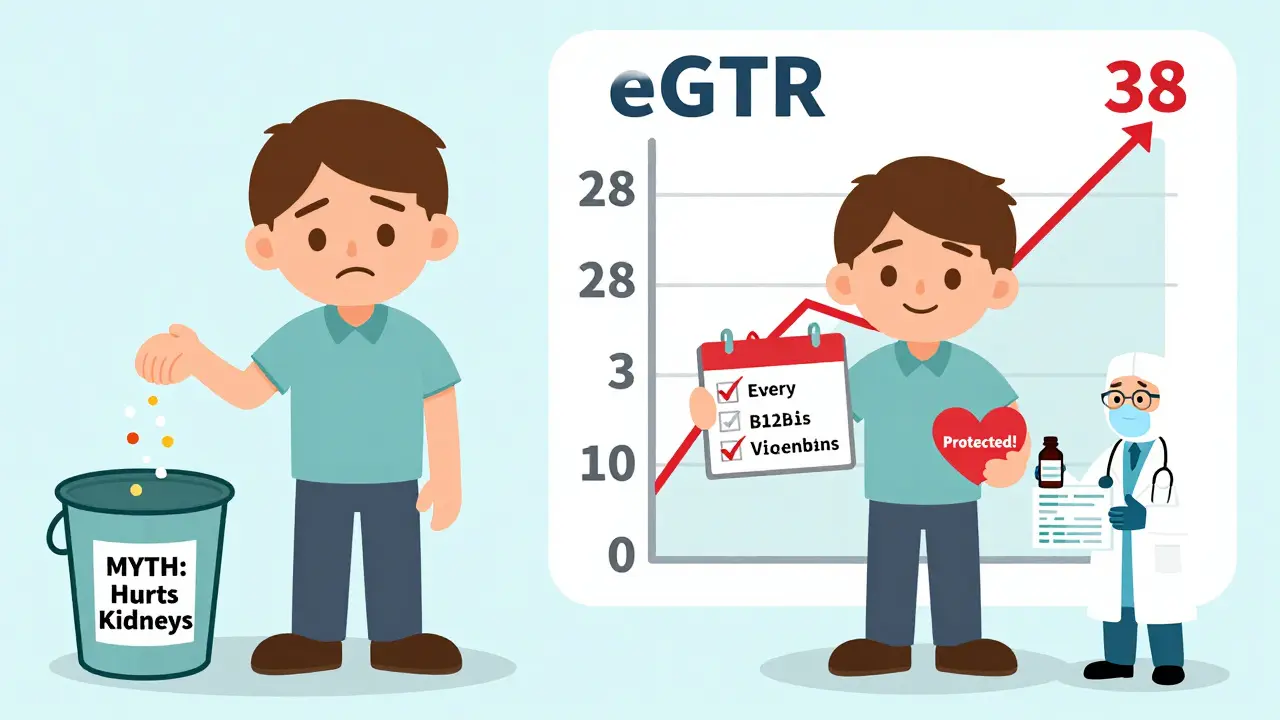
There’s a big myth out there: “Metformin hurts your kidneys.” It’s not true. And believing it causes real harm. A 2022 chart review at Cleveland Clinic found that 22% of patients with eGFR above 30 had their metformin stopped - not because it was unsafe, but because their doctor or patient thought it was damaging their kidneys. One patient, an 82-year-old woman with eGFR of 38, had her metformin discontinued. Her HbA1c jumped from 6.8% to 8.9% in three months. She ended up hospitalized for high blood sugar. The opposite is also true: some patients with eGFR in the 27-29 range kept taking 2,000 mg a day without monitoring. One case report described a 76-year-old with a blood pH of 6.98 - life-threatening acidosis - because his kidneys couldn’t clear the drug. He survived, but barely. The lesson? Metformin isn’t the problem. Lack of monitoring is.How to Monitor Effectively - And What Else to Watch For
Monitoring isn’t just about checking eGFR. Here’s what you need to do:- Check eGFR every 3 to 6 months if you’re on metformin and your kidney function is borderline.
- Test vitamin B12 levels yearly. Long-term metformin use lowers B12 in 7-10% of people. Low B12 can cause fatigue, numbness, or memory issues - and it’s easily fixed with supplements.
- Watch for GI side effects. Nausea, diarrhea, or stomach pain are common at first. Starting low (500 mg/day) and increasing slowly by 500 mg each week cuts these side effects in half. Many people quit metformin because they think it’s “too harsh” - but it’s often just a dosing issue.
- Use a calendar or app to track your eGFR dates and medication doses. A 2023 JAMA study found 41% of patients with diabetes and kidney disease didn’t get their kidney function checked as often as they should.
What If Your Kidney Function Keeps Dropping?
If your eGFR drops from 50 to 40 over six months, don’t panic. Don’t stop metformin automatically. Talk to your doctor. Ask:- Is this a slow, steady decline - or a sudden drop?
- Are you dehydrated? On NSAIDs? Sick?
- Can we reduce the dose instead of stopping?
What’s Changing in 2026?
Guidelines keep evolving. The 2023 KDIGO update now looks beyond just eGFR. It asks: Are you at risk for sudden kidney injury? Are you on blood pressure meds that affect kidneys? Do you have heart disease? This moves us toward personalized care - not just a number. Researchers are also testing cystatin C, a newer blood marker that’s more accurate than creatinine in older adults. The 2024 ADA Standards of Care are expected to include it. And the MET-FORMIN-CKD trial, currently tracking 500 patients with eGFR 25-35, will give us clearer answers on whether low-dose metformin is safe in advanced kidney disease.Bottom Line: You Can Still Take Metformin - If You’re Monitored
Metformin remains the most cost-effective, heart-protecting, weight-neutral diabetes drug on the market. Generic versions cost as little as $4 a month. It’s still used as first-line therapy in 76% of new diabetes cases in the U.S. You don’t need perfect kidneys to take it. You just need to know your numbers - and keep checking them. If your eGFR is above 30, you’re likely still a candidate. If it’s below 30, talk to your doctor about alternatives like SGLT2 inhibitors or GLP-1 agonists, which also protect your kidneys. Don’t let fear or misinformation make you quit a drug that’s keeping you alive and healthy. Ask your doctor: “What’s my eGFR? Is my dose right? When’s my next check?” That’s how you stay in control - not by stopping, but by staying smart.Can metformin cause kidney damage?
No, metformin does not cause kidney damage. It is cleared by the kidneys, but it doesn’t harm them. The myth that it damages kidneys leads many patients to stop taking it unnecessarily, which can worsen blood sugar control and increase heart disease risk.
What eGFR level is too low for metformin?
Metformin is contraindicated when eGFR falls below 30 mL/min/1.73 m². In patients with eGFR between 30 and 44, the maximum daily dose should be reduced to 1,000 mg. For eGFR between 45 and 59, the max dose is 2,000 mg. Always check kidney function regularly if you’re on metformin.
Should I stop metformin before a CT scan?
Yes, if your eGFR is below 60 mL/min/1.73 m², stop metformin 48 hours before a CT scan with iodinated contrast. Restart it only after your kidney function is checked again and confirmed to be stable - usually 48 hours after the scan.
How often should I get my kidney function checked on metformin?
If your eGFR is above 60, check it every 6-12 months. If it’s between 45 and 59, check every 3-6 months. If it’s between 30 and 44, check every 3 months. More frequent checks are needed if you’re ill, dehydrated, or on medications that affect kidney function.
Can I take metformin if I’m on dialysis?
Yes, but with adjustments. For peritoneal dialysis, take 250 mg daily. For hemodialysis, take 500 mg after each session. Metformin is removed during dialysis, so dosing must be timed to avoid low blood sugar or drug buildup.
Does metformin lower vitamin B12?
Yes. Long-term use of metformin is linked to lower vitamin B12 levels in 7-10% of users. This can cause fatigue, nerve tingling, or memory issues. Get your B12 checked yearly and consider supplements if levels are low.
Saylor Frye
January 5, 2026 AT 10:02Look, I get it - everyone’s terrified of kidney numbers now. But metformin isn’t some villain. It’s just a molecule that rides out on urine. If your kidneys are slow, you slow the dose. Done. No drama. The real issue? Doctors who panic at eGFR 48 and yank it like it’s poison. I’ve seen patients crash their HbA1c because some intern read a 2008 guideline and thought ‘contraindicated’ meant ‘never ever.’
Molly McLane
January 6, 2026 AT 04:36As a nurse who’s seen this play out too many times, I just want to say: if your eGFR is above 30 and you’re not dehydrated or septic, keep taking it. Seriously. I had a 78-year-old grandma on metformin for 12 years - her HbA1c stayed at 6.5, she walked 5 miles a day, and her heart was fine. Then her PCP stopped it because her creatinine went to 1.4. Three months later? She was in the ER with DKA. Metformin doesn’t hurt kidneys. Fear does.
Katie Schoen
January 7, 2026 AT 06:10So let me get this straight - we’re all acting like metformin is a toxic dragon guarding the kingdom of kidneys? Bro. It’s a $4 pill that keeps people alive. You don’t stop your car because the exhaust pipe is clogged - you clean the pipe. Same thing. Also, B12 checks? YES. I’ve had patients with ‘brain fog’ who were just B12 deficient from metformin. Fix it. Not drop the drug. 🤦♀️
Joann Absi
January 9, 2026 AT 04:27AMERICA IS BEING POISONED BY MEDICAL INCOMPETENCE. 🇺🇸🔥 Metformin is a LIBERAL PILL that makes you live longer while the elite profit off dialysis centers. I saw a video - a doctor in Boston said ‘eGFR 38 is fine’ - and then he got fired. Why? BECAUSE THE SYSTEM WANTS YOU SICK. They want you on insulin. They want you on GLP-1 agonists that cost $1,000/month. Metformin is free. That’s why they hate it. Don’t let them take your freedom. 🙏💊 #StopTheMetforminPurge
Ashley S
January 10, 2026 AT 10:40This is why I don’t trust doctors. They say one thing, then do the opposite. My cousin’s doctor told her to stop metformin when her creatinine was 1.3. Then she got fat and her sugar went crazy. Now she’s on 5 pills a day. Just take the pill. What’s the big deal?
Rachel Wermager
January 10, 2026 AT 11:59While the eGFR-based dosing paradigm is clinically pragmatic, it remains fundamentally reductionist - it conflates filtration rate with tubular excretion kinetics, ignoring the role of organic cation transporters (OCT2 and MATE1) in renal clearance. Furthermore, the 2023 KDIGO update’s emphasis on dynamic risk stratification (e.g., concomitant RAS inhibitors, volume status, and cardiac output) represents a necessary evolution beyond static eGFR thresholds. The MET-FORMIN-CKD trial’s primary endpoint - composite cardiovascular and renal outcomes - will likely redefine safety thresholds for eGFR 25–35, especially when cystatin C-estimated GFR is incorporated, as it mitigates the confounding effect of sarcopenia in elderly populations.
Tom Swinton
January 10, 2026 AT 23:20I just want to say - I’ve been on metformin for 14 years, and I check my eGFR every 3 months like clockwork. I also take a B12 sublingual because my doctor told me to. I’ve had three CT scans with contrast - each time, I held my metformin for 48 hours before and after. I didn’t get sick. I didn’t crash. I stayed stable. And I’m still here. I’m 69. I walk my dog every morning. I cook my own food. I don’t need fancy new drugs. I need my metformin. And I need my doctor to listen. Please - if you’re reading this and you’re scared - don’t stop. Just check. Just talk. Just be smart. You’ve got this. 💪
Gabrielle Panchev
January 11, 2026 AT 00:36Wait - so you’re telling me that if I have an eGFR of 32, I can still take metformin? But only 1,000 mg? But only if I’m not on NSAIDs? And only if I’m not dehydrated? And only if I’m not over 70? And only if I’m not diabetic for more than 5 years? And only if my B12 is normal? And only if I’m not having a cold? And only if I’m not stressed? And only if I’m not on a plane? And only if my doctor is awake? And only if the lab isn’t backed up? And only if I remember to stop it before the CT scan? And only if I remember to restart it after? And only if I have a calendar? And only if I have a phone app? And only if I have internet? And only if I can read? And only if I’m not depressed? And only if I’m not broke? And only if I’m not on Medicaid? And only if my insurance covers the B12 test? And only if I don’t have a job? And only if I don’t have kids? And only if I don’t have a life? This isn’t medicine. This is a maze designed to make people give up. I’m done. I’m switching to cinnamon.