 Apr, 7 2026

To get this right, you need to move beyond basic filing. You need a system that satisfies global regulators and protects your business from catastrophic failures. Here is how to navigate the complex world of GMP documentation requirements and ensure your facility stays compliant.
The Foundation: What Exactly are GMP Documentation Requirements?
Good Manufacturing Practices (GMP) is a regulatory framework designed to ensure products are consistently produced and controlled according to quality standards. It's not just a set of suggestions; it's a legal mandate. If you're operating in the US, you're looking at 21 CFR Part 211. In Europe, it's EudraLex Volume 4. These rules exist because of past tragedies, like the 1937 Elixir Sulfanilamide disaster, where poor quality control led to over 100 deaths.
Essentially, GMP documentation acts as the backbone of your quality system. It prevents contamination and mix-ups by forcing a level of discipline in how materials are handled and processes are tracked. When an auditor walks into your plant, they aren't just looking at your machines; they are looking at your paperwork. In fact, recent data shows that documentation failures are the single biggest compliance issue in the pharmaceutical industry, with a huge percentage of FDA warning letters stemming from data integrity violations.
The Two Pillars: Procedural vs. Compliance Records
You can't treat all documents the same. To stay organized, you need to split your record-keeping into two distinct categories: the instructions (how we do it) and the evidence (what we actually did).
Procedural and Instructional Documents
These are your "how-to" guides. They tell your staff exactly what to do to keep the product safe. The most critical of these are Standard Operating Procedures (SOPs), which are detailed, written instructions to achieve uniformity in the performance of a specific function. To make SOPs effective, write them in the active voice and aim for an 8th-grade reading level. If a technician can't understand the step quickly, they might improvise, and improvisation is the enemy of GMP.
Other essential procedural documents include:
- Testing Methods: Validated protocols that prove your tests actually work.
- Material Specifications: Exact numerical tolerances (e.g., moisture content must be 3.5% ± 0.2%).
- Bills of Materials: A complete list of every single component with unique identifiers.
Compliance and Batch Records
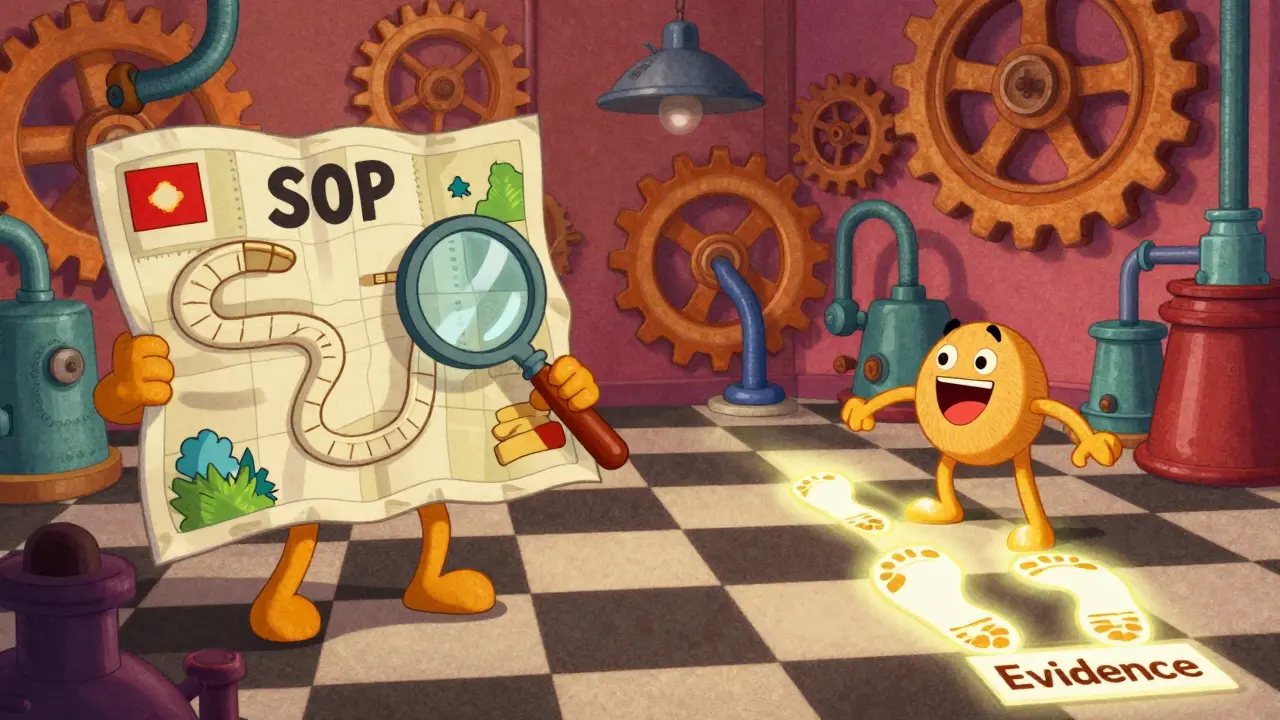
While SOPs are the map, compliance records are the footprints. These prove that you followed the map. A pharmaceutical batch record, for example, must capture dozens of data points, from the exact start and end times of a process to the ID number of the equipment used. If there was a temperature excursion during a warehouse transfer and it wasn't documented, you risk a total product recall.
The Golden Rule: ALCOA+ and Data Integrity
How do you know if a record is actually "good"? Regulators use a framework called ALCOA+, which is a set of principles ensuring data integrity by requiring records to be Attributable, Legible, Contemporaneous, Original, and Accurate. The "plus" adds that records must also be Complete, Consistent, Enduring, and Available.
| Principle | What it means in plain English | Example of a failure |
|---|---|---|
| Attributable | Who did the work and when? | A logbook entry with no signature or initials. |
| Legible | Can anyone actually read this? | Ink smudges or scribbles that hide the original value. |
| Contemporaneous | Was it recorded at the time of the event? | Filling out a batch record at the end of the week from memory. |
| Original | Is this the first recording of the data? | Writing a value on a scrap of paper and then copying it into the log. |
| Accurate | Is the value correct and truthful? | Rounding 3.56% down to 3% to fit a predetermined range. |
One of the biggest pitfalls here is "back-dating." Writing in a logbook today but dating it for yesterday is a major data integrity violation that can lead to a permanent loss of trust with regulators. True contemporaneous recording means the data is captured within 24 hours of the activity.
Digital Transformation: Transitioning to eQMS
Paper logs are slow and prone to error. This is why most modern plants are moving toward Electronic Quality Management Systems (eQMS), which are software platforms used to manage and automate quality processes and documentation. Systems like MasterControl can slash the time it takes to close a Corrective and Preventive Action (CAPA) from 45 days down to 22.
However, going digital doesn't mean the rules disappear. You must comply with 21 CFR Part 11, which governs electronic records and signatures. This means your system needs:
- Audit Trails: A secure, computer-generated record that tracks who changed what, when, and why.
- Identity Verification: Strict login credentials to ensure the person signing the record is who they say they are.
- System Validation: You can't just install the software. You must prove it works via computer system validation (CSV) using frameworks like GAMP 5, often involving over 150 individual test cases.
The trade-off is clear: while electronic validation consumes a huge amount of your QA department's resources initially, the long-term payoff is a 55% reduction in documentation errors.
Regional Differences and Global Challenges
If you sell products globally, you'll notice that while the world is trying to harmonize through the International Council for Harmonisation (ICH), there are still annoying gaps. For example, the US FDA requires any calculation performed to be verified by a second qualified person. In contrast, the EU GMP allows for electronic verification systems that don't require a manual second check.
Medical device makers have it even trickier. If you follow ISO 13485:2016, you'll focus heavily on a traceability matrix linking requirements to tests. But if you're looking at the US FDA's Quality System Regulation (QSR), the focus shifts more toward the Device Master Record. This discrepancy often leads to longer approval times for companies trying to enter both markets.
Practical Tips for a Compliant Documentation Culture
You can have the best software in the world, but if your staff hates the process, they'll find shortcuts. Building a "quality culture" means making documentation a habit, not a chore. Start by implementing the "four-eyes principle"-never let a critical record be finalized without a second person reviewing it.
Follow the 5C principle to keep your records lean and effective:
- Clear: No ambiguous language or vague terms like "about" or "approximately."
- Concise: Only record what is necessary. Avoid fluff.
- Complete: Every field filled; no blank spaces (use "N/A" if applicable).
- Correct: Verified data that matches the actual process parameters.
- Compliant: Meeting all the regulatory standards for your specific region.
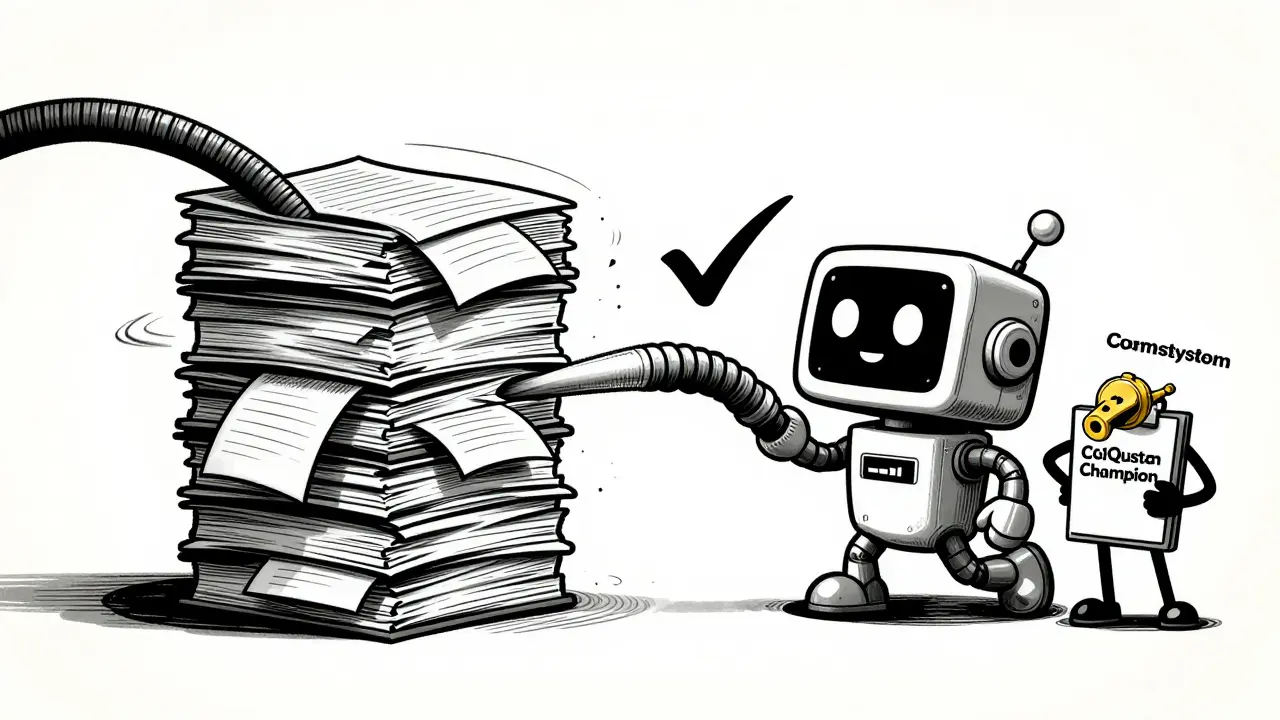
Finally, appoint "documentation champions" in every department. These are people who aren't necessarily managers but are experts in the records. They can catch a missing signature or an incorrect date before it becomes a Form 483 observation during an audit.
How long should I keep manufacturing records?
Retention periods vary by region, but as a general rule of thumb, you should keep records for at least one year beyond the product's expiration date. In the EU, the standard is often at least three years after the distribution of the product is completed. Always check your local regulations, as some specialized products have much longer requirements.
What happens if I find an error in a signed record?
Never use white-out or scribble over a mistake. The correct way to amend a record is to draw a single line through the error, write the correct value next to it, initial it, date it, and provide a brief explanation for the change. This maintains the audit trail and proves you aren't trying to hide data.
Is an eQMS always better than paper?
For scaling and accuracy, yes. eQMS reduces human error and makes retrieval during audits nearly instantaneous. However, the initial cost and the burden of computer system validation can be overwhelming for very small manufacturers. A hybrid system is possible, but it requires very strict controls to ensure the digital and paper parts of the record don't contradict each other.
What is the most common documentation error auditors find?
Incomplete batch records are the top culprit, often accounting for over 30% of citations. This usually happens because technicians are rushed and forget to sign off on a step in real-time, leading to gaps in the record that suggest the process wasn't followed correctly.
Does ALCOA+ apply to raw data from lab instruments?
Yes. The FDA's 2018 Data Integrity Guidance clarified that this includes all data generated during manufacturing. This means raw analytical files from instruments (like HPLC or spectrophotometers) must be preserved and protected from unauthorized deletion or modification.
Next Steps and Troubleshooting
If you're just starting out, don't try to automate everything at once. Begin by auditing your current paper logs-look for blanks, illegible handwriting, and missing dates. Once you have a clean paper process, you can migrate to a digital system without "digitizing the chaos."
For those already using electronic systems, the biggest risk is during migration. When moving to a new software version or provider, ensure you have 100% data migration validation. Losing a few years of historical batch records during a server move is a critical failure that can trigger an immediate regulatory investigation.
dwight koyner
April 9, 2026 AT 12:06The emphasis on the 8th-grade reading level for SOPs is an absolutely critical point. In my experience, the most common cause of deviation is not a lack of will, but a lack of clarity in the instructional text. When technicians are faced with ambiguous phrasing during a high-stress shift, they naturally apply their own interpretation, which is exactly where the risk of non-compliance begins.
Daniel Trezub
April 10, 2026 AT 08:22Honestly, the whole push for eQMS is just a way for software companies to bleed manufacturers dry with subscription fees. Paper doesn't crash, it doesn't need a software update every six months, and it doesn't require a 150-test validation process just to change a font. I've seen plenty of shops stay perfectly compliant with a well-organized binder system without spending half a million on a digital platform.
Jitesh Mohun
April 11, 2026 AT 03:19stop pretending paper is viable in 2024. if you are still using binders you are just waiting for an auditor to find a coffee stain and shut you down. digital audit trails are the only way to actually ensure data integrity because humans lie and forget but logs dont
Victoria Gregory
April 11, 2026 AT 06:49It's so true that we have to be careful about the energy we bring to these processes!!! ✨ Documentation is really just a reflection of how we care for the people who will eventually use the product... it's like a love letter to the consumer's safety! 💖💖
Grace Lottering
April 13, 2026 AT 06:12Audit trails are just a tool for total surveillance. They want every second of a worker's life tracked and logged. It's about control, not safety.
Windy Phillips
April 13, 2026 AT 18:37One would think that basic competence in record-keeping would be a prerequisite for employment in this field; however, the persistence of "back-dating" suggests a systemic lack of integrity that is quite alarming. It is truly fascinating how some people believe a single line through an error is too much effort for their precious time...
Christopher Cooper
April 14, 2026 AT 11:13The distinction between ISO 13485 and the FDA QSR is a massive hurdle for mid-sized firms. I've noticed that the traceability matrix approach in ISO can actually be more robust for complex assemblies, but the FDA's focus on the Device Master Record is what keeps the lawyers happy. It's a balancing act of regulatory philosophies that often results in redundant paperwork just to cover all bases.
Laurie Iten
April 15, 2026 AT 12:41the idea that if it isnt written it didnt happen is a heavy way to look at existence. it turns the actual act of creating into a secondary event to the act of recording it. we live in a world of ghosts and ink
Stephen Luce
April 15, 2026 AT 19:48I can definitely relate to the stress of finding a gap in a batch record right before an audit. That sinking feeling in your stomach is the worst. It really shows why having those "documentation champions" is so helpful-having someone who actually cares and catches things early makes the whole environment feel a lot less hostile.
charles mcbride
April 16, 2026 AT 04:10This is an excellent breakdown of a very daunting topic. I believe that if we focus on the 5C principle, most teams can actually find a bit of joy in the precision of their work. It's all about turning a chore into a point of professional pride!
Sarabjeet Singh
April 16, 2026 AT 07:28Strict adherence to ALCOA+ is the only way forward. No shortcuts.