 Mar, 10 2026
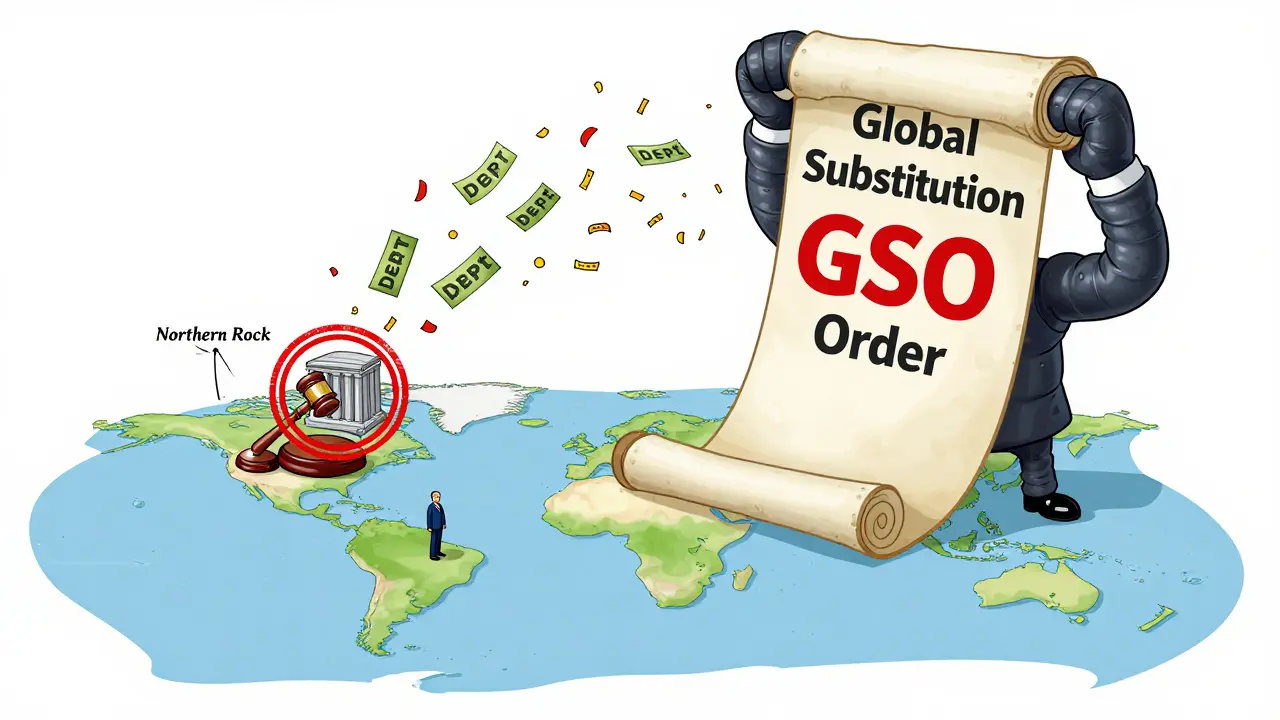
When a company buys a portfolio of thousands of unpaid debts, it doesn’t just take over the money-it takes over the legal rights behind each one. That’s where substitution laws come in. Without them, every single debt claim would need its own court filing to transfer ownership. Imagine filing 2,457 separate motions just to change the name on a lawsuit. That’s what companies used to do. Today, a smarter system called the Global Substitution Order (GSO) changes all that.
What Is a Global Substitution Order?
A Global Substitution Order (GSO) is a single court order that lets one legal entity replace another across hundreds or even thousands of active cases. It’s not about changing who owns a company-it’s about changing who owns the legal claims tied to that company. Think of it like transferring a stack of IOUs from one person to another, but instead of handing over pieces of paper, you’re handing over the right to sue in court. The UK’s High Court first created this tool in 2010 after Northern Rock, a bank that collapsed during the 2008 financial crisis, needed to transfer its debt claims to a new holding company. Instead of filing thousands of individual applications, the court allowed one order to cover them all. The result? Legal costs dropped by 70-85%. That’s not a small saving-it’s transformative. Today, firms like Oaktree Capital Management use GSOs regularly. In 2023, they replaced Deutsche Bank as the claimant in 2,457 separate debt collection cases with one application. The court approved it in under three weeks. Without the GSO, that process would have cost over $285,000. With it? Just $11,500.How Does It Work?
The process is strict but efficient. To get a GSO, you need three things:- Proof of assignment: You must show legally binding documents proving you bought the claims. This isn’t just an invoice-it’s a properly signed, notarized transfer agreement.
- A complete schedule: Every single case must be listed with its exact court number, jurisdiction, and claim amount. Missing even one case can get your whole application rejected.
- A plan for notice: Once approved, you must notify every defendant. The court doesn’t do this for you. You have to prove you will, and how.
Global Comparison: Who Does It Best?
Not every country has a GSO system. Here’s how the top players stack up:| Country/Region | Process Type | Average Processing Time | Approval Rate | Cost for 100 Claims |
|---|---|---|---|---|
| England & Wales (GSO) | Omnibus Order | 22 days | 92% | £8,500-£12,000 |
| European Union (Directive 2023/852) | Harmonized Bulk | 30 business days | 89% | €18,000 for up to 500 claims |
| Germany | Individual Applications | 45 days per claim | 78% | €22,000-€35,000 |
| Japan | Individual Applications Only | Varies | N/A | Per case: ~€300 |
| United States | Individual Motions (FRCP 25(c)) | 60-90 days per case | 85% | $1,200-$2,000 per motion |
The UK wins on speed and cost. The EU’s new directive is promising because it forces all member states to accept each other’s substitution orders-but it’s more expensive. Germany and the U.S. still make companies file one motion per case, which adds up fast. Japan doesn’t even allow bulk processing. If you’re buying debt portfolios internationally, the UK remains the go-to jurisdiction.

Why the UK Leads-And Why It’s Risky
Sixty-eight percent of multinational debt buyers now file their first substitution request in England and Wales. Why? Because GSOs cut time and cost so dramatically. But there’s a catch. GSOs only work in England and Wales. If you need to enforce a judgment in Spain, Germany, or Brazil, you’re back to square one. In 2024, a German leasing company lost €38,000 trying to enforce a UK GSO in Spanish courts. They had to restart the whole substitution process under local law. There’s also a due process problem. In 2022, a GSO led to 187 wrongful default judgments because defendants weren’t properly notified. The court later overturned those rulings. The International Bar Association now recommends mandatory verification steps after substitution-like requiring proof of mailed notices or digital receipts.Who Uses This System?
You won’t find small businesses using GSOs. It’s for big players:- Distressed debt funds like Apollo, Blackstone, and Oaktree that buy portfolios from failing banks.
- Corporate lenders who restructure after mergers or bankruptcies.
- Leasing companies that transfer thousands of equipment leases after asset sales.
The Future: Blockchain and AI
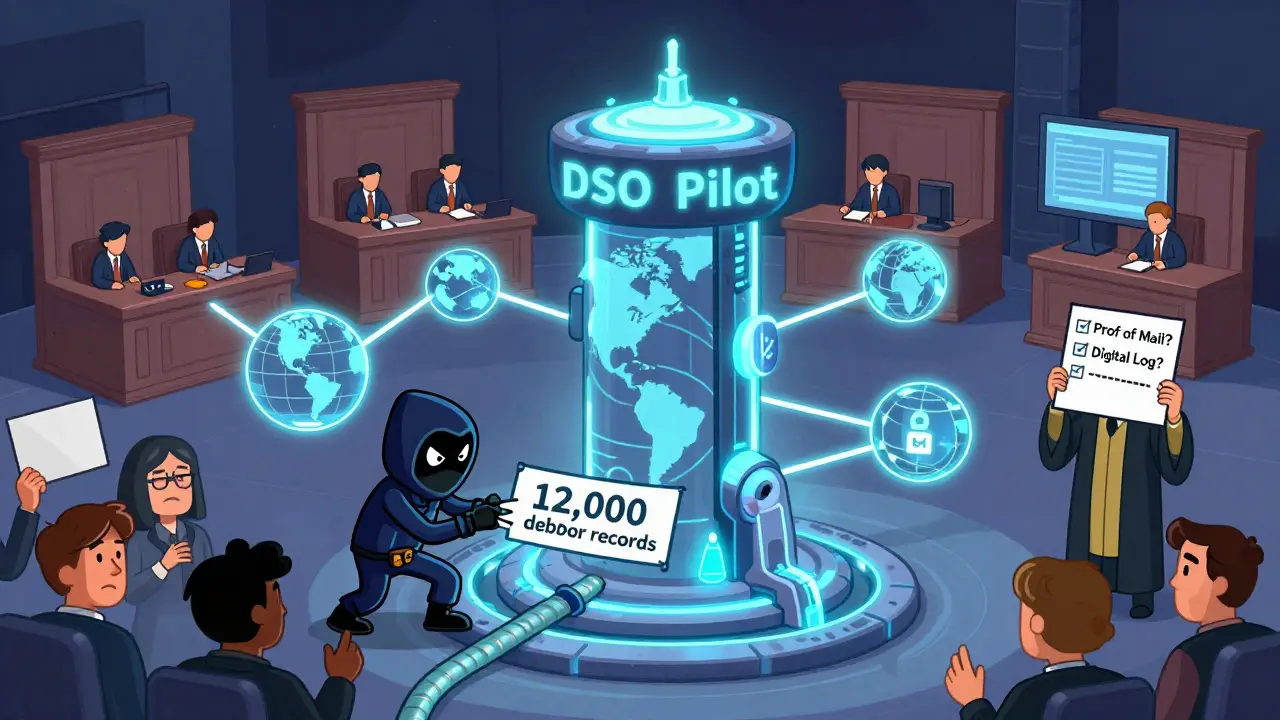
The next leap is digital. In July 2025, the UK launched a pilot called the Digital Substitution Order (DSO). It uses blockchain to automatically update court records across jurisdictions when a GSO is granted. Early results show a 40% drop in processing time. By 2027, Deloitte predicts 75% of major debt acquisitions will use automated substitution systems. But there’s a dark side. In March 2025, a UK litigation finance firm’s system was hacked, exposing over 12,000 debtor records. GDPR compliance is now a critical part of GSO workflows. The Hague Conference is working on a global convention to recognize substitution orders across borders. If adopted in December 2025, it could finally create a true international standard.What You Need to Know
If you’re involved in buying or managing large debt portfolios:- Always file your first substitution in England and Wales if possible-it’s the cheapest and fastest.
- Double-check every case number. 63% of GSO rejections in 2024 came from typos or missing entries.
- Plan your notice strategy before filing. Courts are cracking down on unverified notifications.
- Expect enforcement headaches outside the UK. Budget for local legal help in each country where you need to collect.
- Use trained specialists. A 6-8 month learning curve is real. Don’t try this with a junior lawyer.
Substitution laws are no longer niche. They’re the backbone of a $317 billion global industry. The system isn’t perfect-but right now, it’s the best we’ve got.
What countries recognize Global Substitution Orders (GSOs)?
GSOs are legally binding only in England and Wales. Other countries don’t automatically recognize them. The EU’s 2023 Directive allows member states to accept substitution orders from each other, but each nation still has its own rules. The U.S. and Japan require individual filings. The 2025 Hague Convention may change this, but it’s not yet in force.
Can a GSO be used for non-debt claims?
Technically yes, but in practice, almost all GSOs are used for debt portfolios. Courts have approved them for lease agreements, royalty payments, and insurance claims-but only when there are hundreds of similar cases. It’s not used for single contracts or personal injury suits. The system was designed for bulk, repetitive claims.
What happens if a defendant wasn’t notified after a GSO is granted?
If defendants weren’t properly notified, any judgment against them can be overturned. In 2022, 187 default judgments were voided because of this. Courts now require proof of notice-like certified mail receipts or digital delivery logs. Failure to provide this can lead to the GSO being revoked and fines for the applicant.
How much does it cost to apply for a GSO?
The court fee is fixed at £8,500-£12,000 regardless of how many claims are involved. Legal fees vary: top firms charge $10,000-$25,000 for preparation, depending on portfolio size. This is still far cheaper than filing 1,000 individual motions, which could cost over $2 million.
Is the GSO system growing or fading?
It’s growing fast. The market for GSO services hit $185 million in 2024 and is rising 14.3% annually. With the EU’s harmonized rules and the UK’s DSO pilot, adoption is accelerating. The rise of AI-powered case management tools will make GSOs even more common by 2027. It’s not going away-it’s becoming essential.
Tom Bolt
March 10, 2026 AT 14:50Let me get this straight: you’re telling me a single court order can replace 2,457 individual filings? That’s not efficiency-that’s legal wizardry. And the cost difference? £8,500 vs. $2 million? That’s not a saving, that’s a revolution. The UK didn’t just streamline the system; they detonated it with a neutron bomb of common sense.
But here’s the real kicker: this only works in England and Wales. So if you’re a hedge fund in Texas buying debt from a bankrupt German firm, you’re stuck filing motions in triplicate. That’s not a global system-it’s a British loophole with international consequences.
And don’t even get me started on the 187 wrongful judgments from poor notice protocols. You can’t cut corners on due process and call it innovation. This isn’t Amazon Prime for lawsuits. People’s credit scores, livelihoods, and futures are on the line.
Grammar note: 'substitution laws' should be hyphenated when used adjectivally-'substitution-law process'-but you didn’t do that. Minor, but I’m paid to notice.
Chris Bird
March 12, 2026 AT 11:24So you buy debt, file one paper, and now you can sue 2,000 people? That’s wild. No wonder big money loves this. But what about the guy who owes $500 on a credit card he forgot about? He gets a letter from some company he never heard of and now he’s in court. That ain’t justice. That’s a machine.
UK says it’s fast. But fast for who? Not the guy in Nigeria trying to pay his daughter’s school fees. He doesn’t know what a GSO is. He just knows his bank account got frozen.
This system? It’s like a casino. The house always wins. And the players? They don’t even know the rules.
David L. Thomas
March 12, 2026 AT 17:24Okay, let’s unpack this. The GSO isn’t just a procedural tweak-it’s a paradigm shift in asset mobility. We’re talking about the legal equivalent of a blockchain ledger for litigation rights. The UK didn’t just reduce friction; they eliminated it.
Think about the macroeconomic implications: $317B in distressed debt flows globally. Without GSOs, that market would be paralyzed by administrative drag. Legal tech isn’t about AI chatbots-it’s about structural efficiency at scale.
And yes, enforcement outside England/Wales is a nightmare. But that’s a jurisdictional problem, not a systemic one. The EU’s 2023 directive is the first real step toward harmonization. The Hague Convention in 2025? That’s the holy grail.
The real innovation isn’t the order-it’s the data integrity. A complete schedule with jurisdictional codes? That’s machine-readable legal infrastructure. We’re not just transferring claims-we’re tokenizing them.
And let’s not ignore the DSO pilot. Blockchain + court records? That’s not the future. It’s the present. The only question is whether legacy systems can adapt before they’re obsolete.
Bridgette Pulliam
March 13, 2026 AT 01:52It’s fascinating how such a dry, technical process can have such human consequences. I keep thinking about the person who gets that notice in the mail-'You owe money to Oaktree Capital Management.' They didn’t sign anything with them. They don’t even know who they owe. That’s not just legal-it’s emotional.
And yet, the system works. It’s efficient. It saves millions. But efficiency without empathy is just automation with a suit on.
I wonder if there’s room for a 'human verification' step before the substitution is granted. Not just proof of mailing-but proof that someone, somewhere, paused and thought: 'This person might not understand what’s happening.'
Maybe a short video message from the new claimant? Or a phone call option? Not for everyone. Just for the ones who seem vulnerable.
I’m not saying we slow it down. I’m saying: let’s not forget who we’re talking about.
Shourya Tanay
March 13, 2026 AT 09:05The structural elegance of the GSO is undeniable. The legal architecture-proof of assignment, complete schedule, notice protocol-forms a tripartite governance model that ensures both scalability and accountability. It’s a masterclass in procedural design.
That said, the jurisdictional fragmentation is a critical vulnerability. The EU’s harmonized directive is a necessary counterweight, but its cost structure (€18,000 for 500 claims) suggests it’s designed for institutional players, not SMEs.
Japan’s refusal to adopt bulk processing isn’t archaic-it’s a philosophical stance. Individual adjudication as a safeguard against systemic overreach. That’s not inefficiency; it’s jurisprudential integrity.
And the DSO pilot? That’s where the real disruption lies. If blockchain can cryptographically bind substitution records across borders, we’re not just changing procedure-we’re redefining sovereignty in civil litigation.
But we must ask: who controls the chain? And who audits it? The answer to that determines whether this becomes a tool of justice-or a weapon of opacity.
Gene Forte
March 14, 2026 AT 08:11This is the kind of thing that makes me believe in progress. We’re talking about turning a bureaucratic nightmare into something clean, fast, and fair. Imagine if every system worked like this. Imagine if your taxes, your permits, your permits to open a business-all of it-was this simple.
The UK didn’t just fix a problem. They built a model. And models are meant to be copied. The EU is trying. The US is still stuck in 1998. That’s not a legal issue-that’s a leadership issue.
Yes, there are risks. Yes, people get caught in the cracks. But we don’t fix problems by going backward. We fix them by scaling what works.
Let’s not call this 'risky.' Let’s call it 'unpolished.' And then let’s polish it. Together.
Kenneth Zieden-Weber
March 15, 2026 AT 08:15So let me get this straight: you can legally transfer the right to sue 2,457 people with one form… and the court doesn’t even have to tell the defendants beforehand? That’s not a legal innovation. That’s a loophole with a PowerPoint presentation.
And you’re calling this 'efficiency'? What’s next? A one-click button to seize someone’s car because they missed a payment in 2014? At least with debt collectors, you get a phone call. Here? You get a letter from a company you’ve never heard of, and suddenly you’re in default.
It’s like the legal system got a Tesla upgrade… and forgot to install the brakes.
Mike Winter
March 16, 2026 AT 15:48Interesting piece. I’ve been following this since the Northern Rock days. The GSO was a game-changer-no doubt. But I wonder if we’re romanticizing it too much. The 92% approval rate? That’s impressive. But what about the 8% that get rejected? Were they just typos? Or were they systemic flaws masked by volume?
And the notice protocol? It’s a joke. 'Prove you mailed it'-as if people still check their mail. Half the defendants are homeless. Half are in other countries. Half are just… gone.
I’m not against the system. I’m against pretending it’s perfect. The UK leads because it’s bold. But boldness without humility becomes arrogance.
Also, 'substitution laws'-should be 'substitution-law' in the title. Minor, but I noticed.
Randall Walker
March 18, 2026 AT 11:29One sentence: If you’re buying debt and think you’re doing justice-you’re not. You’re buying a legal weapon.
Miranda Varn-Harper
March 19, 2026 AT 07:03It is, without a doubt, a remarkable development in the field of civil procedure. The reduction in administrative overhead is statistically significant, and the economic implications are, frankly, transformative. However, one must not overlook the foundational principle of procedural due process, which, in this instance, appears to have been subordinated to expediency.
Moreover, the notion that a single jurisdiction can serve as the de facto global hub for debt enforcement raises serious questions regarding sovereignty, equity, and the rule of law. One might argue that the current system resembles a form of legal outsourcing-where procedural norms are exported, but accountability is not.
That said, the proposed Hague Convention, if ratified, may offer a viable pathway toward harmonization-provided that safeguards for notice, verification, and appeal are not merely afterthoughts, but codified requirements.
One final note: the term 'GSO' is used inconsistently throughout this document. It is, in fact, 'Global Substitution Order'-capitalized, and never abbreviated in formal exposition. This is not pedantry. It is precision.