 Feb, 15 2026
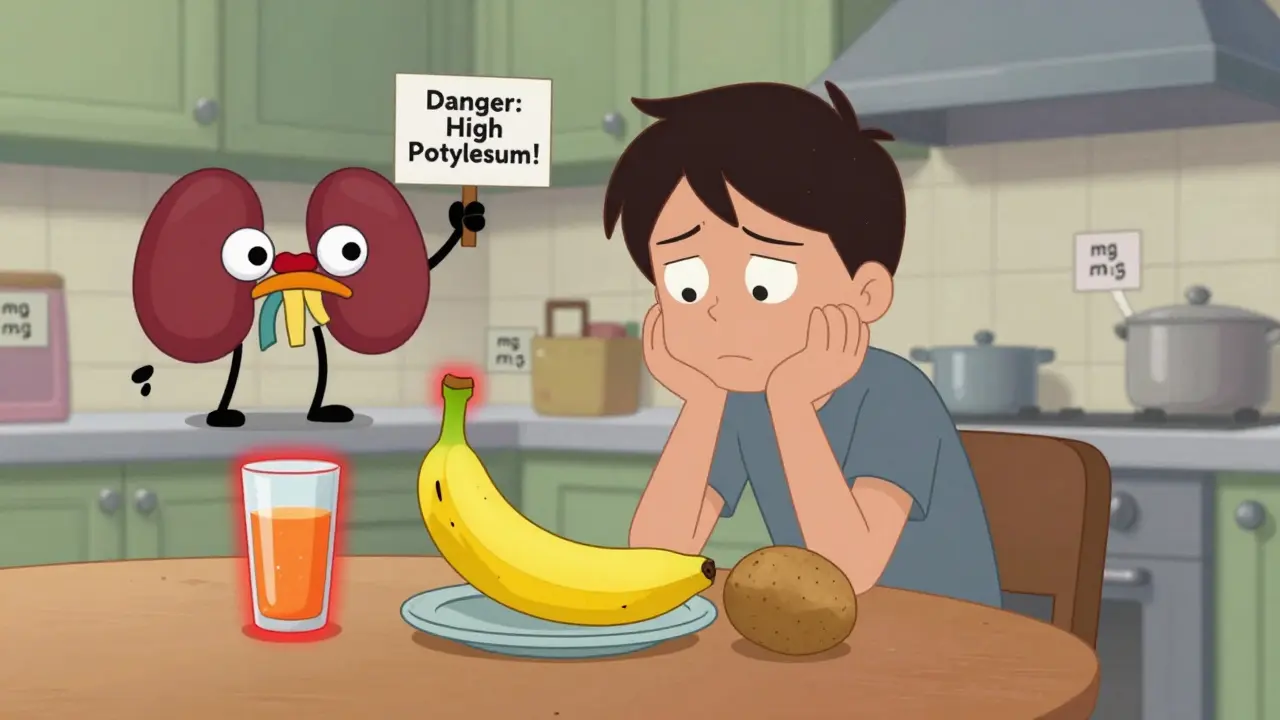
When your kidneys aren't working well, even simple foods can become dangerous. For people with chronic kidney disease (CKD), high potassium levels - a condition called hyperkalemia - can trigger heart rhythm problems, muscle weakness, or even cardiac arrest. It's not rare: up to half of those with advanced CKD experience it. The challenge? Many of the drugs that protect the heart and kidneys - like ACE inhibitors and ARBs - also raise potassium. So doctors face a tough choice: keep the life-saving meds, or risk dangerous spikes in potassium. The answer isn't to stop treatment. It's to manage it - with smart diet changes, precise monitoring, and modern medications.
What Exactly Is Hyperkalemia in CKD?
Hyperkalemia means your blood potassium level is too high. For most people, normal is between 3.5 and 5.0 mmol/L. In CKD, anything above 5.0 mmol/L is considered elevated. But the real danger kicks in at 5.5 mmol/L and above. At that point, your heart's electrical system starts to misfire. You might see tall, peaked T-waves on an ECG. If it climbs past 6.0 mmol/L, your QRS complex widens. That’s a red flag - your heart could stop. And yet, many people with CKD live with this quietly for months because symptoms are vague: tiredness, muscle cramps, or a fluttering heartbeat. The problem isn’t just diet. It’s also the drugs. RAAS inhibitors - medications like lisinopril or losartan - are standard for CKD patients because they reduce protein in urine and slow kidney damage. But they block the body’s natural way of flushing out potassium. In fact, nearly half of all hyperkalemia events in CKD happen after these drugs are started or increased. That’s why monitoring potassium after any dose change is critical - within 1 to 2 weeks, as KDIGO guidelines say.Dietary Limits: How Much Potassium Can You Really Eat?
Not all CKD patients need the same diet. If you’re in stage 1, 2, or early stage 3, you don’t need to cut out bananas or spinach entirely. A “prudent but not restrictive” approach works best. But if you’re in stage 3b, 4, or 5 - and not on dialysis - you need strict limits. The Renal Association recommends 2,000 to 3,000 mg of potassium per day. That’s not much. Here’s what that means in real food:- One medium banana: 422 mg
- One cup of orange juice: 496 mg
- One medium potato (with skin): 926 mg
- One cup of cooked spinach: 839 mg
- One cup of cooked lentils: 731 mg
Emergency Treatment: What Happens When Potassium Spikes
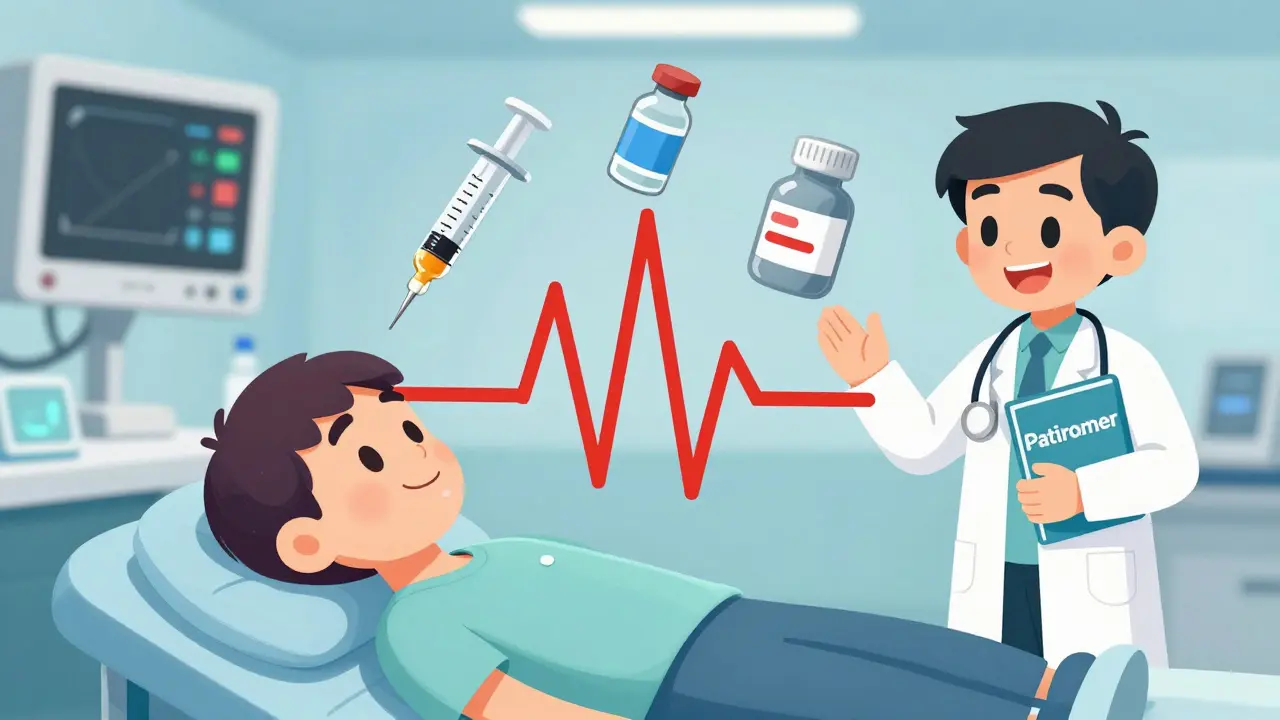
If potassium hits 5.5 mmol/L or higher - especially with ECG changes - you need emergency treatment. This isn’t a wait-and-see situation. Here’s what works, fast:- Calcium gluconate (10 mL of 10% solution IV): Given over 2 to 5 minutes. It doesn’t lower potassium. It just stabilizes the heart muscle so it won’t fibrillate. Onset: 1 to 3 minutes. Lasts 30 to 60 minutes.
- Insulin and glucose (10 units regular insulin + 50 mL of 50% dextrose): This drives potassium into cells. Works in 15 to 30 minutes. Lowers potassium by 0.5 to 1.5 mmol/L. But watch for low blood sugar - 10 to 15% of patients get hypoglycemia.
- Sodium bicarbonate (50 to 100 mmol IV): Only if you’re also acidotic (bicarbonate <22 mmol/L). It helps shift potassium into cells. Onset: 5 to 10 minutes.
Chronic Management: The New Generation of Potassium Binders
For long-term control, we’ve moved far beyond old-school treatments. Sodium polystyrene sulfonate (SPS) was once the go-to. You took it as a powder mixed in water or syrup - three times a day. But it had serious risks: colon necrosis (tissue death), sodium overload, and poor adherence. Many patients just stopped taking it. Now, we have two modern options:- Patiromer (Veltassa): Taken once daily. It binds potassium in the gut and removes it in stool. It’s sodium-neutral - good for people with heart failure or high blood pressure. But it causes constipation in 14% and low magnesium in nearly 19%. It also interferes with thyroid meds - if you take levothyroxine, you need to space them 4 hours apart.
- Sodium zirconium cyclosilicate (SZC, Lokelma): Taken once or twice daily. Works faster than patiromer - lowers potassium by 1.0 to 1.4 mmol/L in just one hour. Great for acute spikes. But it adds sodium: about 1.2 grams per day. That can worsen swelling in heart failure patients (12.3% vs 4.7% with patiromer).
Why These Drugs Let You Keep Your Heart Medications
The biggest win? These binders let you stay on your RAAS inhibitors. Without them, doctors often reduce or stop these drugs when potassium rises. But that’s dangerous. The KDIGO 2019 guidelines show that lowering RAASi doses leads to a 28% higher risk of heart events and a 34% higher risk of kidney failure. One trial (AMETHYST-DN) found that 78% of patients stayed on full RAASi doses when using patiromer. Without it? Only 38% could. Another study (HARMONIZE) showed that 83% of patients on SZC stayed on their mineralocorticoid receptor antagonists (like spironolactone), compared to just 52% without a binder. That’s huge. These drugs reduce heart failure hospitalizations. You can’t afford to stop them.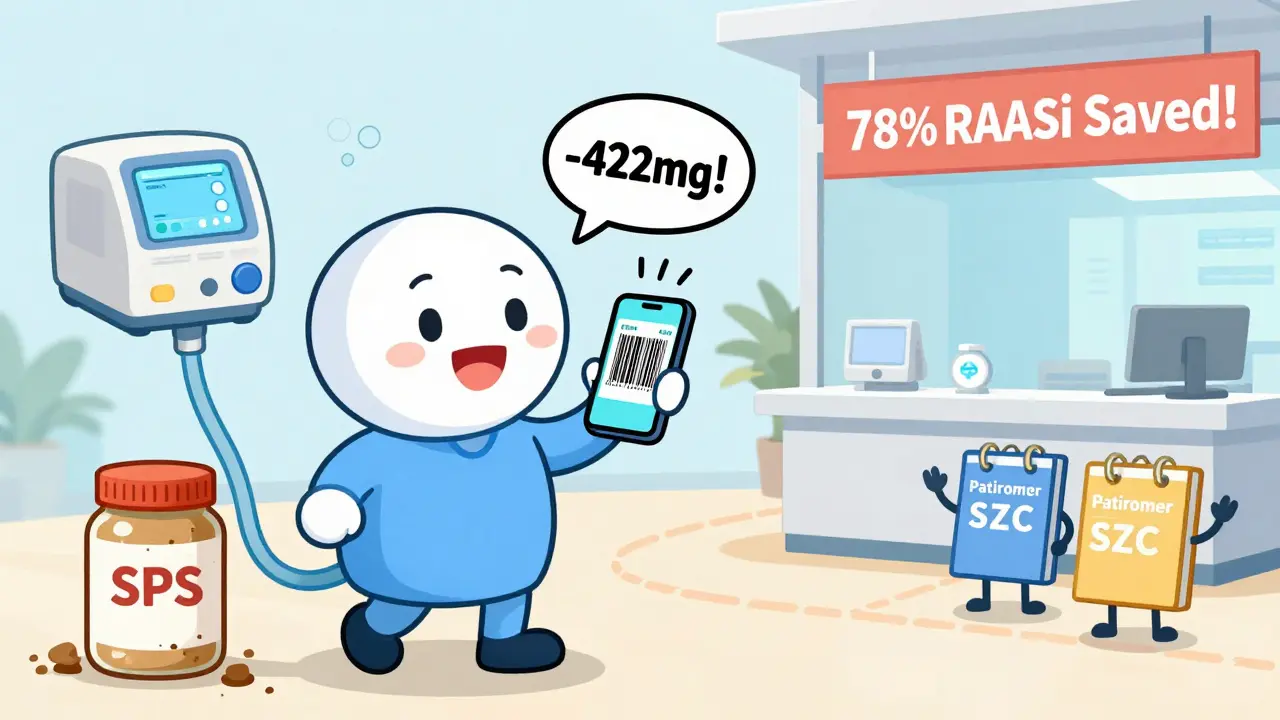
Monitoring and Coordination: The Hidden System Behind the Scenes
Managing hyperkalemia isn’t just about pills and food. It’s about systems. The best clinics use electronic alerts. When a patient’s potassium hits 5.0 mmol/L, the system automatically notifies their nephrologist and dietitian. Within 72 hours, they get a call. Dietitians play a key role. A 60-minute initial session covers: how to read food labels, which cooking methods reduce potassium, and how to replace high-potassium foods (like tomatoes with cabbage or apples instead of oranges). Follow-ups at 2 and 6 weeks help adjust the plan. Pharmacists check for drug interactions. One patient on 7 medications - including levothyroxine, digoxin, and aspirin - had a dangerous drop in thyroid levels because patiromer blocked absorption. Timing fixed it: take patiromer at night, levothyroxine in the morning. And it works. One UK clinic tracked potassium levels every 3 months. RAASi continuation jumped from 52% to 81%.The Future: Digital Tools and New Drugs
The next frontier? Personalization. Trials are testing whether measuring potassium in urine - not just blood - can guide diet more accurately. One study is testing a smartphone app that scans food barcodes and calculates potassium content in real time. Early results? Users stuck to their diet 32% better. New drugs are coming too. Tenapanor - approved for phosphate control - is being tested for potassium. It works locally in the gut and doesn’t get absorbed. Early trials show a 0.48 mmol/L drop. Encapsulated polymers in phase 2 trials are lowering potassium by 1.2 mmol/L in 24 hours. By 2027, experts predict 75% of CKD patients on heart-protective drugs will also be on a potassium binder. It’s not a luxury. It’s becoming standard care.What You Need to Do Right Now
If you have CKD and take RAAS inhibitors:- Get your potassium checked within 1 to 2 weeks after any dose change.
- Ask for a referral to a renal dietitian - don’t wait until you’re in crisis.
- If your potassium is above 5.0 mmol/L, ask if a binder is right for you.
- Know your food: boiled > baked, fresh > juice, low-sodium > salt substitute.
- Never stop your heart or kidney meds without talking to your doctor.
What is the normal potassium level for someone with CKD?
For people with chronic kidney disease, the target potassium range is 4.0 to 4.5 mmol/L. Levels above 5.0 mmol/L are considered elevated, and above 5.5 mmol/L require urgent action. This is stricter than the general population’s normal range (3.5-5.0 mmol/L) because even small increases can affect heart rhythm in CKD patients.
Can I still eat bananas if I have CKD?
You can, but only in very small amounts - and only if your potassium is well-controlled. One medium banana has about 422 mg of potassium. If you’re on a strict 2,000-3,000 mg daily limit (common in stages 3b-5 CKD), that’s nearly 20% of your daily allowance. Boiling or leaching bananas reduces potassium by about 30%. Better options: apples, berries, or peeled cucumbers. Always check with your dietitian before adding high-potassium foods.
Why can’t I just stop my blood pressure medicine if my potassium is high?
Stopping RAAS inhibitors like lisinopril or losartan might lower potassium, but it increases your risk of heart attack, stroke, and faster kidney failure. Studies show that reducing or stopping these drugs raises the risk of death by 2.1 times in CKD patients with heart failure. The goal isn’t to stop the medicine - it’s to manage the potassium with diet and binders so you can keep taking it safely.
How do patiromer and sodium zirconium cyclosilicate differ?
Patiromer works slowly (4-8 hours to lower potassium) and is sodium-neutral, making it better for long-term use, especially in heart failure. Sodium zirconium cyclosilicate (SZC) works faster - within 1 hour - so it’s preferred for emergencies. But SZC adds sodium to your body (about 1.2 g/day), which can worsen swelling. Patiromer may cause constipation or low magnesium; SZC may cause fluid retention. Your doctor picks based on your other conditions.
Are potassium binders covered by the NHS in the UK?
Yes, but access varies. Sodium polystyrene sulfonate (SPS) is widely available and low-cost (£47/month). Newer binders like patiromer (£286/month) and SZC are approved for use but often require prior authorization. Many NHS trusts use them only for patients who can’t tolerate SPS or who have repeated hospitalizations. Cost-effectiveness is a major factor - newer binders are expensive, but they reduce emergency visits, which saves money long-term.
What should I do if I miss a dose of my potassium binder?
If you miss one dose, take it as soon as you remember - unless it’s close to your next scheduled dose. Then skip the missed dose and go back to your regular schedule. Don’t double up. Missing one dose usually won’t cause a spike, but missing several can. Keep a log, set phone reminders, and talk to your pharmacist about pill organizers. Adherence above 80% is linked to fewer hospital visits and better RAASi continuation.
Can dialysis fix hyperkalemia?
Yes - and it’s the fastest way. Hemodialysis removes potassium directly from the blood, often lowering it by 1-2 mmol/L in a single session. That’s why patients on dialysis rarely have life-threatening hyperkalemia. But for those not yet on dialysis, binders and diet are the main tools. Dialysis isn’t a cure for hyperkalemia - it’s a last resort for those with end-stage kidney failure.
Is there a blood test that shows how much potassium I’m eating?
No - serum potassium only shows your current level, not your intake. But researchers are testing urinary potassium excretion as a future tool. If your kidneys are still filtering, the amount of potassium in your urine over 24 hours can estimate how much you’re eating. This could one day help personalize your diet instead of using generic limits. Right now, food diaries and dietitian assessments are still the best tools.
Why do some doctors still use sodium polystyrene sulfonate (SPS)?
Because it’s cheap and available. SPS costs less than £50 a month, while newer binders cost over £250. Many clinics, especially in community settings, still use it as first-line due to cost. But it’s not ideal: it has a high risk of bowel injury (0.5-1% incidence), requires multiple daily doses, and has poor patient adherence. Guidelines now recommend newer agents when possible - but if cost or access is a barrier, SPS remains an option under careful monitoring.
How often should I get my potassium checked if I have CKD?
After starting or increasing a RAAS inhibitor, check within 1-2 weeks. Once stable, check every 3-6 months. If you’re on a potassium binder, check every 3 months. More frequent checks are needed if you’re sick, on new medications, or have symptoms like muscle weakness or palpitations. Many clinics now use automated alerts in electronic records to trigger testing when potassium rises above 5.0 mmol/L.
Philip Blankenship
February 16, 2026 AT 00:44Man, I just read this and had to pause. I’ve been on lisinopril for years with CKD, and no one ever told me how dangerous potassium could get. I thought bananas were just ‘bad’-turns out, one medium one is like 20% of my daily cap. I’ve been boiling my potatoes like a science experiment now. Also, never knew about the salt substitute trap. Thanks for the real talk.
James Lloyd
February 17, 2026 AT 05:27Just want to clarify something: the target range for CKD patients isn’t ‘normal’-it’s a risk-adjusted therapeutic window. Normal for healthy people is 3.5–5.0, but for CKD, 4.0–4.5 is the sweet spot to avoid arrhythmias without sacrificing RAASi benefits. And yes, monitoring within 1–2 weeks of dose changes? Non-negotiable. I’ve seen too many patients crash because someone thought ‘it’s just a little high.’ It’s never just a little.
Tony Shuman
February 18, 2026 AT 19:07So let me get this straight-you’re telling me we’re supposed to live on boiled vegetables and water because some pharmaceutical lobby decided to push expensive binders? And now we’re told not to stop lifesaving meds? Classic. They don’t care if you’re socially isolated, depressed, or can’t eat a family dinner. This isn’t medicine. It’s control disguised as care.
Jonathan Ruth
February 20, 2026 AT 16:47Who the hell wrote this? Some NIH drone? Bananas are fine if you’re not on dialysis. I’m 62, CKD stage 4, eat 2 bananas a day, and my K is 4.3. You’re scaring people into starvation. Also, SPS is garbage-bowel necrosis? No thanks. But patiromer? $286/month? I’m on SSD. You want me to choose between food and meds? Real helpful.
Haley DeWitt
February 22, 2026 AT 11:57This is so helpful!! 😊 I just started my binder last week and was terrified I’d mess up. I set phone alarms for doses and keep a food log. I even boiled my spinach! 🥬💦 You’re right-social isolation is real. I started Zoom dinners with other CKD folks. We share recipes. It helps. Thank you for not just listing facts but acknowledging the human side.
Logan Hawker
February 22, 2026 AT 17:19Let’s be real: the entire narrative around hyperkalemia is a construct of renal pharmacoeconomics. The real issue isn’t potassium-it’s the profit margin on sodium zirconium cyclosilicate. The FDA approved it because it’s patentable. Meanwhile, SPS, which has been used since 1958, is vilified for its 0.5% bowel necrosis risk… while we ignore the 12% non-adherence rate to binders because they taste like chalk. This isn’t medicine. It’s a market.
Steph Carr
February 24, 2026 AT 03:57So I read this like a novel. And honestly? It’s the first time I’ve felt seen. I used to hide my meals at Thanksgiving because ‘no one makes low-K food.’ Now I bring my own boiled sweet potatoes and applesauce. My cousin said, ‘Why don’t you just eat normal?’ I said, ‘Because my kidneys are broken, and if I don’t, I die.’ She didn’t get it. But this post? It gets it. Thanks.
John Haberstroh
February 25, 2026 AT 10:11Here’s the wild thing no one talks about: potassium isn’t the villain. It’s the messenger. High K+ in CKD? It’s your body screaming that your RAASi is doing its job-slowing fibrosis, protecting glomeruli. The real tragedy isn’t the potassium spike. It’s that we’ve turned a physiological signal into a moral failing. ‘Don’t eat bananas’ sounds like discipline. But really? We’re punishing people for surviving.
Carrie Schluckbier
February 25, 2026 AT 13:40Anyone else notice that every single ‘expert’ here works for a pharmaceutical company? The ‘binders are life-saving’ line? That’s not science-it’s marketing. And why is the NHS ‘cost-conscious’? Because they’re rationing care. I bet the same people pushing binders also sell the lab tests that monitor potassium. It’s a loop. A money loop. And we’re the cattle.
Sam Pearlman
February 26, 2026 AT 03:38So you’re telling me I can’t have coconut water? The one thing that makes my post-workout shake taste okay? And I’m supposed to believe that boiling spinach cuts potassium? That’s like saying ‘boil your pain away.’ I’m not gonna risk my heart because some guy in a lab coat says ‘2,000 mg.’ I’ve got a 3-year-old. I’m not dying for a number.
Brenda K. Wolfgram Moore
February 27, 2026 AT 09:41I’m not a doctor, but I’ve been on dialysis for 5 years. I don’t have hyperkalemia anymore. But I still read this stuff. Why? Because it reminds me that I’m not just a kidney. I’m a person who used to eat pizza on Fridays. And now I eat boiled zucchini. But I still laugh. And I still love my family. This post? It didn’t just list facts. It remembered that.
guy greenfeld
February 28, 2026 AT 07:06Here’s the deeper truth: we treat hyperkalemia like a technical problem. But it’s existential. We’re asking people to surrender their autonomy-what they eat, what they love, what connects them to life-for a statistical chance at longevity. And we call it ‘care.’ But care shouldn’t require erasing your identity. Maybe the real solution isn’t more binders… but more compassion.
Kancharla Pavan
March 1, 2026 AT 06:41You people are pathetic. You whine about bananas and coconut water? I’m from a village where people die from malnutrition. You have access to dietitians, binders, ECGs, labs-yet you’re crying because you can’t have orange juice? This isn’t a medical crisis. It’s a moral failure of the privileged. Stop acting like victims. Your kidneys failed. Adapt. Or die. Either way, stop dragging everyone else down with your entitlement.
Linda Franchock
March 2, 2026 AT 14:58Okay, real talk? I used to be a nurse. I’ve seen 3 patients code from hyperkalemia. One was a 48-year-old dad who stopped his lisinopril because he ‘didn’t like the side effects.’ He didn’t know the side effect was dying. So yeah, I’m gonna say it: this isn’t about food. It’s about trust. You have to trust your team. Your meds. Your numbers. Even if it sucks. Because sometimes, the thing that saves you… is the thing you hate.
Liam Earney
March 3, 2026 AT 09:45...I just... I... I’ve been doing this for 8 years. I’ve lost my job. My marriage. My friends. I don’t go to restaurants anymore. I don’t hug my kids after they’ve eaten pizza. I’m so tired. I follow every rule. I boil everything. I take my binders. I check my labs. And still... I feel like I’m slowly disappearing. Is this really what surviving looks like? Just... existing? I don’t know anymore.