 Dec, 6 2025
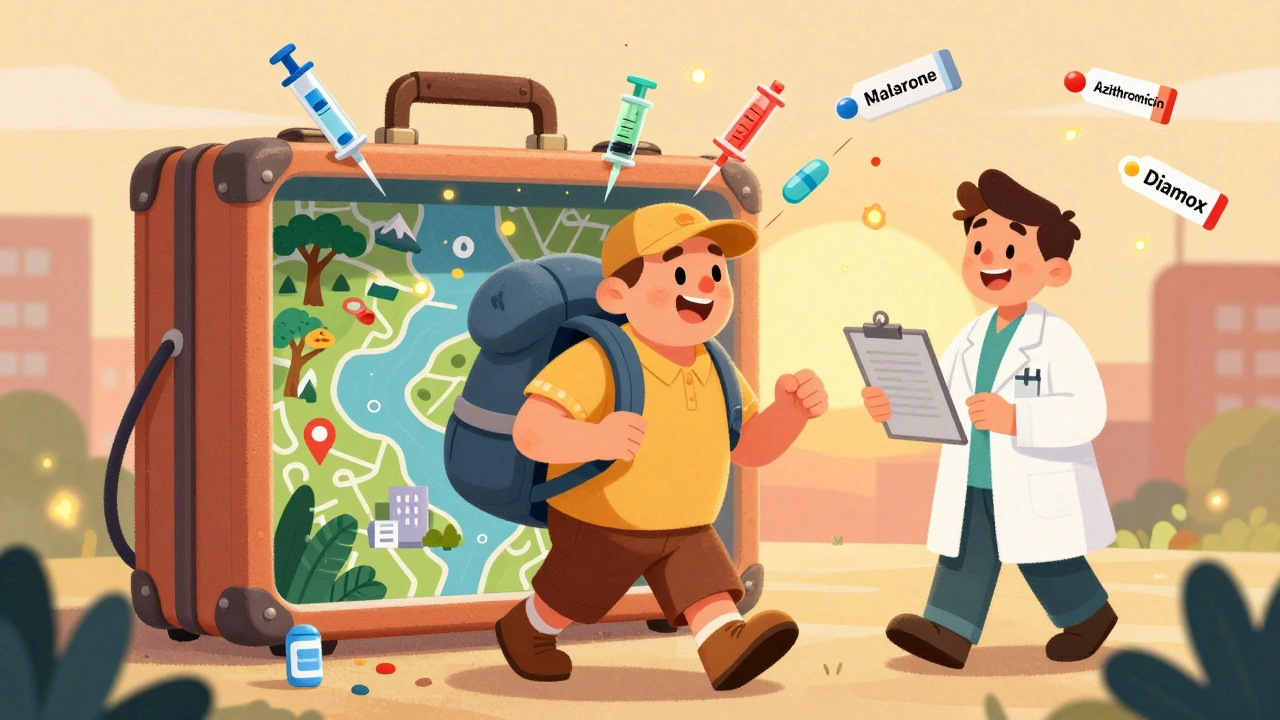
Planning a trip abroad? You might think packing sunscreen and a good pair of walking shoes is enough. But if you’re heading to a region with different disease risks-like parts of Africa, Southeast Asia, or Central America-your biggest travel mistake could be skipping a travel health clinic. These aren’t just pharmacies with extra shots. They’re specialized medical centers built to keep you safe from illnesses you won’t find at home. And the medications they prescribe? They’re not one-size-fits-all. They’re timed, targeted, and tailored to your exact route, health history, and trip length.
Why a Travel Health Clinic Is Different from Your Regular Doctor
Your family doctor knows your medical history. But they don’t know that malaria in Ghana has developed resistance to chloroquine, or that typhoid vaccines need to be given at least two weeks before exposure to work. Travel health clinics do. They track real-time outbreaks, update their protocols quarterly, and know exactly which drugs to avoid based on where you’re going and what you’ll be doing. According to the CDC, travelers who visit specialized clinics reduce their risk of getting sick by up to 72%. That’s not a guess. It’s from a 2022 study in the Journal of Travel Medicine. General practitioners miss 37% more destination-specific risks than travel specialists. Why? Most primary care doctors don’t keep up with the latest country-by-country vaccine and medication guidelines. A travel clinic does. They know that if you’re hiking in the Andes, you might need acetazolamide for altitude sickness. If you’re backpacking through rural India, you’ll need a prescription for azithromycin to treat traveler’s diarrhea on the spot.What Happens During a Travel Clinic Visit
Your first visit usually lasts 30 to 45 minutes. It’s not a quick shot appointment. It’s a full health review. You’ll need to bring:- Your complete travel itinerary (countries, cities, duration)
- Details about your planned activities (e.g., jungle trekking, river rafting, street food tours)
- Your medical history, including chronic conditions like diabetes, asthma, or pregnancy
- A list of current medications
- Your vaccination record (if you have one)
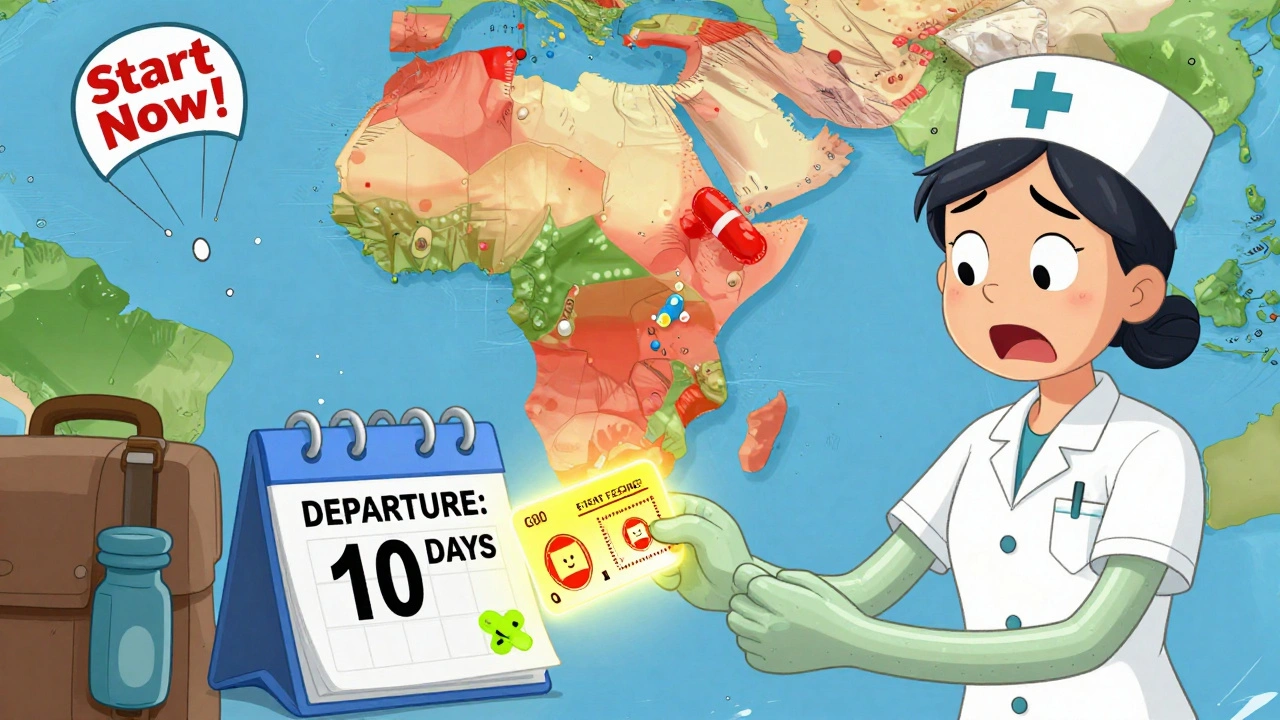
- Yellow fever: Required for entry into parts of Africa and South America. Must be given at least 10 days before travel-and only at CDC-registered clinics. There are 256 of them in the U.S. as of 2024.
- Typhoid: Available as a shot or pill. The pill version needs to be taken over 4 days, with the last dose at least a week before departure.
- Japanese encephalitis: Recommended for long-term travelers to rural Asia during rainy season. Requires two doses spaced 28 days apart.
Medications You Might Need (And When to Start Them)
Not all travel meds work if you start them the day before you leave. Timing matters.- Malaria prophylaxis: This is the most common mistake. If you’re going to sub-Saharan Africa, you might need Malarone (atovaquone-proguanil), doxycycline, or mefloquine. Malarone starts one day before travel. Doxycycline starts two days before. Mefloquine? You need to start it three weeks before departure. Why? Because it builds up slowly in your system. Starting late means you’re unprotected.
- Traveler’s diarrhea treatment: Clinics often prescribe azithromycin (500 mg daily for 3 days) or rifaximin. You don’t take these until you get sick. But you need the prescription in hand. Don’t wait until you’re in a remote village with no pharmacy.
- Altitude sickness: If you’re climbing above 8,000 feet, acetazolamide (Diamox) is typically prescribed at 125 mg twice a day, starting 24 to 48 hours before ascent.
- Antibiotics for chronic conditions: If you’re immunocompromised or on steroids, you might need extra antibiotics for minor infections. Your clinic will coordinate with your regular doctor to make sure nothing conflicts.
Where to Find a Travel Health Clinic
There are over 1,200 certified travel clinics in the U.S. as of 2024. But not all are equal.- University hospitals (like UCLA, UC Davis, Stanford): Offer the most comprehensive services. Consultations cost $150-$250. Usually not covered by insurance, but they handle complex cases best.
- Major hospital systems (like Mayo Clinic, Kaiser Permanente): Mayo offers virtual visits and has 12 locations. Kaiser only serves members and requires appointments 6-8 weeks out.
- Retail clinics (CVS MinuteClinic, Walgreens): Cheaper-$129 on average-and sometimes covered by insurance. But they’re limited. They can give you vaccines and basic advice, but won’t handle complex medical histories or custom medication plans.
What to Bring Home (and What to Leave Behind)
After your visit, you’ll get:- A personalized medication list with dosing instructions
- Prescriptions (some clinics fill them on-site)
- Proof of vaccination (especially the yellow fever card, which is valid for life)
- Written advice on avoiding food/water risks
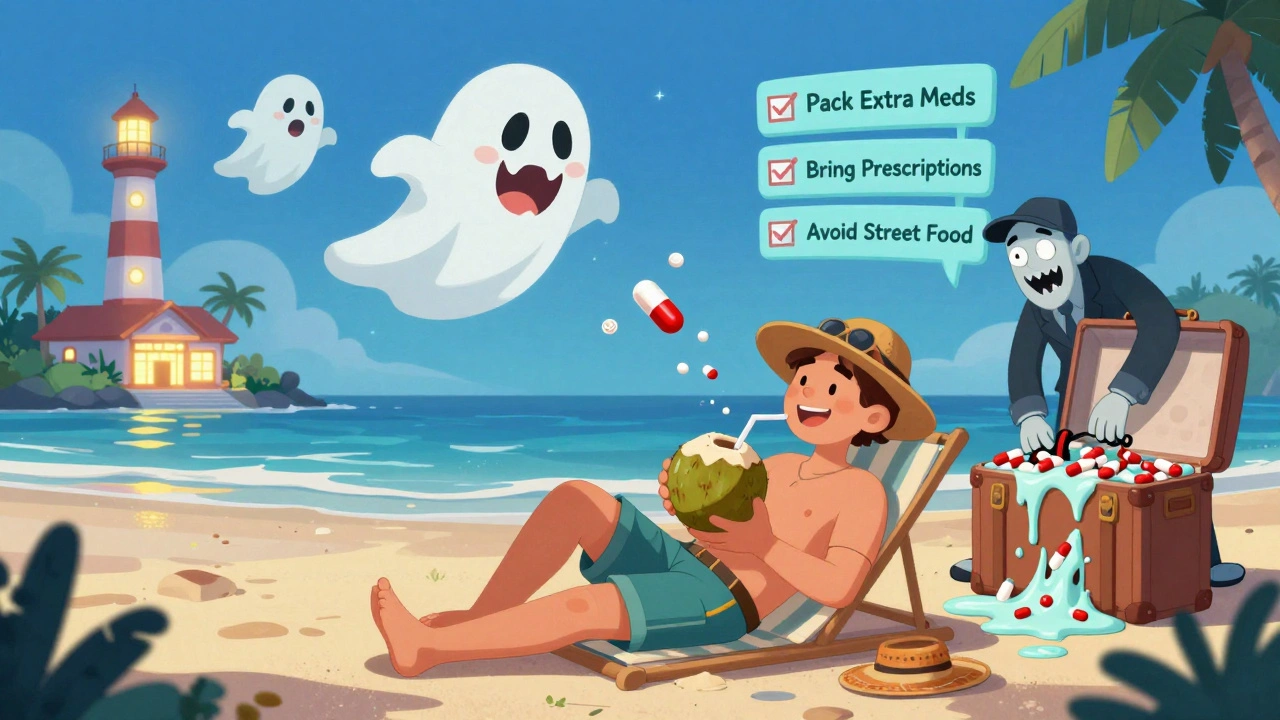
- Extra doses of all meds (in case your bag gets lost)
- Original prescription bottles (some countries require them for customs)
- A small first-aid kit with antiseptic, bandages, and pain relievers
- A note from your doctor if you’re carrying controlled substances (like strong painkillers or ADHD meds)
Nicholas Heer
December 7, 2025 AT 05:39So let me get this straight - the government lets some random clinic in Minnesota decide what meds I need to take before I go to Thailand? 🤡 And they’re charging $250 for it? Meanwhile, my cousin just bought malaria pills off a guy in Bangkok for $3 and he’s still alive. CDC? More like CRYPTOCURRENCY DUMB-CREWS. They’re just trying to sell you vaccines so Big Pharma can buy another yacht. I’m flying with duct tape, garlic, and a prayer. You think they’re gonna stop a plague? Nah. They’re just selling FEAR.
And don’t even get me started on the ‘yellow fever card’ - that’s a 1940s relic. I’ve been to 12 countries and never shown one. No one cares. They just want your cash. Stay safe, sheeple.
Also, why do they say ‘don’t buy meds abroad’? Because they don’t want you saving $200. That’s the whole scam. Fake drugs? Maybe. But so are their ‘CDC-approved’ pills. I’ve seen the receipts.
Next thing you know, they’ll make you get a DNA scan before you can fly to Mexico. #TravelFreedom #NoMoreShots
Sadie Nastor
December 8, 2025 AT 17:04Okay but I just got back from Bali and I went to a Walgreens 3 days before I left 😅 they gave me the typhoid shot and azithromycin and I was fine! I didn’t even get sick! 🥹
Also, I had a panic attack thinking I’d forget my meds so I put them in a tiny ziplock with a sticky note that said ‘DO NOT LOSE THIS OR YOU DIE’ 😂 I’m not proud of it but it worked.
Also, the lady at the clinic gave me a laminated card with all my meds and dosages and I still have it taped to my bathroom mirror. It’s like my travel spirit animal now 🦎
So yes - even if you’re last minute, DO IT. It’s not scary. It’s just… preparedness with extra steps. And honestly? Worth it. I didn’t spend my whole trip worrying about food poisoning. That’s peace of mind you can’t buy.
Also, the yellow fever card is legit. I had to show it in Ghana and they stamped it like it was a passport. So weird. So cool.
Also, I cried when I saw my first mosquito net. It felt like I was in a movie. 🥲
Sangram Lavte
December 10, 2025 AT 12:48In India, we often rely on local clinics for travel advice. Many doctors here are well aware of regional risks, especially for tourists visiting from the West. But I’ve seen travelers buy fake antimalarials from street vendors - it’s dangerous, no doubt.
Still, not everyone can afford a $200 clinic visit. The truth is, basic precautions - clean water, DEET, avoiding raw street food - go further than most think. Vaccines matter, yes. But awareness matters more.
I’ve been to Nepal, Vietnam, and Kenya without visiting a US-style travel clinic. I used WHO guidelines, talked to locals, and carried a basic kit. I didn’t get sick. Not because I was lucky - because I was careful.
Don’t let marketing scare you. But don’t ignore the science either. Balance is key.
And yes, counterfeit drugs are real. But so is misinformation. Read the WHO reports. Not Reddit.
Oliver Damon
December 12, 2025 AT 04:21The real insight here isn’t about vaccines or meds - it’s about the epistemological gap between generalist medicine and specialized, context-aware care.
Travel health clinics operate on what I’d call ‘geospatial immunology’ - a discipline that maps biological risk onto geopolitical and ecological variables. Your doctor treats your body. A travel clinic treats your body *in relation to the environment you’re entering*. That’s a paradigm shift.
And the timing of antimalarials? That’s pharmacokinetics meeting epidemiology. Mefloquine’s 3-week lead time isn’t arbitrary - it’s the half-life of drug accumulation in hepatic tissue combined with the incubation window of Plasmodium falciparum.
Most people don’t realize that travel medicine is the only branch of clinical practice where your destination is part of your diagnosis. You’re not just ‘going to Thailand’ - you’re entering a bio-geographic zone with specific pathogen vectors, drug resistance profiles, and vectorial capacity.
That’s why retail clinics fail. They’re treating symptoms, not systems.
And yes - AI is coming. Soon, your app will sync with WHO outbreak alerts, your EHR, and your flight itinerary to auto-generate a prophylactic plan. We’re already halfway there.
But the human element? Still irreplaceable. A good travel nurse will ask you if you’re planning to drink river water in Laos. Your PCP? They’ll ask if you’re allergic to penicillin.
That’s the difference between care and compliance.
Ryan Sullivan
December 13, 2025 AT 11:58Wow. Another sanctimonious article written by someone who clearly thinks they’re the only person on Earth who’s ever traveled outside of Ohio. Let me guess - you also wear hiking boots to the grocery store and carry hand sanitizer in your pocket like it’s holy water?
You say ‘28% of preventable malaria cases happen because people didn’t start meds early enough’ - great. So blame the people who didn’t read the 17-page PDF you posted. Not the system that charges $250 for a 45-minute consult while CVS gives you the same shot for $129.
And ‘counterfeit drugs in Southeast Asia’? Newsflash - so are 60% of the supplements sold in Whole Foods. But you don’t see me writing a 2000-word manifesto about it.
Stop gaslighting travelers into believing they need a PhD in tropical medicine to go on vacation. Most people are fine. Most people are not dying. And most people don’t care about your CDC charts.
Also - ‘last-minute visit is better than nothing’? That’s not a recommendation. That’s a confession your whole model is broken.
Wesley Phillips
December 15, 2025 AT 10:27Okay but imagine if you could just get a vaccine at Target and be done with it? Like, why do we need a whole ‘clinic’? Why can’t we just get a QR code that says ‘YOU’RE SAFE NOW’? 🤔
Also, I took Malarone one day before and I was fine. Like, I ate street food in Vietnam, drank tap water in Cambodia, and still didn’t get sick. So maybe the whole ‘three weeks’ thing is just a myth? Maybe it’s just corporate FOMO?
Also, the yellow fever card? I had mine laminated and framed. I’m basically a global health influencer now. 🌍💉
And don’t even get me started on the ‘personalized medication list’ - I printed mine on neon pink paper. It’s my travel lucky charm. My dog even licked it.
Also, I cried when I saw the first mosquito net. It felt like a scene from The Last of Us. But in a good way. 😭
Also, I told my Uber driver I was going to Ghana and he started giving me advice. I think I’m becoming a travel guru. #TravelVibes #NoRegrets
Olivia Hand
December 15, 2025 AT 15:06Interesting. But what about people who are immunocompromised? You mention coordination with their regular doctor - but what if their doctor doesn’t even know how to interpret the CDC’s country-specific alerts? What if they’re on biologics and the travel clinic prescribes something that interacts? Who’s liable?
And why is the ‘digital access’ thing only available at top-tier clinics? That’s a class divide disguised as innovation. You’re not ‘personalizing’ care - you’re gatekeeping it.
Also - ‘genetic testing to predict antimalarial response’? That’s not science. That’s pharmacogenomics in its infancy. And it’s being sold as a premium feature. Who’s paying for that? Who’s getting left out?
And let’s be real - the ‘you’re not scared enough’ tone of this article is manipulative. It’s not about safety. It’s about control. You’re turning travel into a compliance checklist.
I’m not against prevention. I’m against the performance of it.
Desmond Khoo
December 17, 2025 AT 06:32Just got back from Peru and I went to a clinic 3 weeks out - best decision ever. Got the yellow fever shot, Malarone, and a prescription for azithromycin. Didn’t get sick. Didn’t panic. Just chilled.
Also, I packed my meds in a little pill organizer with labels in both English and Spanish. My host mom in Cusco thought I was a doctor 😄
And yes - I cried when I saw my first mosquito net. It felt like a superhero cape. 🦸♂️
Also, I bought a tiny first-aid kit and put it in my daypack. Now I’m obsessed. I’ve started packing one for every trip. Even weekend getaways.
Also, my mom said I’m ‘too much’ for planning this hard. I said - ‘Mom, I’m not too much. I’m just not going to die in a jungle.’
Also, I took a photo of my vaccination card and made it my lock screen. I’m weird. I’m proud.
Also - I told my friend who’s going to Kenya to go to a clinic. She said ‘I don’t have time.’ I said ‘I didn’t have time either. I made time.’
You don’t need a PhD. You just need to care. And a little prep goes a long way. 🌿