 Dec, 5 2025

Every year, millions of people in the U.S. avoid medications they think they’re allergic to-only to find out later they never had an allergy at all. The problem? Most people can’t tell the difference between a side effect and a true drug allergy. And that misunderstanding isn’t just inconvenient-it’s dangerous.
What’s the Real Difference?
A side effect is what happens when a drug does something it wasn’t meant to do-like making you nauseous after taking ibuprofen or giving you a headache after starting a new blood pressure pill. These aren’t surprises; they’re known, predictable outcomes built into how the drug works. Side effects usually show up because the drug affects more than just its target. For example, aspirin reduces inflammation by blocking certain enzymes-but those same enzymes help protect your stomach lining. That’s why nausea and upset stomach are common side effects, not signs of an allergy. A true drug allergy, on the other hand, is your immune system going rogue. It mistakes the drug for a threat-like a virus or pollen-and launches a full-scale attack. This isn’t about dosage or how your body metabolizes the drug. It’s about your immune system producing antibodies (usually IgE) that trigger inflammation, swelling, rashes, or even life-threatening reactions. The numbers don’t lie: only 5 to 10% of all reported drug reactions are actual allergies. The rest? Side effects, intolerances, or unrelated coincidences. Yet nearly 1 in 5 Americans claim a penicillin allergy-even though 90 to 95% of them can safely take it after proper testing.Timing Tells the Story
One of the clearest ways to tell them apart is when symptoms show up. If you get hives, swelling around your lips or eyes, or trouble breathing within minutes to an hour after taking a pill or getting an injection, that’s a red flag for a true allergy. These are IgE-mediated reactions, and they escalate fast. Anaphylaxis-a full-body allergic emergency-can happen in under 30 minutes. This isn’t something that fades after a few hours. It gets worse with each exposure. Side effects? They usually show up later. Nausea from antibiotics might hit after your second or third dose. Dizziness from a new antidepressant might take a week to appear. These don’t come out of nowhere. They often get better as your body adjusts, or they disappear when you lower the dose. Delayed reactions are trickier. A rash that shows up 7 to 14 days after starting a new drug could still be an allergy-especially if it’s widespread, itchy, and accompanied by fever or swollen lymph nodes. Conditions like DRESS (Drug Reaction with Eosinophilia and Systemic Symptoms) or Stevens-Johnson Syndrome can take weeks to develop, but they’re immune-driven and require immediate medical attention.Symptom Patterns Reveal the Truth
True allergies rarely stick to one system. If you get a rash and your throat swells and you start wheezing, that’s not a side effect. That’s your immune system firing on all cylinders. According to data from the FDA and Mayo Clinic, 80 to 90% of allergic reactions involve the skin-hives, red patches, or blistering. But if you’re also having trouble breathing, your blood pressure drops, or your stomach cramps violently, you’re looking at a multi-system reaction. That’s the hallmark of an allergy. Side effects? They’re usually solo acts. Nausea alone. Headache alone. Dizziness alone. Even if you get a few at once-like nausea and dizziness from a migraine pill-it’s still likely just the drug’s pharmacology playing out. No immune system involvement. No escalating risk with repeat use.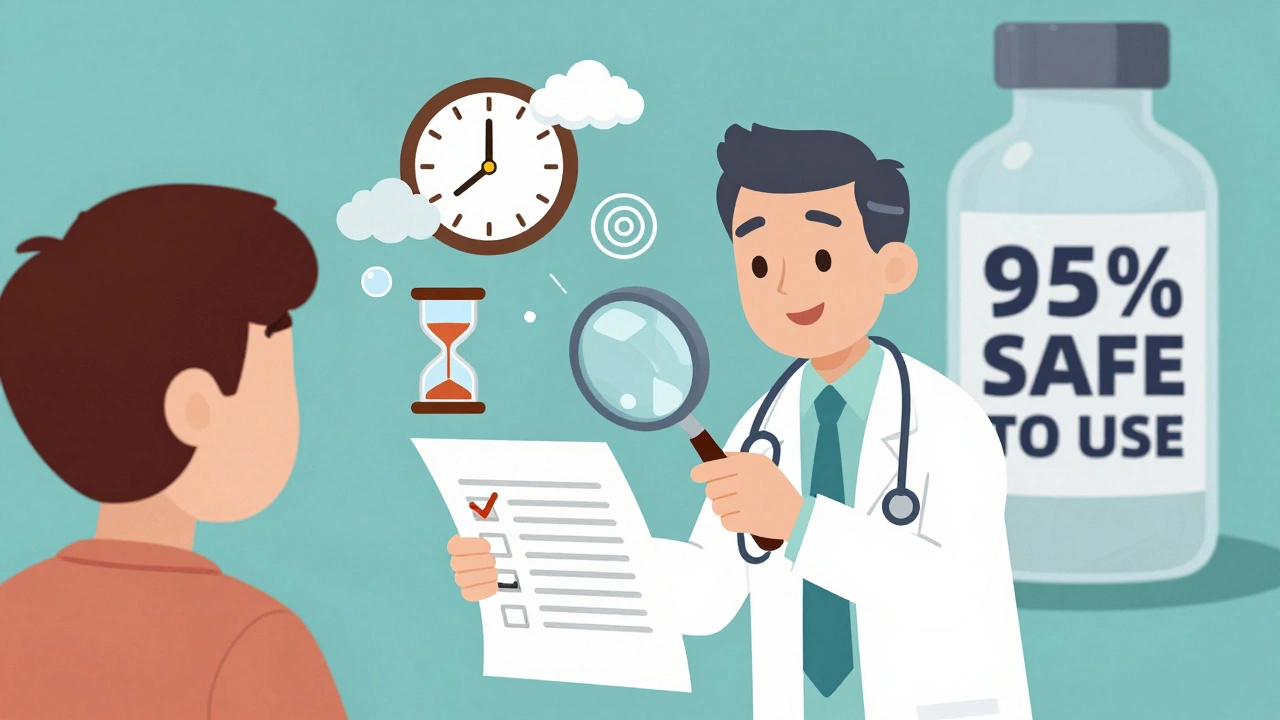
What Happens When You Get It Wrong?
Mislabeling a side effect as an allergy has real consequences. Take penicillin. It’s one of the safest, cheapest, and most effective antibiotics out there. But because so many people think they’re allergic to it, doctors often prescribe broader-spectrum alternatives like vancomycin or fluoroquinolones. These drugs are more expensive, harder on your gut, and more likely to cause antibiotic-resistant infections like C. diff. A 2022 study in JAMA Network Open found that patients wrongly labeled as penicillin-allergic had a 69% higher chance of getting a C. diff infection and stayed in the hospital 30% longer. The CDC estimates this mislabeling adds $1.1 billion to U.S. healthcare costs every year. And it’s not just penicillin. People avoid sulfa drugs, NSAIDs, even anesthesia because they once felt sick after taking them. But if that sickness was just nausea or a headache, they’re missing out on safe, effective treatments.How Do Doctors Confirm an Allergy?
There’s no blood test you can buy online that will tell you if you’re allergic. Diagnosis requires a trained specialist and specific tools. For immediate reactions (like hives or anaphylaxis), skin testing is the gold standard. A tiny amount of the drug is placed under your skin. If you’re allergic, you’ll get a raised, red bump within 15 to 20 minutes. For penicillin, this test is 95% accurate. If the reaction was delayed (like a rash that showed up two weeks later), doctors might use patch testing or lymphocyte transformation tests. These look for T-cell activity, which is harder to detect but just as important. In some cases, a supervised drug challenge is the only way to know for sure. You’re given a small, controlled dose of the drug under medical supervision. If nothing happens, you’re cleared. If you react, you know for certain-and you can stop worrying about avoiding it unnecessarily.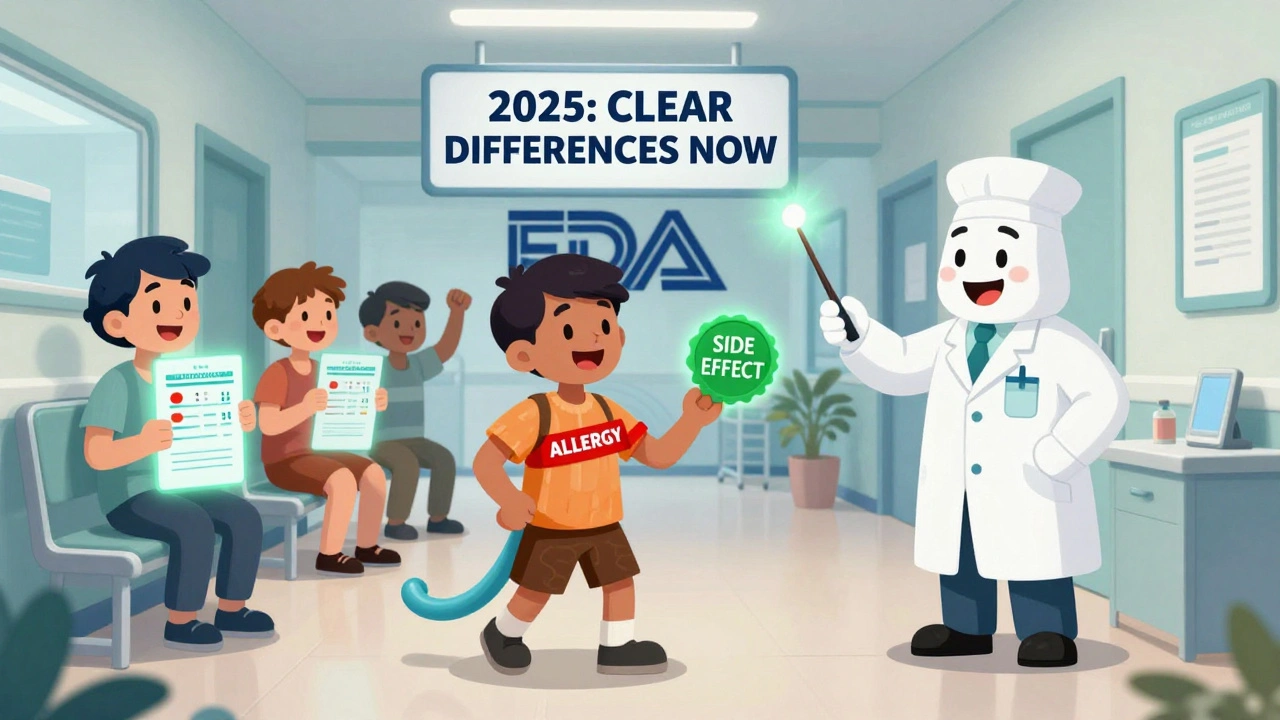
What You Should Do
If you think you have a drug allergy, here’s what to do:- Write down exactly what happened: symptoms, timing, how many doses you’d taken, and whether it happened again.
- Don’t assume it’s an allergy just because you felt sick. Nausea, fatigue, and headaches are almost never allergic.
- Ask your doctor if you should see an allergist. Many primary care providers aren’t trained to distinguish these reactions.
- If you’ve been told you’re allergic to penicillin, ask about getting tested. It’s quick, safe, and could open up better treatment options.
- Update your medical records. If you’ve been mislabeled, get it corrected. Your future doctors need accurate info.
What’s Changing in 2025
The medical world is waking up to this problem. The FDA now requires drug labels to clearly separate side effects from true allergies. Electronic health records must store allergy data in structured fields so systems don’t automatically block medications based on vague reports. Hospitals are hiring pharmacists specifically to review allergy histories. Mayo Clinic’s program has successfully de-labeled 92% of low-risk patients. Epic Systems and other EHR platforms now include decision-support tools that flag potential mislabeling. And in April 2024, new guidelines will officially define three terms:- Allergy = immune-mediated reaction
- Intolerance = non-immune adverse reaction (like stomach upset)
- Side effect = expected, dose-related effect
Bottom Line
You’re not allergic just because a drug made you feel bad. Allergies mean your immune system is involved-and they’re rare. Most reactions are side effects, and they’re manageable. Don’t let fear keep you from safe, effective medicines. If you’re unsure, get it checked. One appointment could change your healthcare for life.Can a side effect turn into an allergy?
No, a side effect cannot turn into an allergy. Side effects are caused by the drug’s chemical action on your body, not your immune system. An allergy develops when your immune system mistakenly identifies the drug as a threat. You can’t “grow into” an allergy from a side effect-but you can develop a true allergy after repeated exposure, even if you never had a reaction before.
Is it safe to take a drug I was once allergic to?
It depends. If you had a true IgE-mediated reaction-like hives, swelling, or trouble breathing-you should avoid the drug until tested. But many people are mislabeled. Skin tests or supervised challenges can safely determine if you still react. Studies show that over 90% of people who think they’re allergic to penicillin can take it safely after evaluation.
What if I only had nausea with a drug? Is that an allergy?
No. Nausea, vomiting, diarrhea, or upset stomach are almost always side effects, not allergies. These happen because the drug affects your digestive system directly. True allergies rarely cause nausea alone-they come with skin, breathing, or circulation symptoms. Labeling nausea as an allergy is common but incorrect, and it can limit your treatment options unnecessarily.
Can I outgrow a drug allergy?
Yes, especially with penicillin. Studies show that 80% of people who had a penicillin allergy as a child lose their sensitivity after 10 years. The immune system can forget the false alarm. That’s why retesting is so important-even if you were told you’re allergic decades ago, you may be able to take the drug safely now.
Should I carry an epinephrine auto-injector if I think I’m allergic?
Only if you’ve had a confirmed anaphylactic reaction or have been advised to by an allergist. Carrying one unnecessarily can cause anxiety and false confidence. If your reaction was just a rash or nausea, you don’t need it. But if you’ve ever had trouble breathing, throat swelling, or a sudden drop in blood pressure after a drug, you should have one-and see an allergist right away.
pallavi khushwani
December 7, 2025 AT 09:20Man, I used to think my nausea from amoxicillin was an allergy-turns out it was just my gut being dramatic. Learned this the hard way after getting a C. diff infection from some fancy antibiotic they gave me instead. Glad someone finally broke this down without jargon.
Kay Jolie
December 7, 2025 AT 20:29Let’s be real-this is a paradigm shift in pharmacovigilance. The conflation of pharmacological intolerance with immunoglobulin E-mediated hypersensitivity is not merely a diagnostic oversight-it’s a systemic failure in patient-centered care. We’re talking about iatrogenic harm cascading through polypharmacy landscapes due to poorly structured EHR ontologies. The FDA’s 2025 taxonomy update? Long overdue. We need standardized immunophenotyping protocols, stat.
Dan Cole
December 8, 2025 AT 17:44Oh wow. So the entire medical establishment has been lying to you for decades? No, wait-they’re just incompetent. You think a headache from a beta-blocker is an allergy? Congrats, you’re a walking case study in medical illiteracy. The fact that 90% of people who say they’re allergic to penicillin aren’t? That’s not a coincidence. It’s negligence. And now they’re making it worse by adding more bureaucratic labels instead of fixing the root problem: doctors who don’t know basic immunology.
Billy Schimmel
December 9, 2025 AT 19:15So... if I got sick after a pill, I shouldn’t panic? Huh. That’s actually kind of a relief. I’ve been avoiding penicillin since I was 8 because I threw up once. Guess I’ll ask my doc about getting tested. Thanks for not making me feel dumb.
Shayne Smith
December 10, 2025 AT 02:13Wait so I’ve been lying to my doctors for 15 years about being allergic to ibuprofen? I just get headaches and thought it was ‘allergic’. LMAO. I’m gonna go update my chart right now. Also, who wrote this? This is the most useful thing I’ve read all year.
Katie O'Connell
December 11, 2025 AT 13:34It is incumbent upon the medical community to adopt a more rigorous, evidence-based nomenclature in the domain of adverse drug reactions. The conflation of pharmacodynamic side effects with immunologic hypersensitivity represents a critical epistemological flaw in contemporary clinical practice. One must question the ontological integrity of patient-reported allergy histories when they are not corroborated by objective immunological data.
Clare Fox
December 12, 2025 AT 11:24i read this whole thing and i’m just sitting here wondering how many people are missing out on good meds bc they thought ‘i felt weird after that one pill’ = allergy. i mean… i once got dizzy after a zpack and swore i was allergic. turned out i was dehydrated and had a migraine. we’re all just guessing half the time. but now i’m gonna ask my doc about testing. thanks for the nudge.
Akash Takyar
December 13, 2025 AT 05:33Dear reader, I commend your willingness to seek clarity in matters of health. It is imperative that we, as individuals, engage proactively with our healthcare providers to distinguish between pharmacological intolerance and true immunological response. I encourage you to schedule a consultation with a certified allergist-this is not merely a precaution, but a responsibility to your future well-being.
Arjun Deva
December 14, 2025 AT 15:42Of course the FDA is ‘updating’ labels-because they’re in bed with Big Pharma. They want you to keep taking drugs you’re ‘allergic’ to so they can sell you more expensive ones later. They’re lying about the 90% stat. My cousin died after they forced her to take penicillin ‘because she wasn’t really allergic.’ You think this is science? It’s profit-driven manipulation.
Inna Borovik
December 15, 2025 AT 01:49Let’s not romanticize this. You think people are ‘mislabeling’ allergies? No-they’re protecting themselves. Doctors misdiagnose all the time. I had a rash after amoxicillin and was told ‘it’s fine’-then I got Stevens-Johnson. So no, I don’t trust your ‘95% accurate’ skin test. I trust my body. And your ‘safe’ alternatives? They’re just chemical cocktails with worse side effects. You’re not helping. You’re gaslighting.
Jackie Petersen
December 16, 2025 AT 21:14Why are we letting the government tell us what’s ‘really’ an allergy? I’m American. I know my body better than some FDA algorithm. If I say I’m allergic, I’m allergic. Stop trying to erase my trauma with your ‘scientific’ labels. This is cultural erasure disguised as medicine.
Annie Gardiner
December 18, 2025 AT 07:41Wait-so the real problem isn’t drug allergies… it’s that people are too dumb to know the difference? That’s rich. I’ve got a friend who got hives from penicillin and nearly died. Now you’re saying he’s probably just ‘mislabeling’? Nah. You’re just trying to make people feel guilty for being cautious. I’ll take my ‘unscientific’ fear over your ‘evidence-based’ arrogance any day.
Rashmi Gupta
December 19, 2025 AT 09:46Interesting. But have you considered that maybe the immune system is smarter than we give it credit for? Maybe the ‘side effect’ is actually a subtle signal the body is trying to send? We’re reducing complex biological responses to checkboxes. That’s not science-it’s reductionism.