 Jan, 13 2026
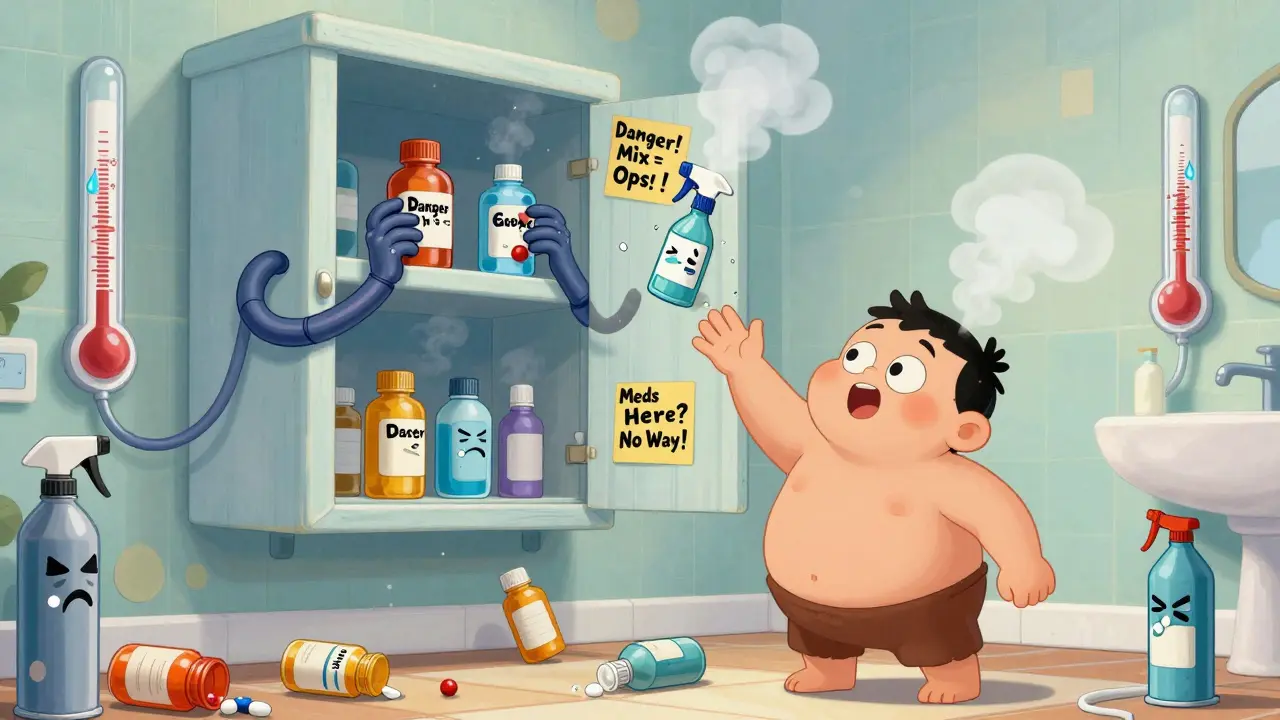
Every year, 60,000 children in the U.S. end up in emergency rooms because they accidentally swallowed medicine - and in most cases, it wasn’t because they were sneaky. It was because the medicine was stored right next to the cleaning spray, the bleach bottle, or the drain cleaner. This isn’t a rare mistake. It’s a common, preventable one. The truth is, your bathroom cabinet isn’t safe for both your pills and your cleaners. Storing them together puts your family at risk - not just from accidental poisoning, but from damaged medicine, dangerous reactions, and even explosions.
Why Mixing Medications and Chemicals Is Dangerous
Medications aren’t just pills. They’re delicate chemical compounds. Heat, moisture, and fumes from household cleaners can break them down. A 2022 study from New York University found that medicines stored within two feet of cleaning products degraded 37% faster. That means your painkiller might not work. Your insulin might lose potency. Your asthma inhaler might fail when you need it most.
And it’s not just about medicine failing. Household chemicals can react dangerously if they come into contact with medication residues. Bleach and ammonia - common in bathroom cleaners - can create toxic gases if spilled near certain medications. Even small amounts of residue on a bottle cap can trigger a reaction if mixed with another chemical later. The American Association of Poison Control Centers recorded over 45,000 cases in 2022 of accidental exposure where chemicals and medicines were stored too close.
Children aren’t the only risk. Older adults with memory issues might grab the wrong bottle. A bottle labeled “Eye Drops” might look like a bottle of contact lens solution - until you open it and smell the sharp chemical odor. That’s why clear labeling and physical separation aren’t just good ideas. They’re lifesavers.
Where Not to Store Medications
Let’s clear up some myths. The bathroom? No. The kitchen counter? No. The fridge door? No. The car glovebox? Absolutely not.
The bathroom is the most common mistake. It’s humid. It’s hot from showers. And it’s where most households keep cleaning supplies. The InfantRisk Center says medications need a dry, cool space - between 58°F and 86°F. A bathroom often hits 90°F after a hot shower. That’s enough to ruin tablets, capsules, and liquids.
The fridge door? It’s the worst place for meds that need refrigeration. Temperature swings there can hit 10°F or more in a single day. Pharmaceutical manufacturers say even a 2°F change can affect stability. That’s why the FDA and Seattle Children’s Hospital both say: if you’re storing liquid meds in the fridge, put them in the back - not the door - and keep them in a sealed, labeled container away from food.
And never store meds in kitchen drawers. That’s where you keep sprays, sponges, and dish soap. A 2022 Consumer Reports survey found 38% of households kept pills in kitchen drawers - right next to chemicals. That’s a recipe for disaster.
Where to Store Medications
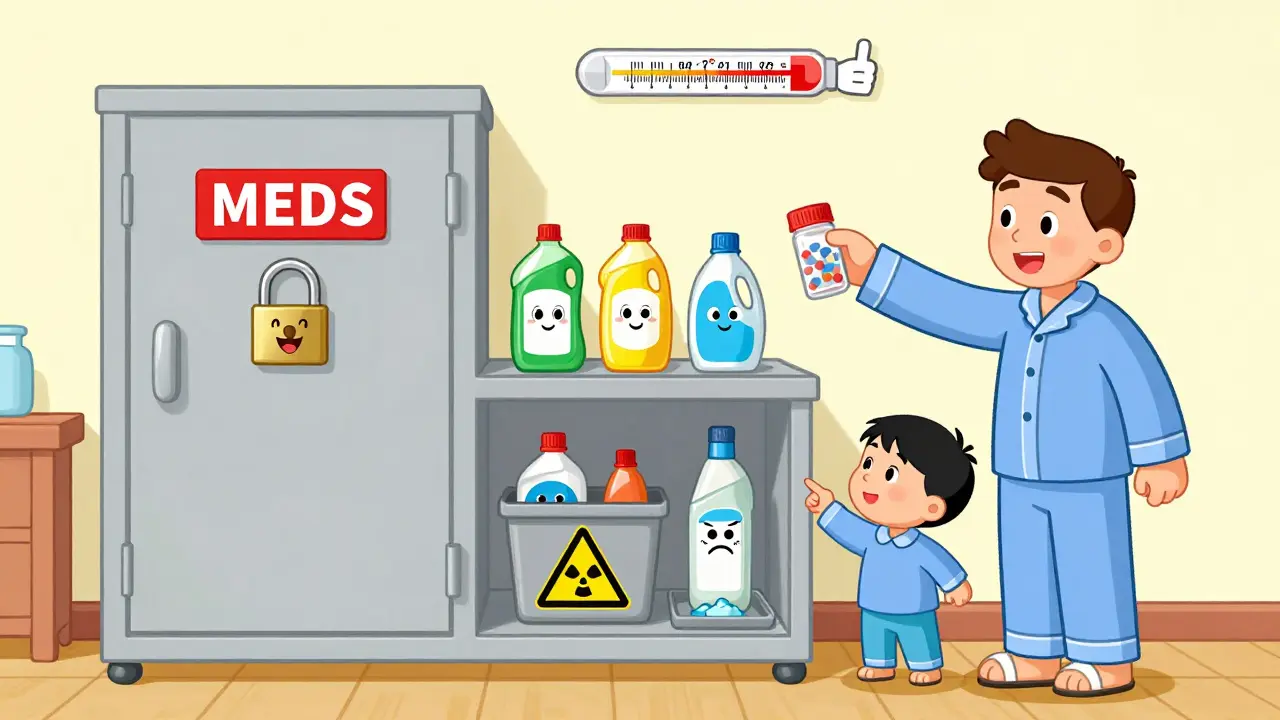
The best place for medications is a locked cabinet - high up, dry, and away from heat. The CDC recommends storing all medicines at or above 48 inches from the floor. That’s out of reach for most toddlers. But it’s not enough to just put them up high. They need to be locked.
Studies show that homes using lockable medication boxes - like the MedLock Pro 3000 - saw an 89% drop in accidental poisonings. A simple key-lock box works too. You don’t need fancy tech. You just need a barrier. And it should be separate from everything else.
For refrigerated medications - insulin, some antibiotics, eye drops - use a small, labeled plastic bin inside the fridge. Put it on the middle shelf, away from milk, eggs, and leftovers. Never store meds in the same container as food. The FDA is clear: no cross-contamination.
Where to Store Household Chemicals
Household chemicals need their own space - and it’s not the same as your meds. Most cleaners, paints, pesticides, and solvents are flammable, corrosive, or toxic. They need ventilation, low storage, and secondary containment.
According to USC EHS and Wisconsin EHS guidelines, corrosive chemicals - like drain cleaners and oven sprays - must be stored below eye level, no higher than 54 inches. That’s because spills are less likely to hit your eyes. But here’s the catch: meds need to be stored above 48 inches. So you’ve got a 6-inch gap where neither can go safely. That’s why separate cabinets are non-negotiable.
Store chemicals on the bottom shelf of a well-ventilated closet - preferably in a garage, laundry room, or utility room. Use spill-proof trays underneath bottles. Label everything clearly. Never store flammables near heat sources. And never, ever store them in a locked cabinet without ventilation. That’s a fire hazard.
How to Create a Safe Storage System
You don’t need a fancy setup. You just need three zones:
- Medication Zone: Locked cabinet at 60 inches or higher. Keep it dry, cool, and away from windows. Use original containers with labels. Add a color-coded label - red for meds.
- Non-Hazardous Cleaners Zone: Lower cabinet at 48-54 inches. Think dish soap, glass cleaner, laundry detergent. Still keep it out of reach of kids, but no need for a lock.
- Hazardous Chemicals Zone: Floor-level cabinet or bin with secondary containment. Store bleach, ammonia, pesticides, paint thinners here. Use trays to catch spills. Label with hazard symbols.
Use clear bins to organize. One bin for pills, one for liquids, one for inhalers. Color-code them: blue for meds, yellow for cleaners, red for hazards. A 2023 InfantRisk Center study found this cut confusion by 62%.
Keep a thermometer in your medication cabinet. If it’s above 86°F or below 58°F, move it. If you’re using a smart system like the SafeMed Home System, it’ll alert you automatically. These systems reduced degradation by 53% in a 2023 CPSC trial.
What to Do If You Can’t Separate Them
Some homes are small. One bathroom. One cabinet. No closet. You’re not alone. But you still need to separate.
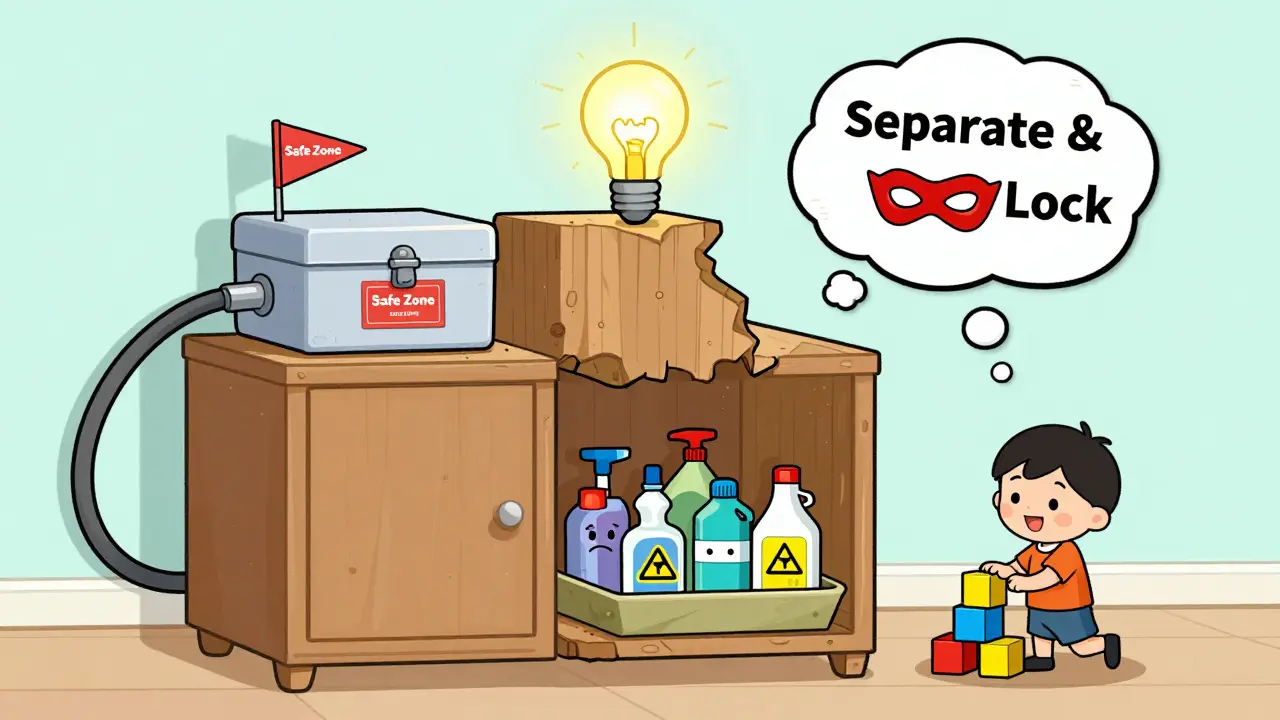
If you have no choice but to share a space, use a lockable, ventilated box for meds - and put it on the top shelf. Keep chemicals below. Use a plastic divider or a tall box to create a physical barrier. Never let them touch. Never store chemicals on the same shelf as meds.
And if you’re tempted to store meds in the fridge because it’s cool - don’t. Unless they’re specifically labeled to be refrigerated. Even then, keep them away from food. The risk of contamination is too high.
Label Everything - Even the Empty Bottles
Empty bottles are dangerous. If you pour bleach into a water bottle, someone might drink it. If you put pills in a candy jar, a child might think it’s a treat. Always keep medications in their original containers. The label has the name, dosage, expiration date, and warnings.
For chemicals, use permanent markers to label everything. Even if it came in a plain bottle. Write the name, hazard symbol, and date bought. And never reuse a food container for chemicals. Ever.
The CDC says households that kept meds in original containers reduced confusion by 67%. That’s not a small number. That’s the difference between a trip to the ER and a safe day at home.
What’s Next? Smart Storage and Future Safety
Technology is catching up. The American Society of Health-System Pharmacists now recommends an 8-foot minimum distance between meds and chemicals - a standard once used only in hospitals. Now it’s being adopted in homes.
Some companies are testing RFID-tagged containers that beep if a chemical is brought within three feet of a medication. Early tests by NIST showed 98% accuracy. These won’t be in every home yet - but they’re coming.
In the meantime, the simplest solution works best: separate, lock, label, and monitor. That’s the three-step plan backed by the EPA, CDC, NIOSH, and poison control centers across the country.
You don’t need to spend hundreds of dollars. You don’t need to rebuild your kitchen. You just need to move the pills out of the bathroom and into a locked box on a high shelf. And put the bleach where kids can’t reach - and where it won’t ruin your medicine.
Frequently Asked Questions
Can I store medications in the same cabinet as vitamins and supplements?
Yes - vitamins and supplements are considered part of your medication storage. They’re not hazardous chemicals, so they can share space with prescription and over-the-counter medicines. But they still need to be in a locked, cool, dry cabinet. Don’t mix them with cleaning products, even if they’re in pill form.
Is it safe to store medications in the garage?
Only if the garage is temperature-controlled. Most garages get hotter than 100°F in summer and colder than 32°F in winter. That’s outside the safe range for most medications (58°F-86°F). If your garage isn’t climate-controlled, don’t store meds there. Use an interior closet instead.
What should I do with expired or unused medications?
Never flush them or throw them in the trash without mixing them with something unappealing. The best option is a drug take-back program. Many pharmacies, hospitals, and police stations offer free disposal bins. If none are available, mix pills with coffee grounds or cat litter in a sealed bag before tossing. This prevents accidental ingestion and keeps them out of water systems.
Can I use a medicine organizer (pill box) for long-term storage?
No. Pill boxes are for daily use only. They don’t protect against moisture, heat, or light. Always keep your main supply in the original bottle inside your locked cabinet. Only transfer pills to a pill box for the week or day you need them. Never store extra doses in a plastic organizer long-term.
What if my child knows where the medicine is kept?
If your child knows the location, the lock is even more important. Kids are curious, and they learn quickly. A locked cabinet is the only reliable barrier. Teach them that medicine isn’t candy - but don’t rely on teaching alone. Physical safety comes first. Even if they understand, they might still reach for it.
Gregory Parschauer
January 15, 2026 AT 02:51This is the kind of negligence that gets kids killed. You think your bathroom cabinet is fine? Newsflash: it’s not. You’re not a responsible adult if you’re storing bleach next to insulin. The CDC isn’t suggesting this - they’re screaming it from the rooftops. And yet people still treat medicine like it’s a snack jar. I’ve seen it. My cousin’s kid ended up in ICU because Mom thought ‘it’s just a pill, how bad could it be?’ Bad. It’s so bad. Lock it. Separate it. Or stop pretending you care about your family.
Acacia Hendrix
January 15, 2026 AT 12:54It’s fascinating how the epistemological framework of domestic pharmacology remains unchallenged in mainstream discourse. The ontological conflation of pharmaceuticals and household toxins reflects a deeper cultural failure in risk cognition. One must interrogate the hegemony of the ‘bathroom cabinet’ as a default storage paradigm - a colonial relic of pre-scientific domesticity. The solution isn’t merely spatial segregation, but a radical re-ontologization of medicinal objects as biohazardous entities requiring protocol-compliant containment. The MedLock Pro 3000 isn’t a product - it’s a philosophical intervention.
Adam Vella
January 16, 2026 AT 10:04While the article presents a reasonable set of guidelines, it fails to address the underlying systemic issue: the lack of standardized labeling regulations for over-the-counter pharmaceuticals and household chemicals. In a properly regulated society, all containers would be required to carry ISO 7010-compliant hazard symbols and material safety data sheet (MSDS) QR codes. The burden of safety should not fall on the individual homeowner - it should be mandated at the federal level by the FDA and CPSC. Until then, we’re just rearranging deck chairs on the Titanic.
Nelly Oruko
January 18, 2026 AT 07:39so i’ve been doing this wrong for years 😅 but honestly? i never realized how dangerous it was until i read this. i keep my insulin in the fridge door and my cleaner under the sink. i’m moving both today. thank you for the clarity. i feel like a better mom already.
vishnu priyanka
January 18, 2026 AT 20:16in india, we just put everything in one cupboard and pray. but honestly, i love how detailed this is. my aunty keeps her diabetes meds next to the mosquito spray - she says ‘both are small bottles, same shelf’. i just shook my head and bought her a lockbox for her birthday. she called it ‘the medicine fortress’. now she’s proud of it. culture changes slow, but little boxes help.
Diana Campos Ortiz
January 20, 2026 AT 19:31thank you for writing this. i’m not great at organizing, but i’ve started using color-coded bins - blue for meds, red for cleaners. it’s so simple, but it’s made me feel safer. i’m not trying to be perfect, just more careful. small steps matter.
Jesse Ibarra
January 21, 2026 AT 07:48YOU’RE ALL STILL DOING IT WRONG. LOCKED CABINET? AT 60 INCHES? THAT’S NOT ENOUGH. YOU NEED A SAFETY-LOCKED, VENTILATED, TEMPERATURE-MONITORED, RFID-ENHANCED, CHILD-PROOFED, HAZARD-SIGNAGE-APPLIED, FDA-COMPLIANT, SMART-APP-CONNECTED MEDICINE VAULT. IF YOU’RE NOT USING THE SAFE MED HOME SYSTEM, YOU’RE A LIVING HAZARD. STOP BEING LAZY. YOUR KID COULD DIE TOMORROW BECAUSE YOU WERE TOO WEAK TO SPEND $80.
laura Drever
January 22, 2026 AT 14:30lol the bathroom thing is a myth. i’ve had meds and bleach in the same cabinet for 12 years. never had an issue. also who has time to color code? just keep em away from toddlers. done.
Randall Little
January 24, 2026 AT 13:06So the CDC says meds need to be stored above 48 inches… but chemicals need to be below 54? That’s a 6-inch gap where nothing can go. So… we’re supposed to build a floating shelf? Or just hope the gods of household safety smile upon us? This is less a guide and more a cruel joke written by someone who’s never lived in a studio apartment.
Trevor Whipple
January 24, 2026 AT 21:28bruh i just keep my tylenol next to the bleach and call it a day. if my kid grabs the wrong bottle, then maybe they’re not meant to survive. also, my cabinet’s got like 30 bottles in it. i ain’t color coding. i got better things to do.
Lethabo Phalafala
January 25, 2026 AT 17:02I cried reading this. Not because I didn’t know - but because I knew, and I didn’t act. My mom had dementia. She once grabbed the drain cleaner thinking it was her eye drops. She didn’t drink it - but she held it for ten minutes, sobbing, saying ‘why won’t this help me?’ I never told anyone. I just moved everything that night. I bought the lockbox. I labeled everything in big letters. I sleep better now. If you’re reading this and you’re still keeping meds and cleaners together… please. Just move them. For the ones who can’t speak for themselves.