 Jan, 16 2026
Running out of medication on a road trip or halfway through a cruise isn’t just inconvenient-it can be dangerous. Whether you’re managing diabetes, high blood pressure, anxiety, or even a simple daily pill, the stakes are real. Medications aren’t just items in your suitcase; they’re lifelines. And if you pack them wrong, you could face delays, confiscation, or worse-missing doses that throw your health off track.
Why Your Medication Packing Matters More Than You Think
Most people assume if they have a prescription, they’re good to go. But that’s not true. Countries have different rules. Airlines have strict policies. Even state lines can trip you up. In 2023, the RV Industry Association reported a 15% medication confiscation rate during cross-state road trips-often because pills were in unlabeled containers. On cruises, 90% of medication issues reported by travel nurses came from passengers transferring pills out of original bottles. That’s not just bad luck-it’s preventable. The U.S. Transportation Security Administration (TSA) allows unlimited prescription meds in carry-on bags, but international travel changes everything. The U.S. Customs and Border Protection requires your medication label to match your passport name. Royal Caribbean, Norwegian Cruise Line, and Carnival all require original pharmacy containers. Skip this step, and you might be denied boarding-or worse, stuck without your meds in a foreign port.Step 1: Start 30 Days Before You Leave
Don’t wait until the night before. Thirty days out, schedule a quick chat with your doctor. Ask three things:- Are all my meds allowed in every country I’ll visit?
- Do I need a letter explaining why I take them?
- Should I get extra refills for delays?
Step 2: Keep Everything in Original Containers
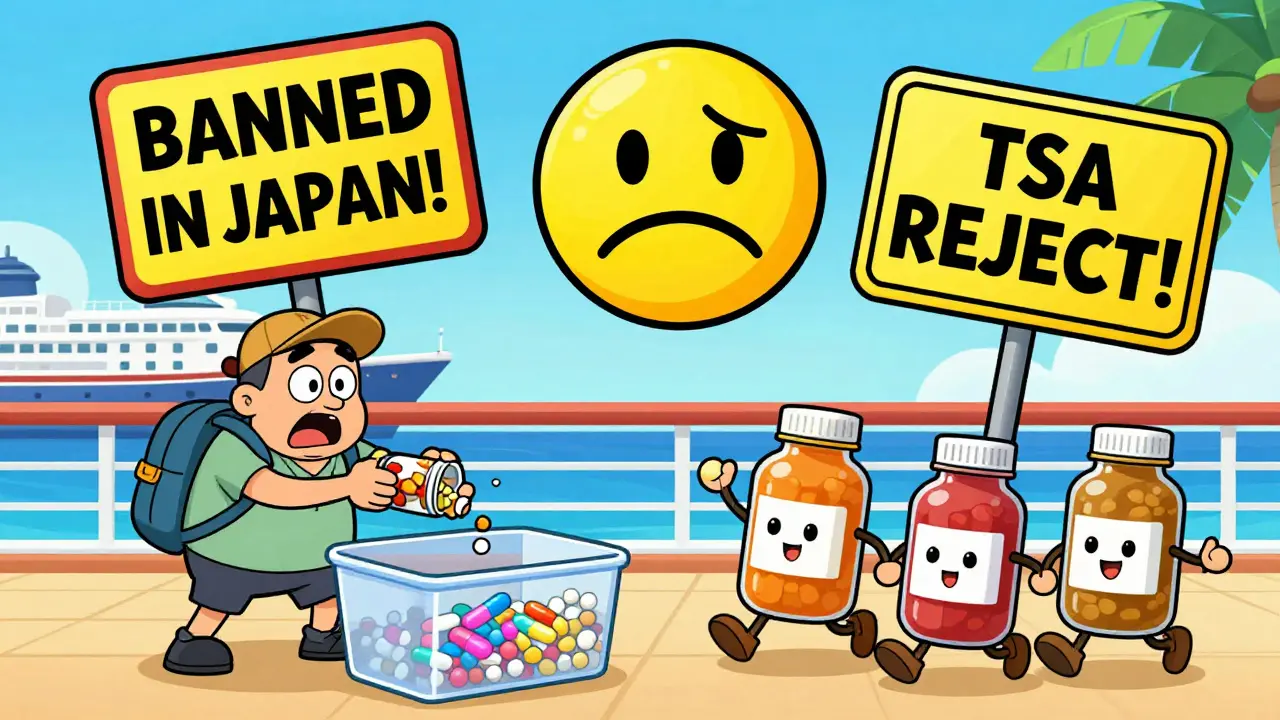
This is non-negotiable. Pharmacy bottles with your name, the drug name, dosage, and prescriber info are your best defense. Even if you hate how bulky they are, don’t dump pills into daily pill organizers unless you’re following strict labeling rules. The TSA and most cruise lines require original containers for international travel. Some countries, like Japan and the UAE, ban certain medications outright unless you have a doctor’s letter and a copy of your prescription. The CDC recommends carrying a printed list with:- Brand name
- Generic name
- Dosage
- Frequency
- Reason for use
Step 3: Pack Extra-At Least 3 Days Worth
Flights get delayed. Cruises change ports. Road trips hit traffic jams. You need a buffer. Royal Caribbean’s 2024 policy requires guests to bring at least three extra days’ supply. Special Journeys’ travel protocol recommends two extra days for cruises and flights, one extra day for road trips. Why? Because according to OAG Aviation’s 2023 report, 23% of international flights experience delays over 3 hours. And that’s just flights. Road trips? AAA says 67% of members have had medication-related issues crossing state lines. Don’t just pack extra pills. Pack extra bottles. If one gets lost or damaged, you’ve got backups.Step 4: Use the Right Packing System
There are five approved ways to organize meds for travel:- Daily blister packs - Pre-filled by your pharmacy with one pill per day, labeled with dates.
- Unit dose boxes - Plastic trays with compartments for morning, afternoon, evening.
- Pill minders - Plastic containers with time slots. Must be taped shut and labeled with your name and times.
- Pill envelopes - Small sealed envelopes with your name, date, time, and pill count. Must be clearly marked.
- Original bottles - Still the gold standard for international travel.
Step 5: Carry-On Only. No Checked Bags.
Checked luggage gets lost. The SITA 2022 Baggage Report shows a 0.02% loss rate-small, but when it’s your insulin, your seizure meds, or your blood thinner, that tiny number becomes a crisis. The FAA and TSA both say: keep essential meds in your carry-on. Put them in a clear, quart-sized Ziploc bag-just like your liquids. This makes security checks faster. Then, slip your doctor’s letter and medication list into a waterproof document sleeve. Tape it to the inside of your carry-on or keep it in your front pocket. Cruise lines like Royal Caribbean and Norwegian require you to declare meds at check-in. If you don’t have them handy, you’ll be held up while staff try to verify everything. Don’t be the person holding up the line.Step 6: Watch Out for Controlled Substances
If you take Adderall, Xanax, oxycodone, or any other controlled substance, you’re in a different category. These are tightly regulated internationally. Norwegian Cruise Line requires you to declare controlled substances 30 days before sailing. Carnival requires a physician’s note for any medication containing codeine or Schedule II substances. Some countries, like the UAE and Singapore, treat even small amounts of these drugs as illegal. You could face jail time. Dr. Michael Thompson, former medical director for Royal Caribbean, says 65% of Caribbean destinations restrict stimulants or psychotropic meds. Always check the U.S. State Department’s travel advisories for your destination. And if you’re unsure, call the embassy.Step 7: Protect Temperature-Sensitive Meds
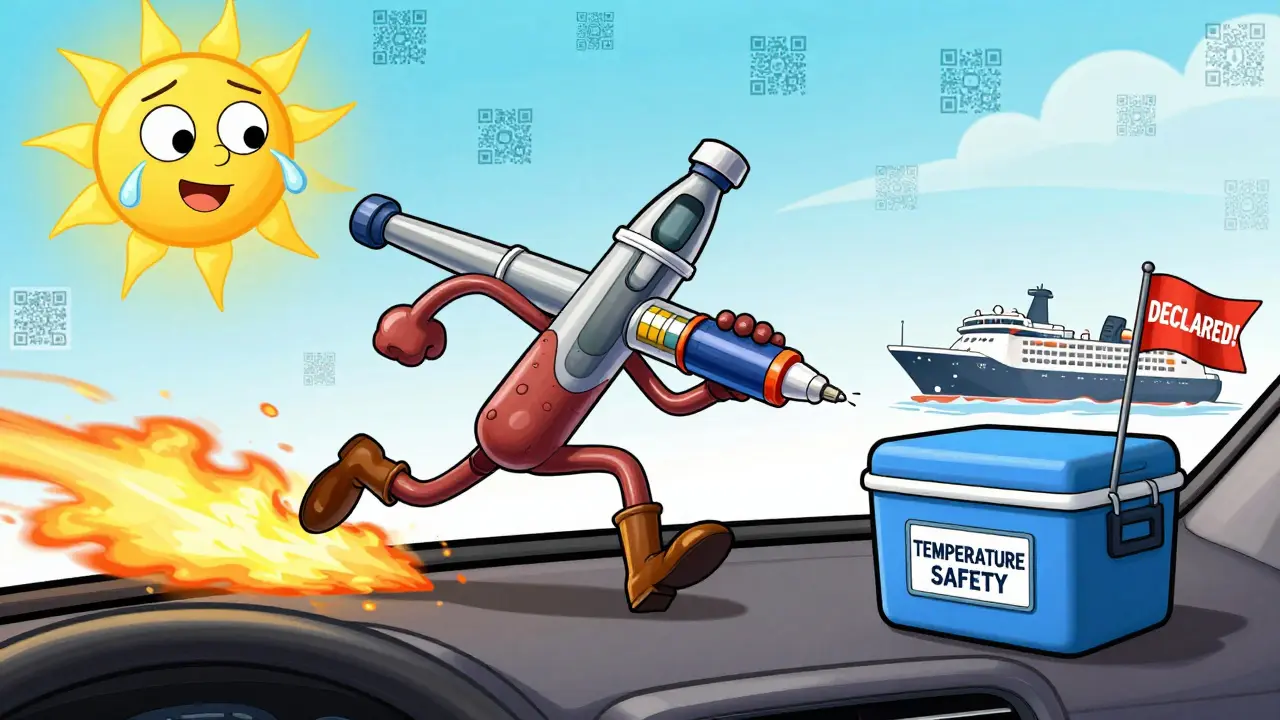
Insulin, epinephrine pens, some biologics, and certain antibiotics need to stay cool. The FDA says 41% of biologic medications degrade if exposed to heat for more than 72 hours. Use a small insulated cooler with a reusable ice pack. Some pharmacies like CVS and Walgreens now offer free travel packs with temperature-controlled cases. You can also buy compact, battery-powered medication fridges online-some hold up to 72 hours without power. Don’t leave meds in the car. On a 90-degree day, a car interior can hit 140°F in under 30 minutes. That’s enough to ruin your meds.Step 8: Digital Backup and Travel Apps
The CDC’s updated 2024 Travelers’ Health guidelines now include a standardized Medication Travel Checklist with QR codes linking to destination-specific rules. Most U.S. travel clinics use it now. Download the IATA Travel Pass app. It lets you upload digital copies of prescriptions and verify them before you fly. Royal Caribbean now requires passengers to submit their medication list electronically 72 hours before sailing-this system cuts boarding delays by 28%. Take a photo of every prescription bottle. Save it in a cloud folder labeled “Travel Meds.” If your meds get lost, you can show the photo to a local pharmacy and get a replacement faster.What Not to Do
Here are the top mistakes travelers make:- Putting meds in checked luggage
- Transferring pills to unlabeled containers
- Forgetting extra days’ supply
- Not checking destination country rules
- Leaving meds in a hot car or direct sunlight
- Assuming your insurance covers care abroad
Special Cases: Insulin, EpiPens, and Medical Devices
If you use insulin, an EpiPen, or a glucose monitor, you need extra steps:- Carry a doctor’s note explaining why you need it.
- Bring twice as many supplies as you think you’ll need.
- Keep insulin in a cooling case-even if it’s just a small insulated pouch.
- For EpiPens, bring two. Always.
- Declare them at security. They’re exempt from the 3-1-1 rule, but TSA needs to know.
What Happens If You Get Caught With the Wrong Meds?
In 2022, 23 passengers were denied boarding on a Royal Caribbean ship because their meds weren’t in original containers. In 2023, a traveler in Dubai was detained for carrying a common U.S. anxiety med that’s illegal there. In the U.S., state laws vary: medical marijuana is legal in 38 states but still illegal in 13. Crossing a border with it-even from a legal state-can lead to confiscation or arrest. Bottom line: when in doubt, leave it home-or get it approved in advance.Final Checklist Before You Go
Use this quick list to make sure you didn’t miss anything:- ✅ All meds in original bottles with labels
- ✅ 3+ extra days’ supply
- ✅ Doctor’s letter and printed medication list
- ✅ Digital copy saved on phone and cloud
- ✅ Temperature-sensitive meds in cooling case
- ✅ Controlled substances declared in advance
- ✅ Medications in carry-on, not checked bag
- ✅ Ziploc bag with meds + waterproof document sleeve
- ✅ Checked destination country restrictions
- ✅ Travel insurance that covers medical emergencies
What to Do If You Lose Your Meds
If your meds get lost, stolen, or damaged:- Go to a local pharmacy with your doctor’s letter and digital copy.
- Call your doctor for an emergency refill authorization.
- On cruises, visit the ship’s medical center-they can often provide a temporary supply.
- Use the U.S. Embassy’s emergency assistance line if you’re abroad.
Bottom Line: Be Prepared, Not Lucky
Packing meds for a trip isn’t about being organized-it’s about being safe. A little prep saves you from chaos. A few extra minutes now means no panic attacks on a highway, no emergency doctor visits on a cruise, no missed ports because you’re stuck waiting for meds. The travel health market is growing fast-$14.3 billion in 2023-and for good reason. People are realizing that smart packing isn’t optional. It’s essential. And with international rules tightening, the window for guesswork is closing. Plan ahead. Pack right. Travel with confidence.Can I put my medications in a pill organizer for travel?
Yes, but only if you keep the original bottles with you. Pill organizers are fine for daily use during your trip, but you must carry the original pharmacy-labeled containers as proof of prescription. Some countries and airlines require original packaging for customs or security checks. If you use a pill minder or daily organizer, tape it shut and label it clearly with your name, the medication name, and times to take it.
Do I need a doctor’s note for my medications?
It’s strongly recommended-especially for controlled substances, insulin, or any medication not commonly found overseas. A letter from your doctor stating your name, the medication, dosage, and medical necessity can prevent delays at customs or security. Some countries, like Japan and the UAE, require this documentation by law. Even if not required, it’s a safety net.
Can I bring my medications on a cruise?
Yes, but you must follow strict rules. All medications must be in original, labeled containers with your name matching your passport. Bring at least three extra days’ supply. Declare controlled substances 30 days before sailing. Keep everything in your carry-on-never in checked luggage. Cruise lines like Royal Caribbean and Carnival now require electronic submission of your medication list 72 hours before departure.
Are there restrictions on medications in different countries?
Yes. Many countries ban or restrict medications that are legal in the U.S., including certain painkillers, ADHD meds, and anxiety drugs. For example, codeine is controlled in many Caribbean nations, and Adderall is illegal in Japan. Check the U.S. State Department’s travel advisories or use the CDC’s Travelers’ Health website for destination-specific rules. Always verify before you go.
What if my medication needs refrigeration?
Use a small insulated cooler with a reusable ice pack. Some pharmacies offer free travel cases that maintain temperature for up to 72 hours. Never leave insulin or other temperature-sensitive meds in a hot car or direct sunlight. On cruises, you can ask the medical center to store your meds, but don’t rely on it-always carry your own cooling solution.
Can I bring over-the-counter meds like ibuprofen or allergy pills?
Yes, and you should. Even if you don’t think you’ll need them, pack basic OTC meds like pain relievers, antihistamines, and anti-diarrheal. They’re often more expensive or harder to find abroad. Keep them in original packaging, and don’t dump them into unlabeled containers. Some countries limit quantities of certain OTC drugs, so check ahead if you’re bringing large amounts.
Do I need to declare my medications at airport security?
You don’t have to declare them unless asked, but it’s smart to have them easily accessible in a clear bag. TSA allows unlimited prescription meds in carry-ons, and they’re exempt from the 3-1-1 liquid rule. If you’re carrying injectables, EpiPens, or insulin, let the officer know-they may need to inspect them separately. Being upfront avoids delays.
What should I do if I run out of meds while traveling?
First, contact your doctor for an emergency refill authorization. Then, visit a local pharmacy with your original prescription label or a printed copy. If you’re abroad, contact the nearest U.S. embassy or consulate for assistance. On cruises, the ship’s medical center can often provide a temporary supply, but they charge extra and may not have your exact brand. Always carry extra meds to avoid this situation.
Nicholas Gabriel
January 16, 2026 AT 20:44Okay, let’s get real-this guide is a lifesaver. I used to dump all my meds into a pill organizer and call it a day. Then I got pulled over crossing into Canada and they confiscated my anxiety pills because the bottle had no label. I had to call my doctor from a gas station bathroom at 2 a.m. Don’t be me. Original bottles. Always. And yes, even if they’re ugly and bulky. They’re your legal armor.
Cheryl Griffith
January 17, 2026 AT 14:30I’m a nurse who’s seen too many people panic on cruise ships because they didn’t bring extra pills. One woman missed her insulin for 18 hours because she packed it in checked luggage. It’s not just about convenience-it’s about survival. I’ve started handing out printed versions of this checklist to my patients before they travel. Seriously, do this. Your future self will thank you.
swarnima singh
January 17, 2026 AT 17:38so like… if u take adderall and go to japan u get jail? like… wtf? why do they even let u fly there then? its like they want u to fail. and then u pay for it. i mean… its just a pill. why is everyone so scared of pills? i think the system is broken. we should all just carry our meds in our hearts. 🙃
Isabella Reid
January 18, 2026 AT 08:22As someone who’s traveled to 17 countries with chronic illness, I can say this: the moment you start treating your meds like luggage, you’re already behind. I keep my insulin in a cooling pouch, my doctor’s letter in a waterproof sleeve taped to my passport, and a photo of every bottle in my cloud. It’s not overkill-it’s insurance. And yes, I’ve had to use all of it. Twice.
Jody Fahrenkrug
January 20, 2026 AT 01:16My mom used to put all her pills in a makeup bag. She lost them in Paris. Ended up in a hospital with a translator and a $400 emergency refill. I now have a ‘travel med kit’ with everything labeled, backed up, and in a Ziploc. I even put a sticky note on my suitcase: ‘DO NOT CHECK THIS.’ It’s weird, but it works.
Kasey Summerer
January 21, 2026 AT 00:05So let me get this straight… I can fly with a gun in my carry-on but I can’t carry my antidepressants in a pill organizer? 😂 TSA really said ‘we trust you with a Glock but not with your mental health’? Cool. Cool cool cool. 🙃
Rob Deneke
January 22, 2026 AT 01:32Don’t forget the extra days. I once thought I was being smart by packing exactly what I needed. Then my flight got delayed 14 hours. I had to beg a pharmacist in Chicago to refill my blood pressure med without a script. He said no. I cried. Don’t be that guy. Pack extra. Always. It’s the difference between surviving and spiraling.
brooke wright
January 22, 2026 AT 22:36Wait-so if I’m on Adderall and I go to Dubai, I go to jail? But if I go to a Walmart and buy 100 of them, I’m fine? That doesn’t make sense. Who decided this? Why do they care? What if I just… don’t tell them? I mean, they don’t check your suitcase for pills. Right? Right??
vivek kumar
January 24, 2026 AT 06:20India has strict rules on psychotropics. Many U.S. antidepressants are banned. I’ve seen friends get detained at Delhi airport for carrying sertraline in unlabeled bottles. Always check the Indian FDA’s list of prohibited substances. Also, carry a printed copy of the WHO’s international drug list-it’s your best defense. Don’t gamble with your health.
Nick Cole
January 24, 2026 AT 19:29I travel with my EpiPen, insulin, and asthma inhaler in a clear bag in my front pocket. I’ve had TSA agents thank me for being prepared. One even gave me a free snack because I was ‘the most organized person they’d seen all day.’ It’s not just about safety-it’s about respect. Do the work. It pays off.
Riya Katyal
January 25, 2026 AT 07:03oh so now i have to declare my xanax to a cruise line like im smuggling diamonds? and if i forget? they just leave me on some island with no meds? lol. sure. next they’ll make me sign a waiver saying i won’t die. this is why i hate travel. why can’t people just be chill?
Henry Ip
January 25, 2026 AT 22:58This is the most practical travel advice I’ve seen in years. I used to think I was being clever by using pill organizers. Then I got stranded in Mexico with no access to my meds. I ended up buying a $200 generic version that didn’t work. Lesson learned. I now have a laminated checklist taped to my toiletry bag. I carry it everywhere. Seriously-do this.
waneta rozwan
January 26, 2026 AT 15:35THIS IS WHY THE WORLD IS FALLING APART. People think they can just ‘wing it’ with their meds. Then they end up in a foreign hospital screaming because their blood pressure is 210/130. I’ve seen it. I’ve cried over it. This isn’t ‘travel tips’-this is a survival manual. Print it. Frame it. Tape it to your fridge. If you don’t do this, you’re not just irresponsible-you’re dangerous.
kanchan tiwari
January 27, 2026 AT 16:47they’re watching us. they know when we take our meds. that’s why they make you declare them. the government is tracking your anxiety levels through your pill bottles. i heard a guy on reddit say the CIA uses the cruise line databases to map mental health trends. i’m not paranoid. i’m PREPARED. i carry my meds in a hollowed-out book. just saying.
Bobbi-Marie Nova
January 29, 2026 AT 03:30I used to think this was overkill… until I got stuck in Puerto Rico with no insulin. I called my doctor at 3 a.m., sent a photo of my bottle, and got a refill in 4 hours. I cried. I hugged the pharmacist. I now carry 5 days’ extra, a printed list, and a photo of every bottle. It’s not OCD-it’s peace of mind. And yes, I’ve already sent this to my entire family. You’re welcome.