 Dec, 8 2025
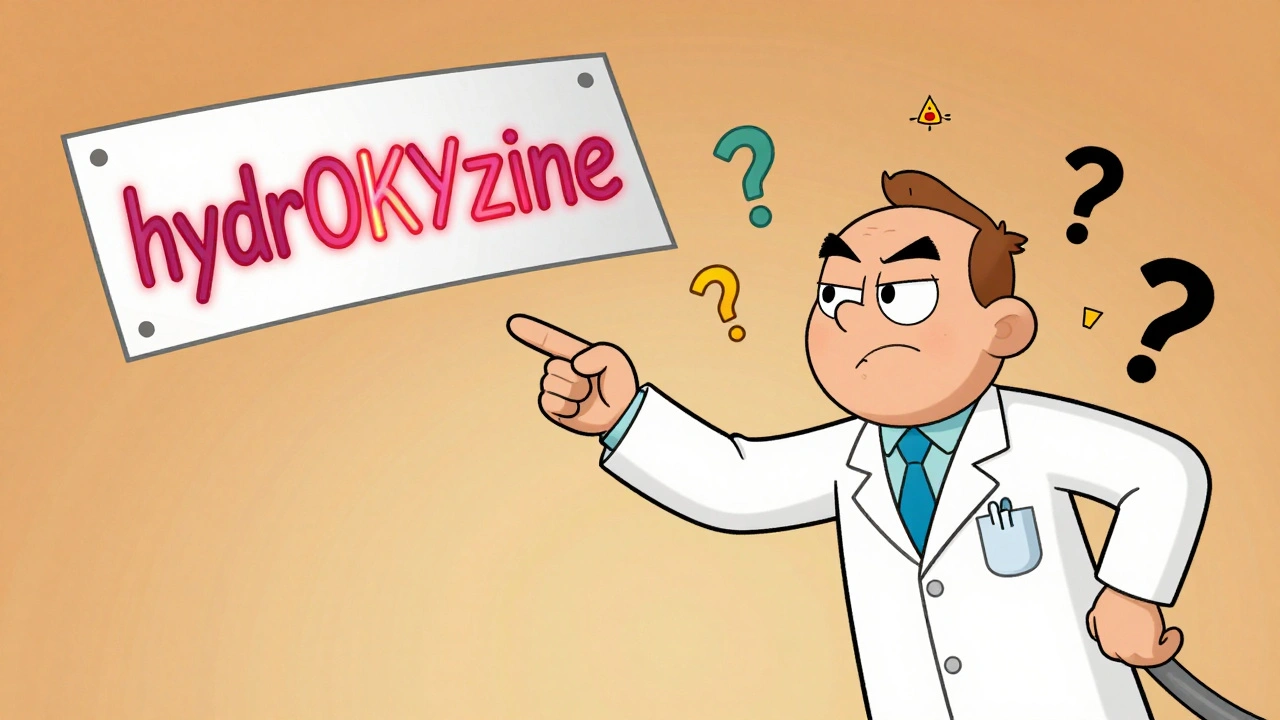
Every year, thousands of patients in the U.S. and U.K. receive the wrong medication-not because of a mistake in dosage, but because two drug names look or sound too similar. Look-alike and sound-alike (LASA) drug names are one of the most common causes of preventable medication errors. You might think pharmacists and nurses would catch these mix-ups easily. But when you’re rushing between patients, juggling dozens of prescriptions, and names like hydrOXYzine and hydrALAzine appear side by side on a screen, it’s not as simple as it sounds.
Why Do Look-Alike Names Cause So Many Errors?
It’s not about poor training. It’s about design. The human brain doesn’t process text like a computer. When two words share 60-80% of their letters, our eyes skip over the differences. Studies show that 1.7 errors happen per 1,000 prescriptions because of this. And in 34% of those cases, the wrong drug actually reaches the patient. About 7% cause real harm-like kidney failure from mixing up cisplatin and carboplatin, or sedation from confusing hydroxyzine with hydralazine.
The problem isn’t new. The FDA launched its Name Differentiation Project back in 2001 after hundreds of reports poured in. Since then, over 3,000 risky drug name pairs have been documented. And it’s not just about spelling. Sound matters too. doXEPamine and doBUTamine are easy to mishear over a noisy hospital intercom. That’s why the solution isn’t just one trick-it’s a system.
Tall Man Lettering: The Visual Lifesaver
The most widely used tool to fight LASA errors is tall man lettering. This isn’t just random capitalization. It’s a precise method where the letters that make two similar names different are capitalized to create a visual break. For example:
- vinBLAStine vs. vinCRIStine
- CISplatin vs. CARBOplatin
- hydrOXYzine vs. hydrALAzine
- doXEPamine vs. doBUTamine
The FDA officially recommends tall man lettering for 35 drug pairs as of 2025. These aren’t random picks-they’re based on years of data showing which pairs cause the most confusion. The capitalization starts from the left and includes 2-4 letters that create the clearest visual contrast. It’s not decorative. It’s engineered.
Research from 2006 found that tall man lettering reduces visual confusion by 32%. That’s huge. But here’s the catch: it only works if it’s applied everywhere. If a pharmacy label uses it but the electronic health record doesn’t, or if the automated dispenser shows one version and the nurse’s chart shows another, the system fails. One ICU nurse on Reddit said it best: “The EHR shows hydroCODONE with tall man letters, but the MAR doesn’t. I get confused switching between systems.”
What Else Works Beyond Capital Letters?
Tall man lettering helps-but it’s not enough on its own. The most effective safety systems combine multiple layers:
- Color coding: Using light blue for insulin, red for high-alert meds. When paired with tall man lettering, error reduction jumps to 47%.
- Purpose-of-treatment labels: Adding “for anxiety” next to hydroxyzine or “for high blood pressure” next to hydralazine cuts errors by another 12%. It gives context, not just letters.
- Barcode scanning: Scanning the drug and the patient’s wristband before administration stops 89% of errors. But it costs hospitals an average of $153,000 to install-so not every clinic can afford it.
- Computer alerts: Systems that flag similar names when you search. But here’s the problem: too many alerts make people ignore them. Clinicians override 49% of LASA alerts because they’re constantly bombarded.
At Johns Hopkins Hospital, they combined all of these: tall man lettering, purpose labels, barcode scans, and smart alerts. Over two years, LASA errors dropped by 67%. That’s the gold standard.

How to Spot a Look-Alike Name-Even If You’re Not a Pharmacist
You don’t need to be a medical professional to help prevent errors. If you or someone you care for is on medication, here’s what to do:
- Check the label. Look for capitalized letters in the middle of the drug name. If it says “HYDROXYZINE” all in caps, that’s wrong. Proper tall man lettering is “hydrOXYzine.”
- Compare the name to the reason you’re taking it. Is this drug supposed to treat your high blood pressure? Or your allergies? If the name doesn’t match the condition, ask.
- Ask for the generic name. Brand names like Valtrex and Valcyte sound almost identical. But their generics-valacyclovir and valganciclovir-are far more distinct. Ask your pharmacist: “Can you show me the generic name?”
- Verify the dosage form. Is it a tablet? Liquid? Patch? Some look-alike drugs come in different forms. A liquid insulin can’t be confused with a tablet, for example.
- Use the “read-back” rule. When the pharmacist hands you the prescription, read the name out loud. Then ask them to repeat it. Miscommunication drops by 52% when this simple step is used.
Handwritten prescriptions are still a major risk. In fact, 41% of LASA errors happen because a doctor’s handwriting is unclear. If you’re given a paper script, don’t assume it’s correct. Take it to the pharmacy and ask them to confirm the name.
Why Some Systems Still Fail
Even with all the tools available, errors still happen. Why? Three big reasons:
- Inconsistent implementation. One system uses tall man lettering, another doesn’t. The same drug looks different on the EHR, the pharmacy label, and the automated dispenser. That’s a recipe for confusion.
- Time pressure. Nurses and pharmacists are stretched thin. When you’re rushing, you rely on shortcuts. And shortcuts are where mistakes creep in.
- Poor printing quality. If the label is faded, smudged, or printed on low-contrast paper, tall man letters become invisible. The Joint Commission requires a 4.5:1 contrast ratio between text and background. Too many labels still don’t meet that.
A 2023 survey of 1,247 pharmacists found that 65% saw inconsistent tall man lettering across systems. And 42% said handwritten orders often skip it entirely. That’s a gap in the safety net.

What’s Changing in 2025?
The fight against LASA errors is getting smarter. In September 2023, the FDA added 12 new drug pairs to its official tall man lettering list, bringing the total to 35. By December 2024, all U.S. healthcare systems must implement these changes.
Technology is catching up too:
- AI tools like Google Health’s Med-PaLM 2 can now predict which new drug names might cause confusion with 89% accuracy.
- Smartphone apps are being tested that use camera recognition to scan vials and warn you if you’ve picked the wrong one-pilot programs at Mayo Clinic are hitting 94% accuracy.
- The National Council for Prescription Drug Programs released a new data standard in early 2023 that lets EHRs, pharmacies, and insurers share real-time LASA alerts.
The goal? Reduce LASA-related errors by 50% by 2025. The ISMP is pushing for mandatory tall man lettering on all labels and screens by 2026. And for good reason: between 2018 and 2023, the FDA blocked 17 new drug names from entering the market because their names were too similar to existing ones.
Final Check: Your Safety Checklist
Here’s a simple, no-nonsense checklist you can use every time you pick up a prescription:
- ✅ Is the drug name written with tall man letters? (e.g., hydrOXYzine, not HYDROXYZINE)
- ✅ Does the label include the reason you’re taking it? (e.g., “for anxiety”)
- ✅ Is the generic name listed? (Ask for it if it’s not)
- ✅ Is the dosage form correct? (Tablet, liquid, injection?)
- ✅ Did the pharmacist confirm the name out loud with you?
- ✅ Does the barcode on the bottle match the one on your wristband (if in a hospital)?
If even one of these is missing, ask. Don’t assume it’s fine. Your life depends on it.
What is tall man lettering and why is it used on prescription labels?
Tall man lettering is a safety technique that uses uppercase letters to highlight the differences between similar-looking drug names. For example, "hydrOXYzine" and "hydrALAzine" use capital letters to show where the names diverge. This helps prevent visual confusion, especially when names share most of their letters. It’s required by the FDA for 35 high-risk drug pairs and is used on labels, electronic systems, and automated dispensers to reduce medication errors.
How common are look-alike drug name errors?
Look-alike and sound-alike (LASA) errors account for about 25% of all reported medication errors. Research shows approximately 1.7 errors occur per 1,000 prescriptions. Of those, 34% reach the patient, and 7% cause harm. Over 3,000 risky drug name pairs have been documented by the U.S. Pharmacopeial Convention as of 2023.
Can I trust that my pharmacy uses tall man lettering?
Not always. While tall man lettering is required for FDA-recommended pairs, implementation varies across systems. A pharmacy label might use it, but the electronic health record or automated dispenser might not. Always check the label yourself. If the name looks like all caps or has no capitalization in the middle, ask the pharmacist to confirm the correct spelling.
What should I do if I think I’ve been given the wrong medication?
Don’t take it. Take the medication back to the pharmacy and ask them to double-check the name, dosage, and reason for use. Compare the label to your doctor’s prescription. If you’re in a hospital, tell your nurse immediately. Most errors are caught before harm happens-if you speak up.
Are handwritten prescriptions more dangerous for LASA errors?
Yes. Handwritten prescriptions are a major source of LASA errors, accounting for 41% of cases. Poor handwriting, unclear abbreviations, and missing tall man lettering make it easy to misread names like "doXEPamine" as "doBUTamine." Electronic prescribing systems reduce this risk significantly by standardizing how names appear.
Do brand names increase the risk of confusion?
Yes. Brand names are often designed to sound similar to make them memorable, which increases confusion. For example, Valtrex (valacyclovir) and Valcyte (valganciclovir) both start with "Val-" and are used for viral infections. Their generic names are much more distinct. Always ask for the generic name when possible, especially for high-risk drugs.
Anna Roh
December 10, 2025 AT 10:03Ugh i just got my blood pressure med and the label said HYDRALAZINE in all caps. No tall man shit. Guess im lucky i checked.
Simran Chettiar
December 12, 2025 AT 01:51It is not merely a matter of orthographic distinction or typographical preference, but rather a profound epistemological rupture in the very architecture of medical communication. The human perceptual apparatus, conditioned by centuries of linguistic homogeneity, is fundamentally ill-equipped to discern semantic variance within near-identical lexical constructs. The capitalization of certain graphemes does not merely serve as a visual cue-it is a hermeneutic intervention, a semiotic reordering that restores agency to the patient in a system that has long rendered them passive recipients of institutional negligence. We must not treat this as a technical fix, but as a moral imperative.
Nikhil Pattni
December 13, 2025 AT 23:04Bro in India we dont even have barcode scanners in most clinics 😅 but we do have this one guy who yells out the drug name real loud before handing it over. Works better than you think. Also, if the script is handwritten, i always take a pic and send it to my cousin who’s a med student. He’s the real MVP 🙌
Katherine Chan
December 15, 2025 AT 04:12This is such an important topic and honestly i wish more people knew about this. Tall man lettering is low effort high impact and if your pharmacy doesn't use it, just ask. Seriously. It takes 5 seconds. And if they don't know what you're talking about? Teach them. We can all be part of the solution 💪
Olivia Portier
December 15, 2025 AT 23:01My mum got confused between hydroxyzine and hydralazine last year and ended up in ER because she thought it was for sleep but it was for BP 😭 i cried for 3 days. Now i check every label myself and i make my whole family do the read-back thing. It’s not paranoid, it’s protection. You got this.
Maria Elisha
December 16, 2025 AT 14:15So like... why does the FDA only care about 35 pairs? There are hundreds more that sound the same. This feels like lip service.
Lauren Dare
December 18, 2025 AT 12:21Let me guess-someone at the FDA thought capitalizing letters would magically fix a broken system. Meanwhile, nurses are working 16-hour shifts with no time to double-check. This is performative safety. The real fix? Hire more staff. Not fancy font tricks.
Taya Rtichsheva
December 18, 2025 AT 15:33So i just checked my zoloft bottle and it says sertraline hcl no caps no nothing. Is that why i felt like a zombie for 3 months? 🤔
Tejas Bubane
December 19, 2025 AT 15:16Look i get it. Tall man lettering sounds smart. But most patients don't care. They just want the pill. The real problem is lazy doctors writing scripts and pharmacies rushing. This whole thing is just tech bros pretending they fixed healthcare with a font change. 🤡
Ajit Kumar Singh
December 20, 2025 AT 01:21In India we have this tradition where the pharmacist asks the patient 'Is this for diabetes?' before giving insulin. No tech needed. No capital letters. Just human connection. Why are we overcomplicating this? The solution was always in the room, not in the EHR.
Angela R. Cartes
December 20, 2025 AT 10:38OMG I just realized my thyroid med is levoTHYROmine and they only capitalize the THY-so it’s like... a subtle power move? 🙃 Like the drug company is saying ‘you better know what you’re taking’? I love it.
Darcie Streeter-Oxland
December 22, 2025 AT 09:44It is an incontrovertible fact that the application of tall man lettering, while ostensibly beneficial, constitutes a superficial palliative measure that fails to address the systemic deficiencies inherent in contemporary pharmaceutical logistics. One cannot mitigate human error through orthographic embellishment alone; the root cause lies in the commodification of healthcare and the consequent erosion of professional diligence.
Andrea Beilstein
December 23, 2025 AT 17:14What if we stopped treating drug names like puzzles and started treating them like weapons? Every time a drug name is approved without considering how it might be misread, we're not just being careless-we're weaponizing language against the vulnerable. This isn't about fonts. It's about who gets to live and who gets buried because someone thought 'close enough' was good enough.
Tiffany Sowby
December 24, 2025 AT 02:22Of course this only matters in the U.S. In other countries, they don't have 200 versions of the same drug with 17 different brand names. We made this mess. Now we get to pay for it with extra capital letters.