 Dec, 9 2025
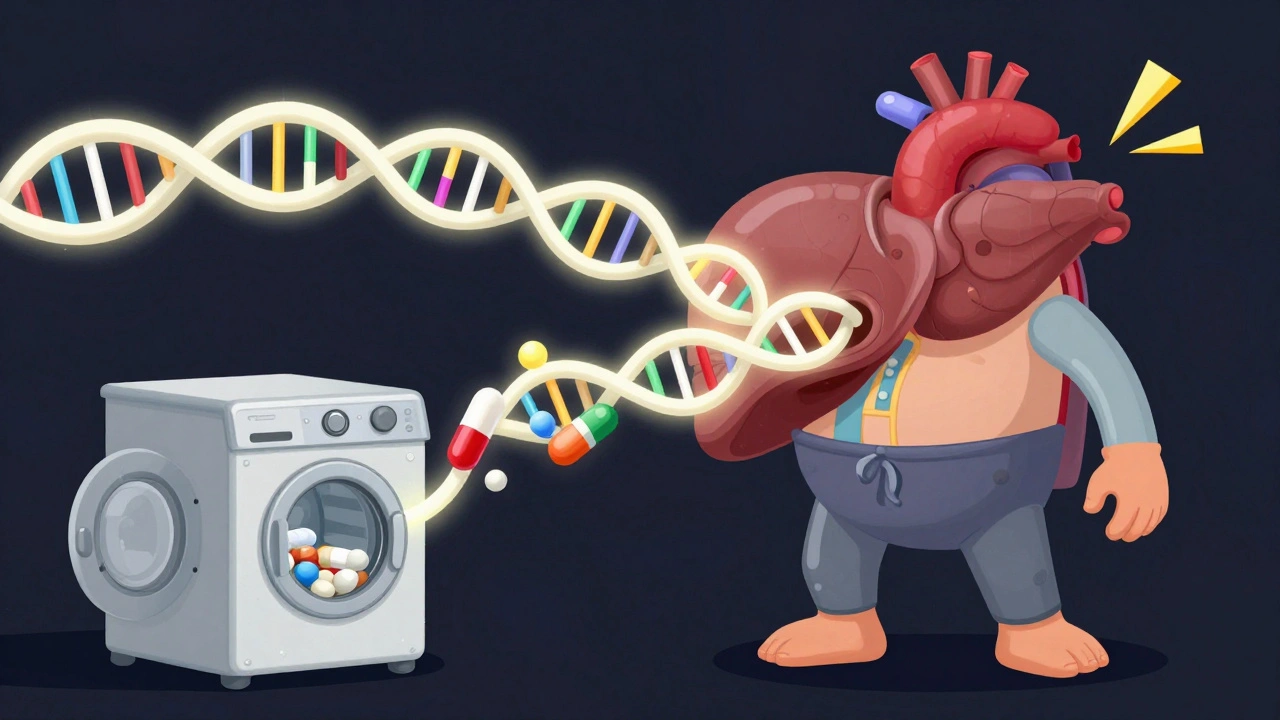
Every year, millions of people take multiple medications - some for chronic conditions, others for short-term symptoms. But what if the problem isn’t just the drugs themselves, but how your body reacts to them? That’s where pharmacogenomics comes in. It’s not science fiction. It’s real, and it’s changing how doctors predict and prevent dangerous drug interactions before they happen.
What Pharmacogenomics Actually Does
Pharmacogenomics studies how your genes affect the way you respond to drugs. It’s not about whether a drug works in general - it’s about whether it works for you. Two people can take the same pill at the same dose, but one might feel fine while the other ends up in the hospital. Why? Genetics. Your DNA holds clues about how your liver breaks down medications, how your body absorbs them, and even how sensitive your cells are to their effects. For example, the CYP2D6 gene controls how fast you process common drugs like antidepressants, painkillers, and beta-blockers. Some people have a version of this gene that makes them ultra-rapid metabolizers - they break down drugs too fast, so the medication doesn’t work. Others are poor metabolizers - the drug builds up to toxic levels. Without knowing your genetic profile, doctors are guessing. The FDA tracks over 148 gene-drug pairs with clinical significance. One of the clearest examples is TPMT and azathioprine. People with certain TPMT variants can’t process this immune-suppressing drug at all. Standard doses cause life-threatening bone marrow suppression. But if you test for the variant first, you can cut the dose by 90% and avoid disaster.How Genetic Variants Change Drug Interaction Risk
Traditional drug interaction checkers look at two drugs: “Does Drug A interfere with Drug B?” But they ignore the most important variable - you. Pharmacogenomics adds a third layer: gene-drug-drug interactions (DDGIs). There are three main ways this plays out:- Inhibitory interactions: One drug blocks the enzyme that breaks down another. For example, fluoxetine (an antidepressant) inhibits CYP2D6. If you’re already a CYP2D6 poor metabolizer, adding fluoxetine can push you into dangerous drug buildup - even if you’ve never had a problem before.
- Induction interactions: One drug speeds up enzyme activity. Rifampin, used for tuberculosis, forces your liver to break down other drugs faster. If you’re a normal metabolizer, this might reduce effectiveness. If you’re an ultra-rapid metabolizer, it could make the drug useless.
- Phenoconversion: This is the sneakiest one. A drug temporarily changes how your genes behave. Say you’re genetically a fast metabolizer of CYP2D6. But you start taking a medication that blocks that enzyme. Suddenly, your body acts like a poor metabolizer - even though your genes haven’t changed. Your drug levels spike. The interaction checker wouldn’t flag this because it doesn’t know your genotype.
A 2022 study in the American Journal of Managed Care showed that when pharmacogenomic data was added to standard drug interaction databases, the estimated risk of major interactions jumped by 30.4%. For antidepressants, antipsychotics, and pain medications, the increase was even higher. That’s not a small number. It’s the difference between a warning and a life-threatening event.
Why Traditional Drug Interaction Tools Fall Short
Most hospital systems and pharmacy software rely on databases like Lexicomp or Micromedex. These tools list tens of thousands of possible drug combinations. But they treat every patient the same. They don’t know if you’re a CYP2C19 poor metabolizer, or if you carry the HLA-B*15:02 variant that makes carbamazepine deadly for you. That’s why a 2021 NIH review called these tools “genetically blind.” They’re like a weather app that says “chance of rain” without knowing if you’re in a desert or a rainforest. You get alerts for things that don’t matter to you - and miss the ones that could kill you. The difference isn’t theoretical. At Mayo Clinic, where they’ve been testing patients preemptively since 2011, clinical decision alerts based on genetic data reduced inappropriate prescribing by 45%. That means real people avoided hospitalizations, overdoses, and organ damage.
Real-World Impact: Reduced Side Effects, Better Outcomes
The numbers speak for themselves. A 2022 meta-analysis in JAMA Network Open looked at 42 studies involving over 10,000 patients. The result? Pharmacogenomics-guided dosing cut adverse drug reactions by over 30% and improved treatment success by nearly 27% across multiple drug classes. Take warfarin, a blood thinner. Its dosing has always been a guessing game. Too much? Bleeding. Too little? Clots. But when doctors factor in CYP2C9 and VKORC1 genes - which control how warfarin is metabolized and how it works - patients spend 27% more time in the safe therapeutic range and have 31% fewer major bleeds. That’s not a minor improvement. That’s life-changing. And it’s not just for rare drugs. Over 300 drugs listed by the FDA include pharmacogenomic information in their labels. That includes common prescriptions like clopidogrel (Plavix), statins, SSRIs, and even codeine. For codeine, poor metabolizers get no pain relief. Ultra-rapid metabolizers turn it into morphine too fast - and risk fatal respiratory depression, especially in children.The Barriers: Why This Isn’t Routine Yet
If the science is this strong, why aren’t all doctors ordering genetic tests before prescribing? The answer is complexity. Only 22% of FDA-labeled gene-drug pairs have official clinical guidelines from the Clinical Pharmacogenetics Implementation Consortium (CPIC). Many doctors don’t know how to interpret the results. A 2023 survey of 1,200 pharmacists found only 28% felt confident explaining PGx reports to patients. There’s also infrastructure. Integrating genetic data into electronic health records costs an average of $1.2 million per hospital system. Reimbursement is patchy - only 19 CPT codes exist for PGx testing, and insurers often pay less than $400 per test, even though the actual cost of the test can be under $100. Worse, the data isn’t diverse. A 2023 study in Cell Genomics found that only 2% of pharmacogenomics research participants are of African ancestry. That means guidelines based on European or Asian populations may not apply to others. A variant common in one group might be rare in another - and if it’s not studied, it’s not included in the guidelines. That’s not just a gap. It’s a risk.
What’s Next: AI, Expansion, and Equity
The future is already here. The NIH’s All of Us program has returned PGx results to over 250,000 people. The FDA plans to add 24 new gene-drug pairs to its list in 2024. Companies like 23andMe now offer limited pharmacogenomic reports to millions of customers. Artificial intelligence is stepping in too. A 2023 Nature Medicine study trained an AI model using genetic data, age, weight, and lab results to predict warfarin dosing. It was 37% more accurate than standard methods. Imagine a system that doesn’t just warn you about drug interactions - it predicts them before they happen, tailored to your DNA. But progress won’t mean anything if it only helps those who can afford it. The goal isn’t just to test more people. It’s to test the right people - equitably. That means funding research in underrepresented populations, training clinicians in diverse settings, and making testing accessible in community clinics, not just academic hospitals.What You Can Do Today
You don’t need to wait for your doctor to order a test. If you’re on five or more medications - especially if you’ve had side effects or treatments that didn’t work - ask about pharmacogenomics. Bring up the CYP2D6 and CYP2C19 genes. Ask if your pharmacy or hospital has a pharmacogenomics program. Some direct-to-consumer tests (like 23andMe) include basic PGx results. You can download your raw data and use free tools like PharmGKB to interpret it. But always talk to a pharmacist or genetic counselor before making changes to your meds. The science is ready. The tools are improving. The only thing holding us back is the belief that one-size-fits-all dosing still works. It doesn’t. Your genes do. And now, we finally have the tools to listen to them.How does pharmacogenomics reduce the risk of drug interactions?
Pharmacogenomics identifies genetic variants that affect how your body processes drugs - like whether you’re a fast or slow metabolizer of certain enzymes (e.g., CYP2D6). This lets doctors avoid prescribing drugs that could build up to toxic levels or become ineffective. It also reveals hidden interactions, like phenoconversion, where a drug temporarily changes your metabolic phenotype. This reduces the chance of adverse reactions that standard drug interaction checkers miss.
Are pharmacogenomic tests covered by insurance?
Coverage is limited. Only 19 CPT codes exist for pharmacogenomic testing, and reimbursement ranges from $250 to $400 per test. Many insurers don’t cover preemptive testing, but some will pay if a test is ordered for a specific drug reaction or treatment failure. Medicare and Medicaid coverage varies by state and situation. Always check with your provider before testing.
Which drugs are most affected by pharmacogenomics?
Drugs metabolized by CYP2D6, CYP2C19, CYP2C9, and TPMT are most affected. Common examples include antidepressants (fluoxetine, sertraline), painkillers (codeine, tramadol), blood thinners (warfarin), anti-seizure meds (carbamazepine), and chemotherapy agents (azathioprine). The FDA lists over 148 gene-drug pairs with clinical relevance, and this number is growing.
Can pharmacogenomics prevent all drug interactions?
No. Pharmacogenomics primarily addresses pharmacokinetic interactions - how your body absorbs, breaks down, and eliminates drugs. It doesn’t fully predict pharmacodynamic interactions, like how two drugs might both lower blood pressure and cause it to drop too far. It also doesn’t account for non-genetic factors like kidney disease, liver damage, or drug quality. But when combined with clinical judgment, it removes a major blind spot in safety.
Is pharmacogenomics testing only for people with chronic illnesses?
No. Even healthy people on occasional medications - like painkillers or antibiotics - can benefit. For example, someone with a CYP2D6 poor metabolizer variant might have a severe reaction to codeine after surgery. Preemptive testing (done once, results stored for life) can prevent future risks, whether you’re on one drug or ten. It’s not just for chronic disease - it’s for anyone who might ever take a prescription.
Iris Carmen
December 10, 2025 AT 18:55Noah Raines
December 11, 2025 AT 15:53Katherine Rodgers
December 12, 2025 AT 07:46Lauren Dare
December 13, 2025 AT 01:12Lola Bchoudi
December 14, 2025 AT 07:44Graham Abbas
December 15, 2025 AT 06:40Haley P Law
December 15, 2025 AT 15:46Andrea DeWinter
December 16, 2025 AT 15:16Asset Finance Komrade
December 17, 2025 AT 06:08Stacy Tolbert
December 17, 2025 AT 23:06Rich Paul
December 18, 2025 AT 02:55Delaine Kiara
December 19, 2025 AT 07:45