 Nov, 29 2025

More than half of people with chronic illnesses don’t take their medications as directed. Not because they’re careless, but because it’s complicated. They forget. The pills cost too much. They don’t understand why they need them. Or they’re overwhelmed by five different bottles on the counter. And when they skip doses, their blood pressure spikes, their blood sugar goes wild, or their heart condition worsens. The result? More hospital visits, more emergency care, and more deaths-all preventable.
Pharmacists Are the Most Accessible Health Experts You’re Already Seeing
Most people see their doctor once or twice a year. But they walk into a pharmacy every few weeks-sometimes every week. That’s why pharmacists are uniquely positioned to catch problems early. Unlike doctors who have 15-minute appointments, pharmacists have time. They can sit down, ask questions, and actually listen.
In the U.S., community pharmacists see patients four to six times more often than physicians. That’s not just convenience-it’s a lifeline. When a patient doesn’t refill their statin for three months, the pharmacist notices. When someone picks up their diabetes meds but skips their blood pressure pills, the pharmacist sees the pattern. And when a patient says, “I can’t afford this,” the pharmacist doesn’t just nod. They find a solution.
What Pharmacists Actually Do to Improve Adherence
It’s not just handing out pills. It’s a full set of evidence-based strategies backed by data from over 120,000 patients. Here’s what works:
- Medication reconciliation: After a hospital stay, pharmacists review every single drug a patient is taking-checking for duplicates, dangerous interactions, or doses that no longer make sense. One study found this alone cut readmissions by 28% in heart failure patients.
- Personalized counseling: A 20-minute chat isn’t just about side effects. It’s about understanding the patient’s life. Are they working two jobs? Do they have memory issues? Can they read the label? One patient in a Veterans Affairs program said, “My pharmacist figured out I was skipping my blood pressure pills because I was too embarrassed to admit I couldn’t afford them.” She got help enrolling in a patient assistance program. Her blood pressure stabilized within months.
- Medication synchronization: Instead of five separate trips to the pharmacy each month, pharmacists align refill dates so all prescriptions are due on the same day. One cardiac patient reduced his pharmacy visits from five to two per month. Less hassle. Fewer missed doses.
- Follow-up calls and reminders: Automated texts are helpful. But a real person calling to ask, “How’s your medication going?” changes outcomes. Studies show these calls improve adherence by up to 12%. And they’re not just about refills-they’re about barriers. Cost? Transportation? Confusion? The pharmacist digs in.
- Screening for depression and anxiety: Mental health and medication adherence are deeply linked. A simple PHQ-2 or PHQ-9 screen during a routine visit can uncover why someone stopped taking their antidepressant. Addressing the root cause-like untreated depression-leads to better results than just nagging about pills.
Why Pharmacists Outperform Other Approaches
There are apps, wearables, and nurse-led programs. But none match the pharmacist’s blend of expertise, access, and trust.
Studies show pharmacist-led programs boost adherence by 4% to 6.3% more than usual care-for diabetes, hypertension, and high cholesterol. That might sound small, but it’s huge in real terms. Patients who stick to their meds are 30% to 45% more likely to control their blood pressure. That’s not just numbers-it’s fewer strokes, fewer heart attacks, fewer hospital beds taken up.
One 2024 study tracked over 300,000 people. Those who got pharmacist support had significantly better adherence than those who didn’t. The difference wasn’t close. It was statistically solid-P<0.0001. And the cost savings? Over $100 per person per year for diabetes. Over $120 for high blood pressure. That’s real money saved on emergency care, hospital stays, and long-term complications.
Pharmacists also excel where others struggle. For patients on five or more medications, adherence improved by 37%. For those with mental health conditions, refill rates went up. After hospital discharge, follow-up rates jumped. But here’s the catch: they’re less effective for people with severe dementia. That’s not a failure-it’s a signal. These patients need family support, not just pharmacy visits.
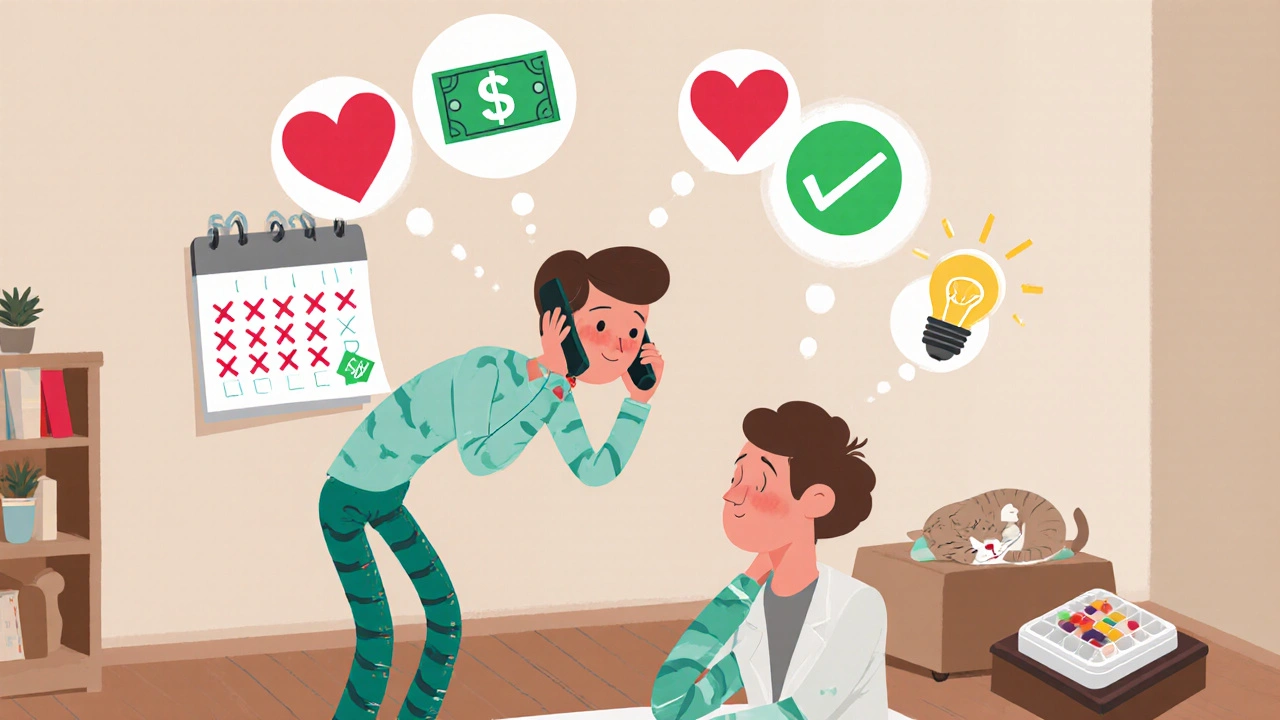
The Hidden Barriers Pharmacists Solve
Most people think non-adherence is about forgetfulness. But the real reasons are deeper:
- Cost: 68% of adherence interventions target this. A $50 copay can derail a month’s treatment. Pharmacists know about manufacturer coupons, state assistance programs, and generic alternatives. They don’t just say “take your meds”-they help you pay for them.
- Complex schedules: Five pills at different times? That’s confusing. Pharmacists simplify. They use pill organizers. They create visual charts. They break it down: “Take the blue one with breakfast, the white one at bedtime.”
- Communication gaps: Patients often don’t understand why they’re on a drug. “Is this for my heart? My kidneys? Why do I need it if I feel fine?” Pharmacists explain in plain language. No jargon. No pressure. Just clarity.
- Health literacy: 38% of patients struggle to read or understand medication labels. Pharmacists adapt. They use pictures. They speak slowly. They ask, “Can you show me how you take this?”
One Reddit user shared: “My CVS pharmacist noticed I wasn’t refilling my blood pressure meds. She sat down with me for 20 minutes. Turns out I was skipping them because I thought they were making me dizzy. She checked the interaction with my other meds and switched me to a better one. My BP’s been normal for eight months.”
But not all experiences are good. Some patients feel judged. One Trustpilot review said: “The pharmacist kept calling about refills but never asked why I couldn’t afford it. She just made me feel guilty.” That’s the risk when training is inconsistent. Good pharmacists don’t shame-they support.
How Pharmacists Get Trained for This Work
This isn’t something pharmacists pick up overnight. It takes real training.
Most programs require certification in motivational interviewing-a 87-hour course that teaches how to guide, not lecture. They learn how to use Medication Therapy Management (MTM) systems to document every conversation, every change, every follow-up. And they need formal agreements with doctors to adjust meds when needed.
It takes 4 to 6 months for a pharmacist to become proficient. That’s why not all pharmacies do it well. Only 58% of community programs deliver the full intervention as designed, according to one 2022 analysis. The rest? They might give a flyer or send a reminder text-but they miss the human connection.
That’s changing. More pharmacy chains are investing in training. And new tools help. Integrated EHR templates cut charting time by 35%. Pharmacy technicians now handle reminder calls, freeing pharmacists to focus on counseling. And 17 Medicare Advantage plans are now paying pharmacists based on results-not just visits.
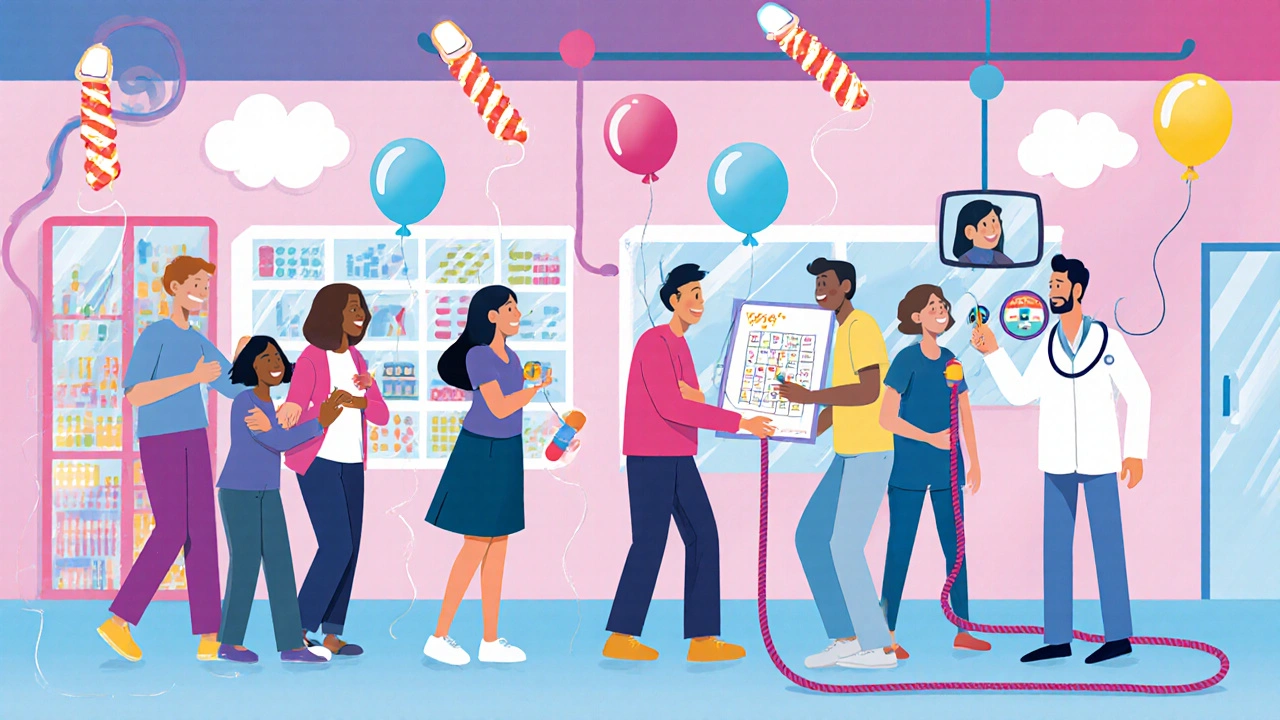
The Bigger Picture: Why This Matters
Medication non-adherence costs the U.S. healthcare system $300 billion a year. That’s more than the entire annual budget of the CDC. It’s not just waste-it’s human suffering.
Pharmacist-led programs are one of the most cost-effective tools we have. Harvard economist Dr. David Cutler found every $1 spent on pharmacist adherence services saves $7.43 in future care. The CDC says these interventions could prevent 23,000 premature deaths from heart disease by 2030.
And adoption is growing. 89% of Medicare Part D plans now include pharmacist adherence services. The Veterans Affairs system has 100% coverage. Over 90 Fortune 500 companies now offer these services to employees. Even the American College of Cardiology calls pharmacist involvement a “key component” of hypertension care.
But funding is still shaky. Only 38% of programs have stable long-term payment models. Until all insurers pay for this work, it’ll remain patchy. That’s why policy changes matter. CMS expanded reimbursement in 2023. The National Pharmacist Adherence Collaborative launched in 2024. These are steps forward.
What Patients Should Expect
If you’re on chronic meds, don’t wait for your pharmacist to reach out. Ask for help. Say: “I’m having trouble keeping up with my pills. Can we sit down and figure this out?”
Bring your full list of meds-even supplements and over-the-counter drugs. Tell them if you skip doses. Tell them if you can’t afford them. Tell them if you’re scared of side effects. They’ve heard it all. They’re not there to judge. They’re there to help you live better.
And if your pharmacist doesn’t offer this kind of support? Ask why. Push for it. Your health depends on it.
Why do so many people stop taking their medications?
People stop taking meds for many reasons-not just forgetting. Cost is the biggest issue, with 68% of non-adherence linked to unaffordable copays. Other reasons include complex dosing schedules, fear of side effects, not understanding why the medicine is needed, depression, and low health literacy. Many patients feel embarrassed to admit they’re skipping pills, so they stay silent until something goes wrong.
Can’t apps or text reminders do the same thing as pharmacists?
Digital tools help, but they’re not enough. Apps can send reminders, but they can’t adjust your meds, find you a cheaper option, or spot that you’re depressed. A 2023 review found blended approaches-pharmacist counseling plus app reminders-were 22% more effective than either alone. The human connection matters. Pharmacists understand context. Apps don’t.
Do pharmacists have the authority to change my prescriptions?
In most cases, no-but they can recommend changes. Through formal Collaborative Practice Agreements (CPAs), pharmacists in 48 states can adjust doses, switch drugs, or order labs under a doctor’s supervision. In VA hospitals and some clinics, they have full prescribing authority for certain conditions. Even without prescribing power, they’re the bridge between you and your doctor, making sure your concerns get heard and acted on.
How do I know if my pharmacist is actually helping me with adherence?
Look for these signs: They ask how you’re feeling, not just if you refilled. They check for side effects and ask if you understand why you’re taking each pill. They offer to sync your refills. They help you find cost-saving options. If they just hand you the bottle and say, “Have a good day,” you’re not getting the full service. Ask for a Medication Therapy Management (MTM) session-it’s free under Medicare Part D.
Is this service covered by insurance?
Yes, in many cases. Medicare Part D covers Medication Therapy Management (MTM) at no extra cost if you meet certain criteria-like having multiple chronic conditions and taking several high-cost meds. Many Medicaid and private plans also cover it. Even if your plan doesn’t pay, community pharmacies often offer free adherence counseling as part of their standard care. Ask your pharmacist. Don’t assume it’s not available.
What if my pharmacist doesn’t offer these services?
You have options. First, ask if they can start. Many pharmacies are willing if patients request it. If not, find another pharmacy that does-especially if you’re on Medicare. Chain pharmacies like CVS, Walgreens, and Rite Aid have formal adherence programs. You can also ask your doctor for a referral to a clinical pharmacist or a medication therapy management program in your area. Your health is worth the effort.
Peter Lubem Ause
November 30, 2025 AT 06:17Pharmacists are the unsung heroes of chronic care. I’ve seen it firsthand-my uncle’s blood pressure dropped after his pharmacist caught he was doubling up on his meds because the labels looked similar. No doctor ever asked him about his reading glasses. But the pharmacist? She noticed he squinted at the bottle and printed him a giant-font label. That’s not just service-that’s care.
And the cost stuff? Huge. I know a guy who skipped his statin for a year because he thought $400/month was normal. His pharmacist found a patient assistance program that cut it to $5. No fanfare. No drama. Just a human who cared enough to dig.
Most people think pharmacists just count pills. They don’t get that we’re talking about real lives here. Someone skipping insulin because they’re choosing between meds and rent? That’s not noncompliance-that’s systemic failure. Pharmacists are the first line of defense against that.
And don’t even get me started on med sync. Five trips a month? For someone with mobility issues or no car? That’s a death sentence disguised as convenience. One day? One stop? That’s dignity.
Why aren’t we funding this more? Why aren’t insurers paying pharmacists like they’re the frontline clinicians they are? This isn’t a nice-to-have. It’s a public health imperative.
linda wood
November 30, 2025 AT 09:26So let me get this straight-pharmacists are doing the work of nurses, social workers, and therapists… and still only get paid per pill?
Meanwhile, my insurance won’t cover a 20-minute chat but will pay for a $12,000 MRI. Classic.
LINDA PUSPITASARI
December 2, 2025 AT 05:51OMG YES 😭 I had my pharmacist call me last month because I didn’t pick up my antidepressant. She didn’t just ask why-she asked if I was okay. Turned out I was scared of the side effects and didn’t know how to talk to my doctor. She walked me through it. I cried in the parking lot. She gave me a hug. That’s not a job. That’s love in a white coat. 🤍
Also-med sync changed my life. I used to forget half my pills. Now I just grab one bag. Boom. Done. 🙌
Latika Gupta
December 4, 2025 AT 00:09But do pharmacists really have time for all that? In India, we have 1 pharmacist for every 5,000 people. They’re running around like crazy. How can they sit and chat? It sounds nice but… unrealistic?
Sullivan Lauer
December 5, 2025 AT 18:00THIS. THIS IS THE MOST IMPORTANT THING NO ONE IS TALKING ABOUT. I had a friend who had a heart attack at 42. Turns out he hadn’t taken his beta-blocker in 14 months because he thought it made him ‘feel weird.’ His pharmacist didn’t just say ‘take your meds.’ She asked him what ‘weird’ meant. Turns out he was scared he’d lose his libido. She got him a different med with fewer side effects. He’s alive today because someone listened. Not his doctor. Not his wife. His pharmacist. And now he’s the one telling everyone to go talk to theirs.
Doctors write scripts. Pharmacists save lives. Period. And if you think this is just about ‘adherence,’ you’re missing the point. This is about dignity. This is about being seen. This is about someone who remembers your name and asks how your dog is doing.
Let’s make this standard. Not optional. Not a bonus. A requirement. Because people are dying while we argue over who gets paid what.
Sohini Majumder
December 7, 2025 AT 13:01Pharmacists?? 😭 Like… the people who yell at you for not having your insurance card?? I mean… sure… if you’re in some fantasy land where everyone has time and money and no one’s stressed… but in real life?? People just want the damn pill and to get out of there. This is so… performative. Like, ‘look at us, we care!’ but no one’s paying them to do it. Also… ‘medication reconciliation’? That’s just a fancy way of saying ‘we’re fixing your doctor’s mess.’
tushar makwana
December 9, 2025 AT 06:06in india we dont have much but still i see my local pharmacist sit with old people and explain pills in hindi. sometimes he gives extra medicine for free if they dont have money. he dont get paid for that. but he does it. i think this is not about country or money. this is about heart. pharmacy is not just shop. it is place where people come when they scared. and pharmacist is the one who dont judge.
Richard Thomas
December 10, 2025 AT 20:22While the anecdotal evidence presented is compelling, one must interrogate the methodological rigor of the cited studies. The 120,000-patient cohort lacks stratification by socioeconomic status, and the 4% to 6.3% adherence increase may be statistically significant but clinically marginal when adjusted for confounding variables such as comorbidities and baseline health literacy. Furthermore, the absence of a control group utilizing digital adherence platforms renders comparative efficacy claims speculative at best.
Matthew Higgins
December 12, 2025 AT 08:14my grandma’s pharmacist remembers her dog’s name. last time she went in, the pharmacist asked how fluffy was doing. grandma cried. not because she was sick. because someone remembered.
that’s the whole thing right there.
Mary Kate Powers
December 13, 2025 AT 23:10One of the most underrated things pharmacists do? They catch drug interactions before they happen. I had a patient on warfarin who started taking a new OTC painkiller. The pharmacist flagged it immediately-she called the doctor, got it switched, and saved a potential bleed. That’s not ‘service.’ That’s prevention on a whole other level.
And let’s be real-no app sends a text saying ‘hey, I saw you picked up your blood pressure med but not your cholesterol one. Everything okay?’
That’s the magic. Human connection. No algorithm can replicate that.
Sara Shumaker
December 14, 2025 AT 01:47It’s funny-we treat doctors like oracles, but they’re time-starved. We treat pharmacists like order-takers, but they’re the ones holding the whole system together.
Maybe the real question isn’t ‘how do we get patients to take their meds?’
It’s ‘how do we stop treating healthcare like a transaction?’
When you hand someone a pill and walk away, you’re not healing them. You’re just giving them a tool. But when you sit down, ask about their job, their kids, their fear of side effects… you’re giving them a reason to keep going.
Pharmacists aren’t just filling prescriptions.
They’re filling gaps in the soul.
Scott Collard
December 15, 2025 AT 13:19Stop romanticizing pharmacists. They’re not saints. They’re employees. And if you want real change, stop asking them to fix a broken system. Fix the system. Pay them properly. Regulate pricing. End insurance games. Don’t put the emotional labor on the pharmacist while CEOs cash in.