 Dec, 12 2025
Green tea extract is everywhere-pills on drugstore shelves, powders in smoothies, capsules labeled "pure antioxidant support." It’s marketed as a natural way to boost metabolism, fight aging, or support heart health. But what most people don’t realize is that this seemingly harmless supplement can quietly mess with your prescriptions. If you’re taking even one medication, especially for heart disease, cancer, or high blood pressure, drinking green tea extract could be making your treatment less effective-or even dangerous.
How Green Tea Extract Interferes with Medications
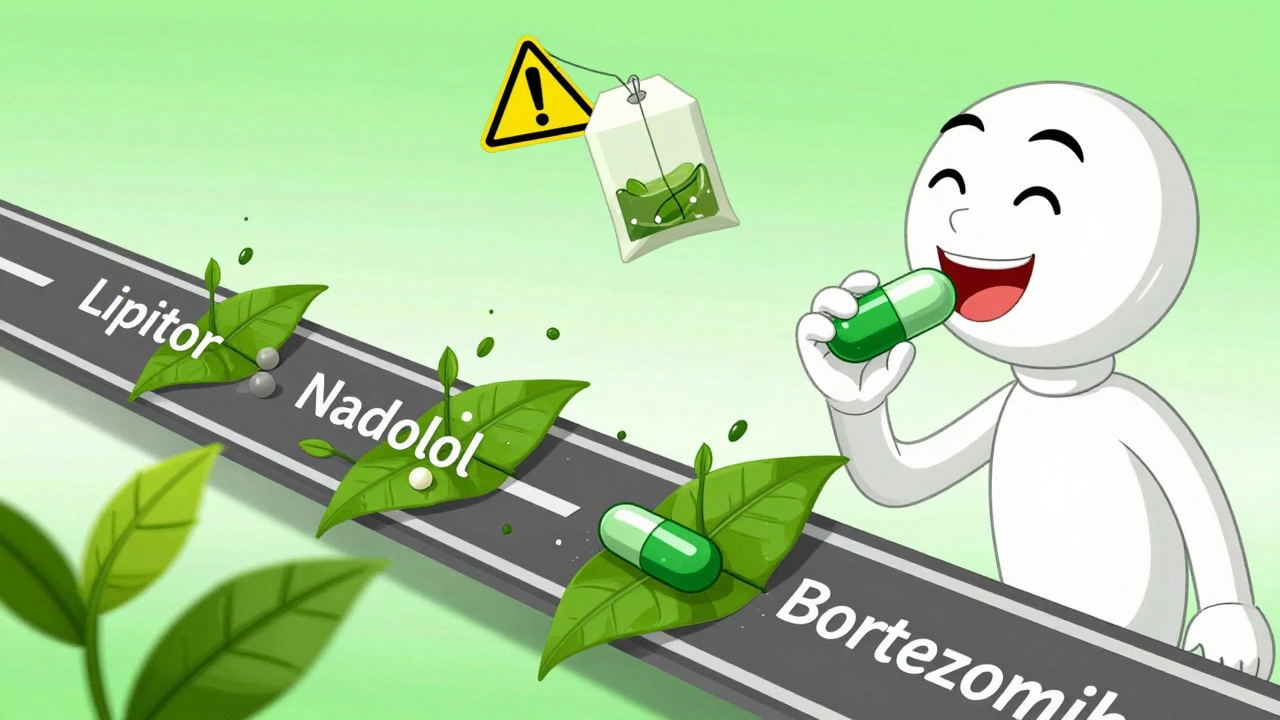
Green tea extract isn’t just tea in a capsule. It’s concentrated. One capsule can contain 250 to 500 mg of EGCG (epigallocatechin gallate), the main active compound. That’s five to ten times more than what you’d get from a cup of brewed tea. And EGCG doesn’t just float around harmlessly. It actively blocks the transporters in your gut and liver that move drugs into your bloodstream. Think of it like a roadblock on a highway-your medicine can’t get where it needs to go.
On top of that, green tea extract contains caffeine. A typical cup of tea has 30-50 mg. But a supplement? That can push 100-200 mg per serving. That’s like drinking two strong coffees in one go. Caffeine doesn’t just wake you up-it can overstimulate your heart, raise your blood pressure, and clash with stimulants or heart meds.
The real danger comes from the combo: EGCG blocking drug absorption, and caffeine amplifying side effects. This dual-action makes green tea extract far riskier than most herbal supplements. Studies show it has over three times more documented drug interactions than ginkgo biloba and nearly six times more than milk thistle.
Medications That Can Be Seriously Affected
Some drug interactions are mild. Others can be life-threatening. Here are the big ones you need to know about:
- Nadolol (Corgard) - Used for high blood pressure and heart rhythm issues. Green tea extract cuts its absorption by up to 83%. That means your blood pressure could spike unexpectedly.
- Atorvastatin (Lipitor) and Rosuvastatin (Crestor) - These cholesterol drugs lose up to 40% of their effectiveness when taken with green tea extract. Your LDL might stay high, even if you’re taking your pill daily.
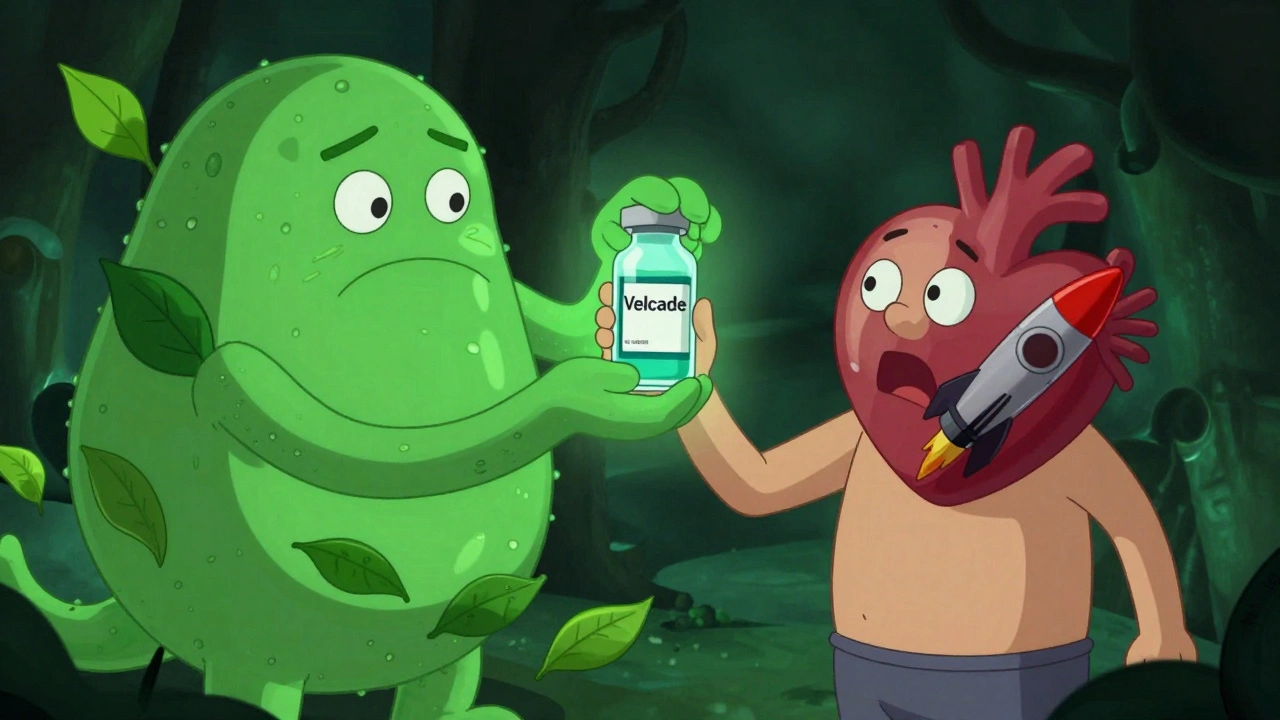
- Bortezomib (Velcade) - A chemotherapy drug for multiple myeloma. EGCG binds directly to it, reducing its cancer-killing power by half. MD Anderson Cancer Center found a 15% treatment failure rate in patients who kept taking green tea supplements during therapy.
- 5-Fluorouracil - Another chemo drug. Green tea extract slows its breakdown, causing toxic levels to build up. This can lead to severe nausea, mouth sores, and even bone marrow suppression.
- Imatinib (Gleevec) - Used for leukemia. Green tea cuts its absorption by 30-40%, making it harder to control the disease.
- Lisinopril - A common blood pressure pill. Studies show green tea reduces its absorption by about 25%.
- Beta-agonists (like albuterol) - Used for asthma. The caffeine in green tea extract can cause your heart to race dangerously fast-sometimes by 20-30 beats per minute.
- Warfarin (Coumadin) - A blood thinner. While the interaction isn’t always clear-cut, Cleveland Clinic’s internal review found that 18% of unexpected INR spikes in warfarin patients were linked to green tea use.
These aren’t theoretical risks. They’re documented in peer-reviewed journals, hospital case reports, and cancer center protocols. The National Comprehensive Cancer Network explicitly advises patients on bortezomib to avoid green tea extract entirely.
Why Supplements Don’t Warn You
You won’t find a clear warning on most green tea extract bottles. In fact, a 2021 FDA survey found that only 12% of products mention drug interactions-even though the FDA itself says supplements with known risks should carry those warnings.
Why? Because under the Dietary Supplement Health and Education Act (DSHEA) of 1994, manufacturers don’t need to prove safety or efficacy before selling. The FDA can only act after harm is done. In 2022, the FDA sent out 17 warning letters to green tea supplement companies for failing to label risks. By early 2023, only 29% had fixed their labels.
Meanwhile, the market keeps growing. Global sales hit $2.17 billion in 2022 and are projected to grow nearly 9% a year through 2028. More people are buying it-especially cancer survivors looking for "natural" support-despite the known risks.
What You Should Do
If you’re taking any prescription meds, here’s what to do right now:
- Check your meds. Look at your list. Are you on any of the drugs mentioned above? Even if you’re not sure, assume it’s a risk until proven otherwise.
- Stop taking green tea extract. If you’re on bortezomib, warfarin, or any chemotherapy drug, stop immediately. There’s no safe dose when these drugs are involved.
- If you’re on blood pressure or cholesterol meds, limit yourself. One or two cups of brewed green tea a day (not extract) is likely okay. But avoid capsules, powders, or energy drinks with green tea extract.
- Talk to your pharmacist. They see your full medication list. Ask: "Could green tea extract interfere with any of these?" Don’t assume they know you’re taking it-many patients don’t mention supplements.
- Wait 4 hours between meds and tea. If you’re not on a high-risk drug but still want to drink green tea, space it out by at least four hours from your pill time. That cuts interaction risk by about 60%.
And if you’re thinking, "But it’s natural!"-remember: natural doesn’t mean safe. Poison ivy is natural. Snake venom is natural. Green tea extract is a potent biochemical agent. Just because it comes from a plant doesn’t mean your body treats it gently.
What’s Changing
The FDA and European Medicines Agency are finally paying attention. In 2023, the FDA listed green tea extract as a "high-priority substance" for interaction labeling. The EMA added 12 new interactions, including one with dabigatran (Pradaxa), a blood thinner. Researchers are now exploring ways to make green tea extract safer-like isolating only the antioxidants without the transporter-blocking compounds.
But until those changes happen, the responsibility is on you. You can’t rely on labels. You can’t assume your doctor knows you’re taking it. And you definitely can’t trust marketing claims that say "safe for daily use."
The truth? Green tea extract isn’t the villain. But it’s not the harmless wellness trend it’s sold as either. For people on medications, it’s a silent risk-one that can quietly undo weeks, months, or even years of treatment.
Can I still drink brewed green tea if I’m on medication?
Yes, in moderation. One to two cups of brewed green tea per day (containing about 50-100 mg EGCG and 30-50 mg caffeine) is generally low-risk for most people. Avoid drinking it right before or after taking your meds-wait at least four hours. But if you’re on bortezomib, warfarin, or chemotherapy drugs, even brewed tea should be avoided unless your doctor says otherwise.
Is green tea extract safer than caffeine pills?
No. Caffeine pills only affect your nervous system and heart rate. Green tea extract does that too-but it also blocks how your body absorbs and processes dozens of medications. That makes it far more dangerous. A caffeine pill might give you jitters. Green tea extract might make your blood pressure meds stop working.
What should I do if I already took green tea extract with my medication?
Don’t panic, but don’t ignore it either. If you’re on a high-risk drug like bortezomib, warfarin, or a statin, contact your doctor or pharmacist right away. Watch for signs like sudden increases in blood pressure, unusual fatigue, heart palpitations, or worsening symptoms. If you’re on chemotherapy, let your oncology team know immediately-they may need to check your drug levels.
Are there any supplements that are safer than green tea extract?
Some, but not many. Vitamin D, magnesium, and fish oil have very few known interactions. But even "safe" supplements can interfere with certain drugs. Always check with your pharmacist before starting anything new. The safest approach is to avoid supplements unless your doctor recommends them for a specific, documented reason.
Why don’t doctors always warn patients about this?
Many doctors don’t ask about supplements. Patients often don’t mention them because they think they’re harmless. A 2022 American Heart Association study found that 22% of heart failure patients were using green tea supplements without their doctor’s knowledge. It’s a communication gap. That’s why it’s up to you to bring it up-don’t wait for your doctor to ask.
Final Thought
Green tea extract isn’t evil. But it’s not a harmless wellness habit either. For people on medication, it’s a hidden variable-one that can change how your drugs work without you even noticing. If you’re taking pills for your heart, your blood pressure, your cholesterol, or your cancer, treat green tea extract like you would any other drug: with caution, with awareness, and with a conversation with your healthcare provider. Your treatment plan is too important to leave to chance.
Donna Hammond
December 13, 2025 AT 20:55This is one of the most important posts I've read all year. I'm a pharmacist, and I see this exact scenario every single week-patients on statins or blood pressure meds popping green tea extract because they think it's 'natural' and 'safe.' The data here is rock-solid, and the fact that labels don't warn people is criminal. Please, if you're reading this: stop self-prescribing supplements. Talk to your pharmacist. They're trained for this exact thing.
Lauren Scrima
December 15, 2025 AT 10:15So... you're saying my $40/month "anti-aging miracle" is just a fancy way to sabotage my Lipitor? 🙃
Jade Hovet
December 16, 2025 AT 11:44OMG YES!! 😭 I took green tea capsules with my beta-blocker and ended up in the ER with a heart rate of 140. My doctor said it was "likely" the supplement. I didn't even think to mention it because I thought it was "just tea"... now I'm terrified of everything I put in my mouth. 🙏
Rawlson King
December 17, 2025 AT 13:46Of course the FDA doesn't regulate this. Big Pharma owns the system. They want you dependent on pills. Green tea has been used for 4,000 years. This is fearmongering dressed as science.
John Fred
December 19, 2025 AT 11:02As someone who’s been on Imatinib for 8 years, I can confirm: my oncologist banned green tea extract cold turkey. Said the interaction could tank my response rate. I switched to chamomile tea. No jitters, no interference. Still feel great. 🙌
Himmat Singh
December 20, 2025 AT 12:07It is a curious phenomenon, this modern predilection for biochemical reductionism masquerading as wellness. The pharmacological interference of epigallocatechin gallate with hepatic drug transporters is not merely a theoretical concern; it is a well-documented, empirically validated phenomenon. One must, therefore, exercise the utmost circumspection when integrating phytochemical supplements into a pharmacotherapeutic regimen. The assertion that "natural" equates to "benign" is not only fallacious-it is dangerously simplistic.
Jennifer Taylor
December 21, 2025 AT 20:04WAIT. So if I take green tea extract and my blood pressure meds, I could have a stroke AND my cancer treatment could fail AND my heart could race out of my chest?!?!?! 😱 I just bought 3 bottles from Amazon yesterday. I'm going to throw them in the toilet right now. And I'm telling everyone I know. This is a cover-up. Big Tea and Big Pharma are working together. I saw a documentary about this. They even banned matcha in Japan in '98 but erased it from the internet. I have screenshots. I'm not crazy. I'm just informed.
Shelby Ume
December 22, 2025 AT 12:37Thank you for writing this. I'm a nurse, and I've seen too many patients on warfarin who swear they "only drink tea." I always ask. I always remind them: "It's not just tea. It's a drug." I keep a laminated card in my pocket with the top 5 dangerous interactions. I hand it out. No one ever says no. You're doing the work we're too busy to do.
nithin Kuntumadugu
December 22, 2025 AT 13:20lmao so green tea is bad now? next they'll say water is dangerous because it has hydrogen. 🤡 i take green tea extract with my meds and i feel like a god. 10/10 would recommend. also my dog eats it too. he's 14 and runs like a cheetah. science is a cult.
Richard Ayres
December 22, 2025 AT 20:11This is a critical public health message, and I appreciate the clarity and evidence-based framing. I’ve shared this with my aging parents, both on multiple medications. The fact that supplement labels aren't required to disclose interactions is a regulatory failure-and it puts vulnerable populations at risk. I hope this gets amplified beyond Reddit. It deserves to be in medical journals, not just in a comment thread.
Constantine Vigderman
December 22, 2025 AT 22:47Bro I just found out my mom’s INR spiked because of her "detox tea" 😳 She’s been taking it for 2 years! I printed this out and gave it to her with a highlighter. She cried. Then she threw out the whole stash. We’re going to her pharmacist tomorrow. Thank you for this. 🙏❤️
Hamza Laassili
December 24, 2025 AT 10:43THIS IS A LIBERAL TRAP!! 🇺🇸 Green tea is AMERICAN! Wait no-CHINESE! But we stole it and made it better!! The FDA is just trying to control you! Drink your tea, fight the system! 💪🔥
Harriet Wollaston
December 24, 2025 AT 15:44I’m from the Philippines and we drink green tea every day with meals. No one here has heart attacks from it. Maybe it’s the dose? Maybe it’s the way we prepare it? I don’t know. But I do know that fear doesn’t help people. Education does. This post? It’s education. Thank you.
Cole Newman
December 25, 2025 AT 05:29you're all overreacting. i take 3 green tea capsules with my lisinopril and my blood pressure is better than ever. if your meds don't work with tea, maybe you're just weak. also, i'm 23 and i've been doing this for 5 years. you're all just scared of plants.