 Mar, 5 2026
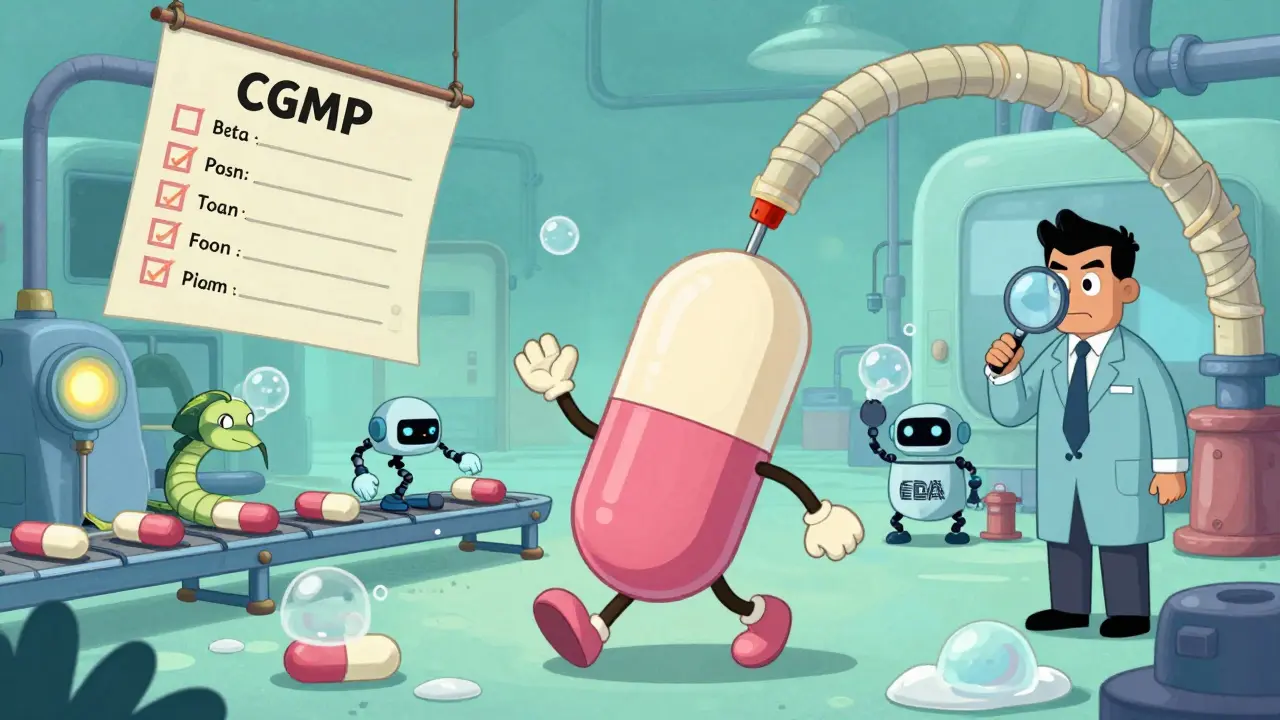
Every pill you swallow should work exactly as it should. Not close. Not almost. Exactly. That’s not luck. It’s the result of a strict, invisible system built into every step of making generic medicines. And without it, counterfeit drugs would flood the market - pills that look real but contain no active ingredient, the wrong ingredient, or dangerous contaminants. The system that stops this? Generic manufacturing standards.
Why Quality Isn’t Tested - It’s Built
You might think quality control means testing every pill at the end. But that’s not how it works. The FDA has been clear since the 1960s: quality can’t be tested into a product. You can’t catch a fake pill by looking at it. You can’t smell it. You can’t feel it. A counterfeit drug can pass a lab test if it has the right chemicals - even if those chemicals are arranged wrong. That’s why quality must be built in from the start.This idea is the core of Current Good Manufacturing Practices (cGMP). These aren’t suggestions. They’re legally binding rules under 21 CFR Part 211. Every facility making generic drugs - whether in the U.S., India, or China - must follow them. The rules cover everything: who handles the ingredients, how clean the rooms are, how equipment is cleaned, and how every batch is tracked. If a factory skips one step, the entire batch is rejected.
The system doesn’t just prevent mistakes. It makes counterfeiting nearly impossible. Why? Because counterfeiters can’t copy the process. They can’t replicate the 15,000+ quality checks done per batch. They can’t afford the clean rooms, the sensors, or the software that monitors every variable in real time.
The SQUIPP Framework: What Gets Tested
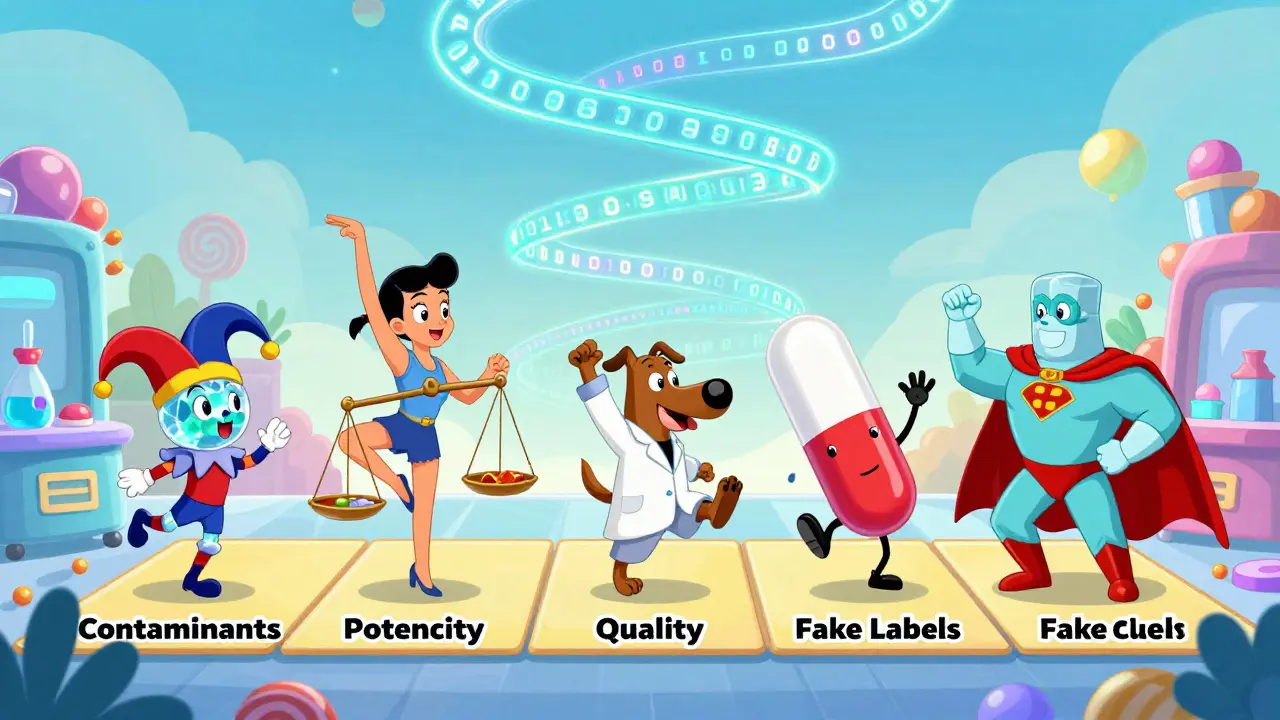
Generic drugs aren’t just copies. They’re scientifically proven to be identical to brand-name drugs. That’s enforced through the SQUIPP framework - Safety, Quality, Identity, Potency, and Purity. Each letter represents a non-negotiable requirement.- Identity: Does the pill contain the right drug? Not just the right molecule, but the exact crystal form. A wrong crystal shape can make a drug useless. Manufacturers use infrared spectroscopy and high-performance liquid chromatography to confirm identity with 99.9% accuracy.
- Potency: Does it have the right amount of active ingredient? Too little? It won’t work. Too much? It could be dangerous. Every batch is tested to ensure drug content falls within 95-105% of the target.
- Purity: Are there harmful impurities? The 2018 valsartan recall showed how dangerous this can be. Even trace contaminants from bad solvents or unclean equipment can cause cancer. Manufacturers must test for over 20 known impurities - and monitor for unknown ones.
- Quality: Does the pill dissolve properly? A pill that doesn’t break down in your stomach won’t work. Dissolution testing ensures 80% of the drug is released within 30-45 minutes - same as the brand-name version.
- Safety: Is the manufacturing environment safe? Clean rooms must meet ISO Class 5 standards: fewer than 3,520 particles per cubic meter. That’s like having a sterile operating room for every batch.
These aren’t theoretical checks. They’re mandatory, repeatable, and audited. A single batch can undergo 200+ tests before it leaves the factory.
Track-and-Trace: The Digital Shield
Even the best physical controls can’t stop a fake pill that slips through if it’s labeled correctly. That’s where digital systems come in.The U.S. Drug Supply Chain Security Act (DSCSA) requires every prescription drug package to have a unique serial number - like a digital fingerprint. That number is scanned at every stop: from the factory, to the distributor, to the pharmacy. If a package doesn’t match the system, it’s flagged. No exceptions.
By 2023, 92% of the top 50 generic manufacturers had full track-and-trace systems. Smaller companies lag behind, but even they’re catching up. Why? Because the cost of a single counterfeit incident - lawsuits, recalls, lost trust - can wipe out a small business.
These systems don’t just catch fakes. They trace them. If a batch of metformin is found to be contaminated, regulators can find every pharmacy that received it - within hours. That’s impossible without digital tracking.
What Happens When Standards Slip
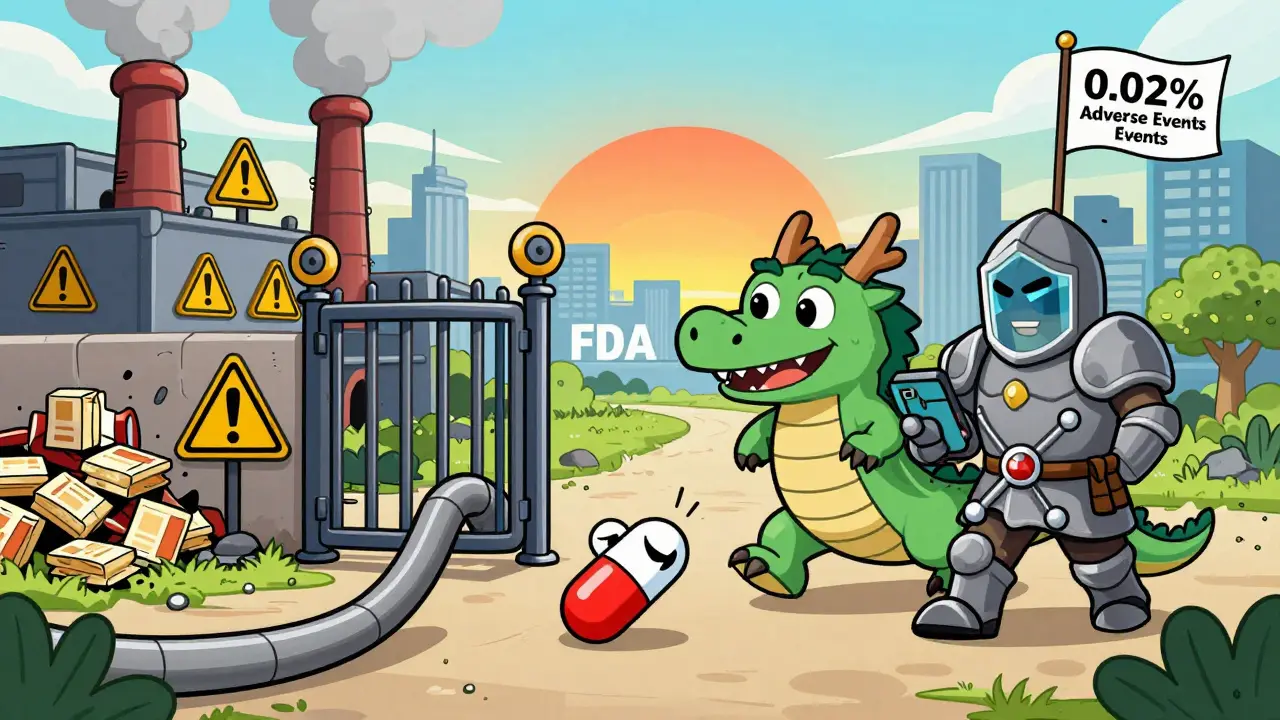
Not every factory follows the rules. The FDA inspects over 4,000 facilities each year. In 2023, 94% of U.S.-based generic drug plants passed without issue. But in India? Only 78%. In China? Just 65%.When inspections find problems, they don’t just say “fix it.” They issue a Form 483 - a public notice of violations. The most common? Inadequate investigation of failed tests (37% of warning letters) and poor cleaning validation (29%). One company skipped cleaning equipment between batches. Result? A batch of blood pressure pills contained traces of another drug. Patients had dangerous side effects. The recall cost millions.
Counterfeiters know where the weak spots are. Interpol’s 2022 Operation Pangea seized $21 million in fake medicines - 78% of them falsely labeled as generics. Most came from unregulated factories in Southeast Asia and Africa. These aren’t just bad pills. They’re lethal.
Why Generic Drugs Are Safer Than You Think
Many people believe brand-name drugs are safer. They’re not. When made under cGMP, generics are just as safe - maybe even safer.The Generic Pharmaceutical Association found that FDA-regulated generics have a 0.02% adverse event rate. Brand-name drugs? 0.03%. That’s not a difference. That’s noise.
Why? Because generics are held to the same standards - and sometimes, stricter ones. To get approval, a generic must prove bioequivalence: its absorption in the body must fall within 80-125% of the brand-name drug. That’s tighter than what’s accepted in some countries. In places without strong oversight, the range can be as wide as 75-133%. That’s a recipe for failure.
And here’s the kicker: generics make up 90% of all prescriptions in the U.S. - but only 23% of drug spending. That’s because they’re cheaper. But their quality? It’s not cheap. It’s world-class.
The Cost of Getting It Right
Implementing these standards isn’t cheap. A full electronic Quality Management System (eQMS) can cost $2-5 million. A single near-infrared spectrometer? $500,000. Training staff? 200+ hours per year per employee.But the cost of failure? Far higher. A single recall can cost $100 million. A single death from a counterfeit drug can destroy a company’s reputation forever.
Smaller manufacturers struggle. But they’re not left behind. Cloud-based eQMS platforms now let small firms pay for quality by the month - not by the million. Veeva QualityOne, for example, helps firms monitor 50+ spectral traits to detect fakes. It’s not perfect - but it’s better than nothing.
What’s Next? AI, Blockchain, and Molecular Tags
The future of counterfeit prevention isn’t just about more tests. It’s about smarter ones.AI is already being used to spot patterns in data that humans miss. IBM and Siemens have invested $1.2 billion in AI tools that predict quality failures before they happen. By 2027, these systems could cut counterfeit incidents by 40%.
Blockchain is being tested by the WHO for antimalarial drugs in Africa. Each pill gets a digital trail from factory to patient. No middlemen. No tampering.
And then there’s the next frontier: molecular taggants. Tiny, harmless markers added to drugs that can be read with a smartphone. Think of them as invisible barcodes at the atomic level. By 2026, the EU will require them for all prescription drugs.
These aren’t sci-fi. They’re coming. And they’ll make counterfeiting even harder.
Final Reality Check
Counterfeit drugs are still a problem - especially in places with weak regulation. The WHO estimates 1% of medicines in rich countries are fake. In some low-income nations? Up to 30%.But in places where cGMP is enforced - like the U.S., EU, Canada, Japan - the rate is below 0.1%. That’s not luck. It’s policy. It’s investment. It’s thousands of trained workers doing their jobs, every day.
When you take a generic pill, you’re not taking a cheap substitute. You’re taking a product that went through more scrutiny than almost anything else you consume. And that’s why, despite everything, the system works.
It’s not perfect. But it’s the best defense we have. And it’s built to last.
phyllis bourassa
March 5, 2026 AT 21:12Okay but let’s be real - if you think generic drugs are safe because of cGMP, you’ve never seen the inside of a factory in Indore. I’ve got cousins who work in pharma there. They told me about the ‘magic dust’ they add to make batches pass. It’s not contaminants - it’s just… vibes. And yeah, the sensors are fancy, but if the guy running them is on his third cup of chai and a WhatsApp call from his mom, who’s really checking?
And don’t even get me started on the ‘bioequivalence’ lie. 80-125%? That’s like saying your car’s fuel efficiency is ‘equivalent’ if it goes from 15 to 25 mpg. You’re still gonna run out of gas on the highway. I’ve had generics that made me feel like I’d been hit by a truck. Not the good kind of hit. The ‘why is my vision blurry and my heart doing the cha-cha’ kind.
And yes, I know the stats say 0.02% adverse events. But those are *reported*. What about the ones people just chalk up to ‘bad luck’ or ‘getting old’? I call it the silent pill massacre. And no, I’m not paranoid. I’m just the person who reads the fine print. And the fine print has a lot of footnotes. And none of them say ‘your life is a beta test.’
Sean Callahan
March 7, 2026 AT 05:31lol i read this whole thing and still dont know if im supposed to be impressed or scared. like yeah the tech is insane - infrared spectrometers, digital fingerprints on pills, clean rooms cleaner than my ex’s apartment - but what happens when the machine breaks? or the guy who calibrated it got fired last week? or someone just… forgets to hit save?
also why is everyone acting like this is new? my grandpa took generics in the 70s and lived to 92. maybe we just need less obsession with perfection and more trust in basic human decency? or at least a decent lunch break for the QC team.
also why is it always ‘india’ and ‘china’? what about the 12% of u.s. plants that failed? nobody talks about that. just saying.
Ferdinand Aton
March 7, 2026 AT 06:46Wow. So we’re paying $2 for a pill but the system behind it costs $5 million? That’s not quality control. That’s a corporate tax dodge disguised as public health. Someone’s making bank on this. Probably the same people who sold you the ‘safe’ generic that gave you liver damage.
And AI predicting failures? That’s just a fancy way of saying ‘we’re too lazy to train people.’ Give me a human with a clipboard and a coffee any day. Not a robot that thinks ‘slightly off crystal shape’ is ‘within tolerance.’
Also - molecular tags? On a pill? That’s not innovation. That’s a dystopian Walmart loyalty card. Next they’ll scan your iris when you pick up your metformin. ‘Welcome back, Patient #8472. Your last refill was 37% bioavailable. We’re disappointed.’
William Minks
March 7, 2026 AT 21:55This is actually kind of beautiful 😊
Like… think about it. Every time you take a pill, you’re trusting a system that’s more complex than the entire U.S. tax code. And it *works*. Not perfectly. But well enough that 99.9% of the time, you’re not dying.
It’s like the internet. We all complain about it, but when it works? It’s magic. And this? This is the internet of medicine. No ads. No pop-ups. Just science, sweat, and sensors.
Also, props to the workers in clean rooms. I can’t even handle my own laundry. These people? They’re heroes in lab coats. 👏🫶
Susan Purney Mark
March 9, 2026 AT 13:39I work in a pharmacy and I see this every day. People assume generics are ‘cheap’ so they’re ‘less safe.’ But I’ve had patients come in crying because their brand-name blood pressure med went from $15 to $400. They’d rather skip doses than pay. So we give them the generic - and they’re fine. Stable. Alive.
Yes, the system is rigorous. Yes, there are failures. But the fact that 90% of prescriptions are generics and the death rate is lower than brand? That’s not luck. That’s dignity.
Don’t let the fear-mongering make you forget: access saves lives. And this system? It gives access without sacrificing safety. That’s worth celebrating.
Also - if you’re worried about contamination? Wash your hands. And maybe stop Googling ‘fake pills’ at 2 a.m. 😊
Bridget Verwey
March 10, 2026 AT 15:45So let me get this straight - you’re telling me we’ve got robots sniffing out crystal structures and blockchain tracking every pill like it’s a Bitcoin… but we still can’t fix the fact that 30% of medicines in some countries are fake?
Wow. We built the Death Star and then forgot to install the air conditioning. Classic.
Also - ‘molecular taggants’? That’s not science. That’s a Marvel villain’s side hustle. ‘Behold, my new pill! It has a barcode only my drone can read!’
Meanwhile, in the real world, grandma in rural Mississippi is still choosing between her insulin and her cat’s food. So yeah. Cool tech. But fix the system first. The rest is just glitter on a sinking ship.
Weston Potgieter
March 10, 2026 AT 20:25Quality built in not tested - yeah right. That’s what they said about Boeing 737 Max too. Then the planes started falling out of the sky. Same playbook. Same PR. Same ‘trust the process’
200+ tests per batch? More like 200+ ways to fake the logs. The system’s not a shield - it’s a smokescreen. You think the guy in Mumbai with 3 broken sensors and a Google Translate version of the cGMP manual is doing 15000 checks? He’s doing 3 and praying.
And don’t even get me started on the ‘FDA passed 94% of U.S. plants.’ That’s because they show up with a clean room, a fake batch, and a $2000 gift card to the inspector’s favorite sushi place. It’s theater. Not science.
Also - 0.02% adverse events? That’s not proof. That’s a rounding error. I’ve known 5 people who got sick from generics. Nobody talks about them. Because the system works. Right. 😏
Vikas Verma
March 11, 2026 AT 04:16As someone from India working in pharmaceutical QA, I must say this article misses the point. The system is not perfect - but it is evolving. We are investing in eQMS, AI, and training. Yes, some factories cut corners. But thousands of us are not. We are engineers, not criminals.
The FDA inspection rate in India is low? True. But we have our own NMPA and CDSCO. And they are getting tougher. Last year, 47 facilities were shut down for cGMP violations. That’s not negligence. That’s accountability.
And yes, we make 40% of the world’s generics. We are not the problem. We are the solution. Stop blaming. Start supporting.
Jeff Mirisola
March 12, 2026 AT 23:25Look - I’m not a doctor. I’m not a scientist. I’m just a guy who takes 6 pills a day and doesn’t want to die.
This article? It made me feel safe. Not because I understand infrared spectroscopy. But because I know someone out there is obsessing over it. For me. For my kids. For my grandma.
So yeah - the system’s expensive. The tech’s insane. The process? Overkill.
But I’d rather have overkill than underkill.
Thank you to the people who do this. You’re the unsung heroes. I don’t know your names. But I’m alive because you showed up. And that’s enough.
Ian Kiplagat
March 14, 2026 AT 11:58Interesting. But let’s not pretend this is unique. The UK’s MHRA does the same. EU? Same. Japan? Double. The real story isn’t the tech - it’s the global patchwork. Some countries have lasers. Others have flashlights.
And the ‘molecular tags’? Cute. But if you can’t track a pill from factory to pharmacy, a barcode on the atom won’t help.
Bottom line: regulation > innovation. Always.
🫶
Amina Aminkhuslen
March 14, 2026 AT 18:32Oh honey. You really think the FDA is some saintly guardian? Let me tell you about my cousin’s husband’s coworker who worked at a plant in Tennessee. They were making metformin. One batch had traces of nitrosamine. They knew. They didn’t report it. They just… repackaged it. Label said ‘lot 2024-07-15.’ It was lot 2023-11-09. Rebranded. Re-labeled. Re-sold.
And guess what? The FDA didn’t catch it. The pharmacy chain didn’t catch it. The patient didn’t catch it. Until he started bleeding from his gums.
This isn’t a system. It’s a game of whack-a-mole with a broken mallet. And we’re all just waiting for the next mole to pop up.
Also - 0.02% adverse events? That’s not data. That’s a PR pitch. And I’m not buying.
Tim Hnatko
March 14, 2026 AT 22:24Just wanted to say - I’m a retired lab tech. I worked in a generic drug plant for 32 years. We did 200+ tests per batch. We had clean rooms. We had sensors. We had audits.
And every single time? We threw out a batch. Not because it failed. Because something felt off.
Not because the machine said so. Because *we* felt it.
That’s the part no one talks about. The human instinct. The quiet voice saying ‘no.’
That’s what keeps us safe. Not the AI. Not the blockchain.
Just someone who cared enough to say no.