 Aug, 11 2026

FDA Serious Adverse Event (SAE) Classifier
Select all outcomes that occurred during your medication use. The FDA defines an event as "serious" only if it meets one or more of these specific legal criteria.
Classification Result
Criteria Met:
Recommended Action:
This event should be reported to the FDA via the MedWatch program. Manufacturers are required to report fatal/life-threatening events within 7 days and other serious events within 15 days.
Context:
While this may not meet the strict regulatory definition of an SAE, you should still discuss it with your healthcare provider. If it affects your quality of life, it can be reported voluntarily to help track side effect patterns.
Have you ever read a medication guide or a clinical trial consent form and felt your heart skip a beat at the mention of "serious" side effects? You aren't alone. Many patients see the word serious and immediately assume it means their life is in danger or that the drug will cause catastrophic damage. But here is the truth that often gets lost in medical jargon: in the world of the U.S. Food and Drug Administration (FDA), "serious" has a very specific legal definition that doesn't always match what we feel as patients.
Understanding this distinction isn't just about calming nerves; it's about knowing when to seek immediate help and how to protect your health. The FDA classifies these events not by how painful they are, but by their impact on your daily life and survival. Let’s break down exactly what counts as a Serious Adverse Event (SAE), why it matters, and how you can use this knowledge to stay safe.
The Five Criteria That Define a Serious Adverse Event
To the FDA, an event is only labeled "serious" if it meets one of five strict outcomes. It doesn’t matter if the event was caused by the drug or something else; if it happens while you are taking the medication and fits one of these categories, it is reported as serious. This system, formalized in regulations like 21 CFR 312.32, ensures that no significant safety signal slips through the cracks.
- Death: Any fatal outcome associated with the product use.
- Life-threatening: A situation where the patient was at substantial risk of dying at the time the event occurred. It wasn't necessarily fatal, but death could have happened if intervention hadn't occurred.
- Hospitalization: This includes initial admission to a hospital or prolonging an existing stay by 24 hours or more due to the event.
- Disability or Permanent Damage: A substantial disruption to your ability to carry out normal life functions. Think of losing vision in one eye or long-term nerve damage that prevents you from working.
- Congenital Anomaly or Birth Defect: Any birth defect observed in the child of a woman who used the drug during pregnancy.
There is also a catch-all category called Important Medical Events. These are situations that might not fit the five criteria above but still jeopardize the patient and require medical intervention to prevent one of those serious outcomes. For example, a severe allergic reaction that is treated quickly in an urgent care clinic might be classified here because, without treatment, it could have led to hospitalization.
Serious vs. Severe: The Critical Difference
This is where most confusion lies. In everyday language, if something is "severe," it feels serious. But in pharmacovigilance-the science of monitoring drug safety-these two words mean completely different things.
Severity refers to the intensity of the symptom. The National Cancer Institute uses a scale from Grade 1 to Grade 5:
- Grade 1: Mild symptoms; no intervention needed.
- Grade 2: Moderate symptoms; minimal local intervention required.
- Grade 3: Severe symptoms; may require hospitalization or invasive intervention.
- Grade 4: Life-threatening consequences; intensive care required.
- Grade 5: Death.
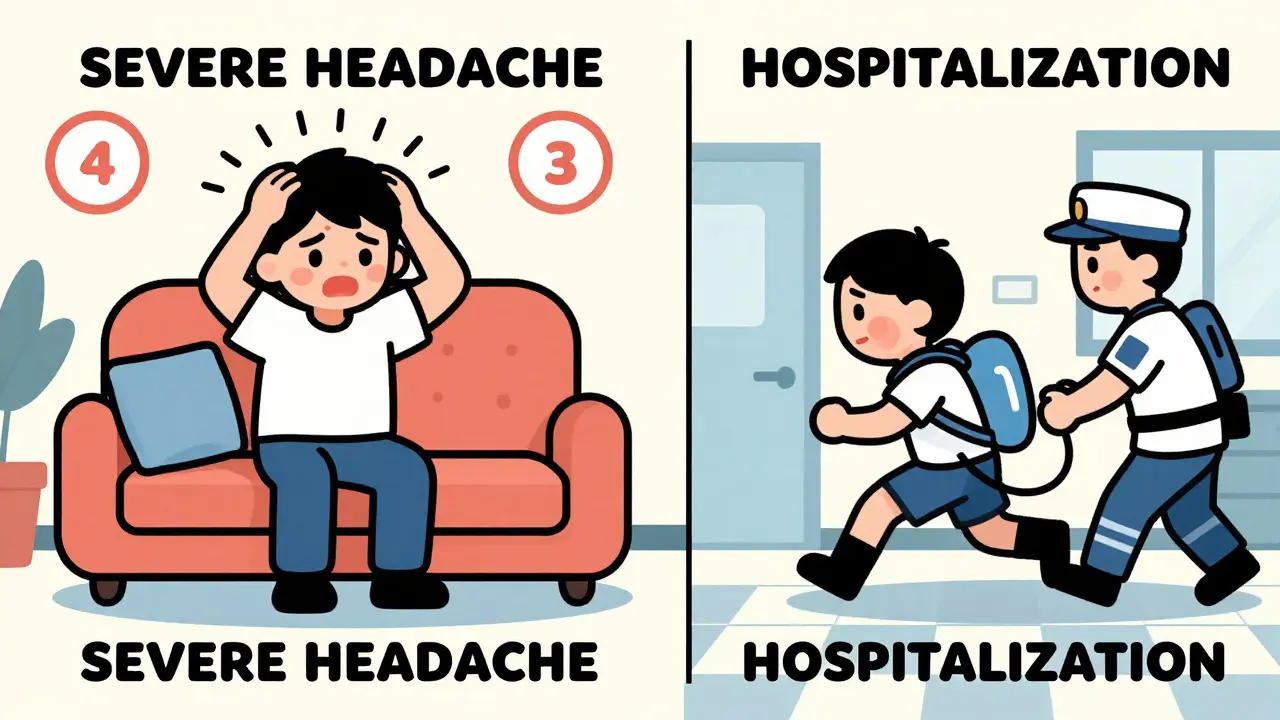
A headache can be Grade 3 (severe) if it is excruciating and requires strong painkillers. However, if it doesn't send you to the hospital or cause permanent disability, it is not a Serious Adverse Event. Conversely, a mild rash (Grade 1) that causes an allergic reaction leading to a 2-day hospital stay is a Serious Adverse Event because of the hospitalization criterion.
Dr. Robert Temple, former Deputy Center Director for Clinical Science at the FDA, has noted that confusing these terms is the most common misunderstanding among patients. A severe side effect might be uncomfortable, but it isn't necessarily "serious" in the regulatory sense. Understanding this helps reduce unnecessary anxiety when reading clinical trial data.
| Feature | Severity (Intensity) | Seriousness (Outcome) |
|---|---|---|
| Definition | How bad the symptom feels (Grade 1-5) | Specific outcomes like death or hospitalization |
| Example | Excruciating migraine (Grade 3) | Mild nausea requiring ER visit (Hospitalization) |
| Reporting Trigger | Monitored for quality of life | Must be reported to FDA within 15 days |
| Patient Impact | Comfort and daily function | Survival and major life changes |
Why Does This Classification Matter to You?
You might wonder why the FDA cares so much about categorizing these events. The answer is early detection. The SAE classification system acts as an alarm bell. When thousands of doctors report similar serious events, the FDA can identify patterns that weren't visible during smaller clinical trials.
In 2022 alone, this system contributed to 128 medication safety alerts and 47 label changes. This means that because someone reported a serious event, millions of other patients were protected through updated warnings or stricter usage guidelines. The FDA’s Sentinel Initiative, which monitors data from 300 million patient records, relies on these classifications to spot trends in near real-time.
For you, the patient, understanding this means you know what warrants immediate attention. If you experience a side effect that leads to hospitalization or threatens your life, it is critical that it gets recorded. This data protects future patients and ensures that drugs on the market remain safe for everyone.
How Patients Can Report Side Effects
While doctors and pharmaceutical companies are required to report SAEs, patients play a vital role too. The FDA encourages direct reporting through its MedWatch program, established in 1993 to allow consumers and health professionals to report adverse events and product problems to the agency.
In 2022, the FDA received over 38,000 reports directly from patients using Form 3500B. This represents a growing trend of empowered patients who understand that their voice matters. Here is how you can participate:
- Identify the Event: Did you experience a new symptom after starting a medication? Did it lead to a doctor's visit, emergency room trip, or hospital stay?
- Gather Information: Have the name of the drug, the dosage, and the dates you took it ready. Note any other medications you are taking.
- Submit the Report: You can file online via the FDA’s Safety Reporting Portal or mail in Form 3500B. The process is designed to be user-friendly, though it does take some time to fill out accurately.
Even if you aren't sure if the drug caused the issue, report it. The FDA’s experts determine causality later. Your report adds a data point to the global safety database, helping to catch rare but dangerous reactions that clinical trials might miss.
Navigating Clinical Trials and Consent Forms
If you are considering joining a clinical trial, you will encounter extensive information about adverse events. The FDA mandates that consent forms include a "Risks and Discomforts" section. Look for plain-language definitions. The FDA recommends sponsors define a serious adverse event as: "An event that results in death, requires hospitalization, causes significant disability, or presents a life-threatening situation."
Don't hesitate to ask your research team to explain the difference between expected side effects (like fatigue or mild nausea) and serious ones. A 2023 survey found that only 32% of patients accurately interpreted SAE information without extra explanation. It is perfectly okay to say, "Can you give me an example of a serious event for this study?" This clarity ensures you are making an informed decision about your participation.
Looking Ahead: Better Transparency for Patients
The landscape of drug safety is evolving. The FDA recognizes that complex terminology creates barriers. Recent initiatives, such as the 2023 draft guidance on enhancing SAE reports, aim to standardize language for patient-facing materials. The goal is to make safety information more accessible and less intimidating.
Additionally, technology is playing a bigger role. AI tools are now being piloted to prioritize serious reports, reducing review times from weeks to days. This means that when you or your doctor reports a serious event, it gets reviewed faster, potentially speeding up safety decisions that affect public health.
As a patient, you are not just a passive recipient of medication; you are an active participant in the safety ecosystem. By understanding what makes an event "serious" in the eyes of the FDA, you gain control over your health narrative. You know when to push for answers, when to seek emergency care, and how to contribute to the safety of the broader community.
Is every side effect listed on a drug label considered serious?
No. Drug labels list all known side effects, ranging from mild (like dry mouth) to serious (like liver failure). Only those meeting specific criteria-such as causing hospitalization, death, or permanent disability-are classified as Serious Adverse Events (SAEs). Most common side effects are not serious.
What should I do if I experience a potential serious adverse event?
First, seek appropriate medical attention. If the event is life-threatening, call emergency services. Once stabilized, inform your prescribing doctor. They are required to report SAEs to the FDA. You can also submit a report directly to the FDA via the MedWatch program to ensure the data is captured.
Does the FDA require proof that the drug caused the event?
No. An event is reported as an SAE if it occurs during treatment, regardless of whether a causal relationship is proven. The FDA evaluates the data later to determine if the drug likely caused the event. Suspected causality is enough for initial reporting.
How long does the FDA have to report a serious adverse event?
For fatal or life-threatening events, manufacturers must report to the FDA within 7 calendar days. For other serious events, the timeline is 15 calendar days. This rapid reporting allows for quick safety assessments.
Can a mild side effect become a serious adverse event?
Yes. If a mild symptom, such as a slight fever, escalates and leads to hospitalization or a life-threatening condition, it is then classified as a serious adverse event based on the outcome (hospitalization/life-threatening), not the initial severity.
Where can I find the safety profile of a medication?
You can find detailed safety information in the "Prescribing Information" or "Medication Guide" provided with your drug. These documents are available on the FDA website under the Drugs@FDA database. Look for sections titled "Warnings and Precautions" or "Adverse Reactions."