 Jan, 10 2026
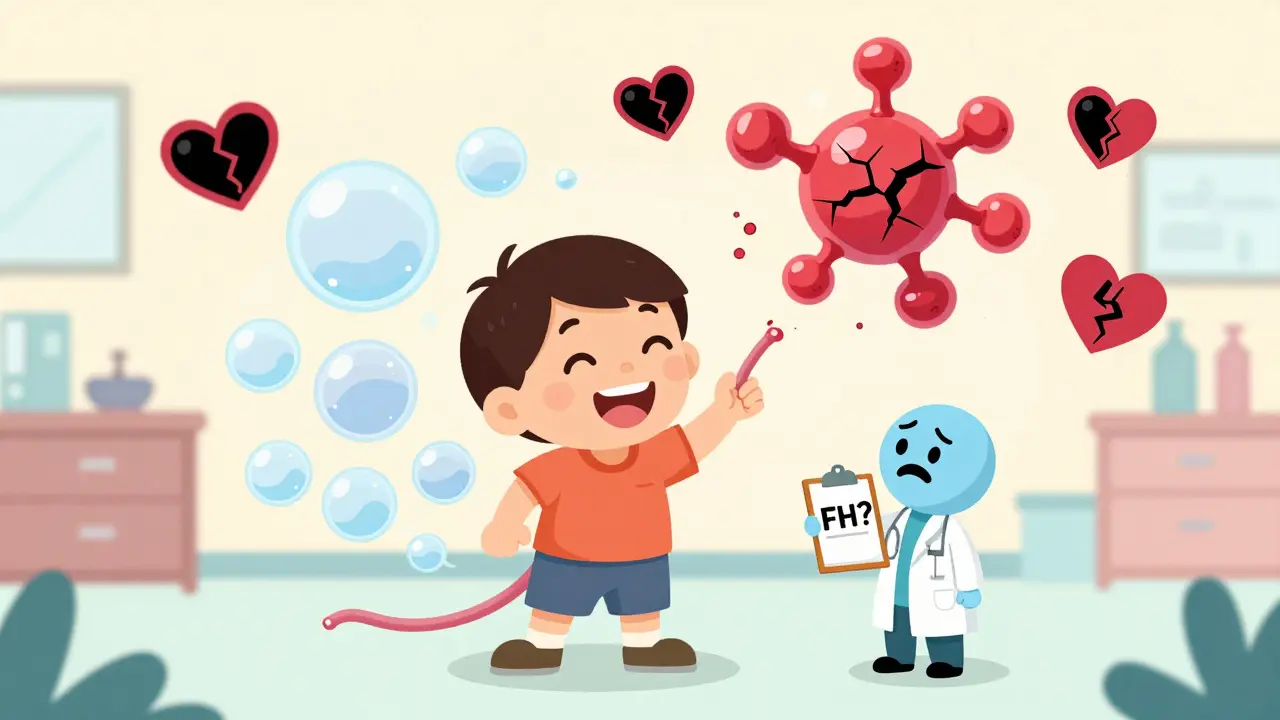
Familial hypercholesterolemia isn't just high cholesterol. It's a silent genetic time bomb. People born with this condition have cholesterol levels so high from birth that their arteries start clogging decades before most people even think about heart health. Left untreated, a 30-year-old with familial hypercholesterolemia (FH) can have the same risk of a heart attack as a 60-year-old with normal cholesterol. And here’s the worst part: most of them don’t even know they have it.
What Is Familial Hypercholesterolemia?
Familial hypercholesterolemia is an inherited disorder that keeps your body from removing LDL cholesterol - the "bad" kind - from your blood. Normally, your liver uses receptors to pull LDL out of circulation. In FH, those receptors are broken or missing because of a gene mutation, usually in the LDLR, APOB, or PCSK9 genes. So LDL builds up, sticks to artery walls, and forms plaques. This isn’t a lifestyle issue. It’s not about eating too much cheese or skipping the gym. This is genetics. You’re born with it.
There are two main types. Heterozygous FH (HeFH) means you inherited one faulty gene from one parent. That affects about 1 in every 200 to 250 people worldwide. Homozygous FH (HoFH) is rarer - 1 in 160,000 to 1 million - and happens when you get the bad gene from both parents. LDL levels in HoFH can soar past 400 mg/dL. Without treatment, many children with HoFH have heart attacks before age 10.
Why Is It So Often Missed?
Most people with FH feel fine. No chest pain. No dizziness. No symptoms at all. That’s why it’s called a silent killer. Doctors don’t routinely check cholesterol in kids unless there’s a family history. And even then, many don’t know what to look for.
Physical signs like yellowish bumps on tendons (xanthomas) or a white ring around the cornea (corneal arcus) can appear in teens or young adults with HeFH - but only about 20% of people show them. The rest are diagnosed only after a heart attack, stroke, or sudden cardiac death. In the U.S., only 6-10% of people with FH have been identified. That means over 1.3 million Americans live with this condition without knowing it.
Even when doctors spot high cholesterol, they often assume it’s just diet-related. They’ll tell you to eat less saturated fat and exercise more. But for someone with FH, those changes alone won’t cut it. Their LDL is too high, too early, and too stubborn.
How Is It Diagnosed?
There’s no single test, but there’s a clear path. First, a blood test. In adults, LDL levels above 190 mg/dL raise a red flag. In children, it’s 160 mg/dL. If you’ve got that, and a family history of early heart disease, FH is likely.
The gold standard is genetic testing - finding the exact mutation. But it’s expensive and not always covered by insurance. So doctors rely on clinical tools like the Dutch Lipid Clinic Network (DLCN) criteria, which scores your LDL levels, family history, physical signs, and age of onset. A score of 6 or higher means definite FH.
Universal screening for kids between ages 9 and 11 is now recommended by the American Heart Association and the American Academy of Pediatrics. That’s the best shot we have at catching FH before it’s too late. But only 12% of U.S. pediatricians actually do it, according to the American College of Cardiology. Why? Lack of training, lack of time, and lack of awareness.
Cascade Screening: The Most Powerful Tool We Have
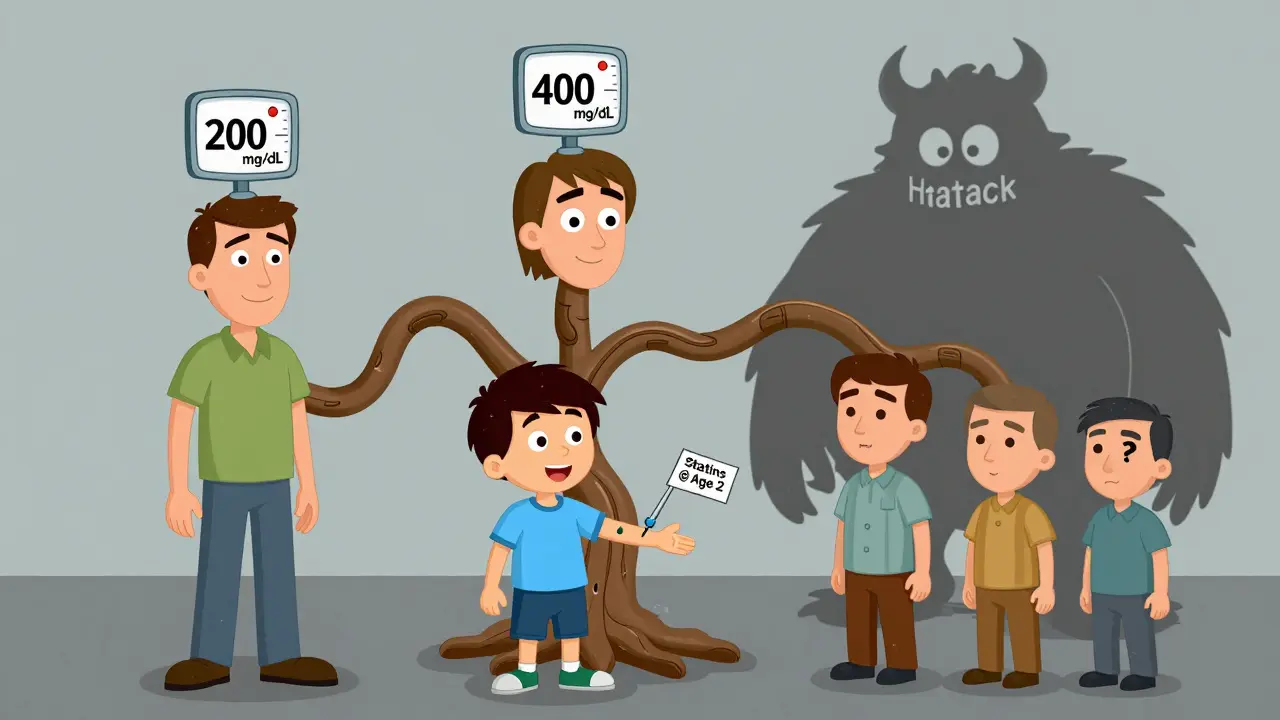
Once you find one person with FH, you’ve found a whole family at risk. That’s because it’s autosomal dominant - each child of an affected parent has a 50% chance of inheriting it. Cascade screening means testing the parents, siblings, and children of the first diagnosed person. Then, their relatives too.
This isn’t just smart - it’s cost-effective. A 2021 study found cascade screening costs just $13,500 per quality-adjusted life year gained. In the U.S., that’s well below the $50,000 threshold experts consider good value. In the Netherlands, where cascade screening has been mandatory since the 1990s, over 18,000 cases have been found. In the U.S., only 30-40% of eligible families get screened.
And here’s the kicker: if you have a parent with FH, your risk is 50%. If you have a sibling with FH, your risk is 50%. If you’re a child of someone with FH, you need a cholesterol test by age 2. That’s not a suggestion. That’s a medical necessity.
Aggressive Treatment Starts Early - Even in Kids
Statins are the first line of defense. They block cholesterol production in the liver. For adults with FH, high-intensity statins like atorvastatin or rosuvastatin are standard. But here’s what most people don’t know: treatment can and should start as early as age 2 if one parent has FH. If both parents have it, treatment may begin at birth.
Studies from the Netherlands and South Africa show that kids who start statins before age 10 have nearly normal life expectancy. Their arteries stay clear. Their heart attacks become rare. That’s not a theory. That’s real data from real people.
But statins alone often aren’t enough. Many people with FH need combination therapy: statin + ezetimibe (which blocks cholesterol absorption in the gut) + a PCSK9 inhibitor like evolocumab or inclisiran. Inclisiran is a game-changer - it’s a twice-yearly injection that lowers LDL by 50% or more. No daily pills. No missed doses.
Target LDL levels? Below 100 mg/dL for adults. Below 135 mg/dL for children. And it’s not just about hitting the number - it’s about reducing LDL by at least 50% from baseline. That’s aggressive. But it’s necessary.
Why the U.S. Is Falling Behind
The science is clear. The guidelines are solid. The tools exist. So why are so many people still dying?
First, awareness. Most GPs don’t know how to spot FH. They see high cholesterol and think "obesity" or "poor diet." They don’t ask about family history. They don’t order genetic tests. They don’t refer to lipid specialists.
Second, access. There’s one lipid specialist for every 1.5 million people in the U.S. Most people live hours away from one. Insurance often denies genetic testing unless you’ve already had a heart attack.
Third, system failure. There’s no national FH registry in the U.S. The Netherlands, the UK, and Norway have them. They track every diagnosed case. They automatically flag relatives. They follow up. They save lives. In those countries, 20-30% of FH cases are found. In the U.S., it’s 6-10%.
And then there’s the delay. The FH Foundation found that 72% of diagnosed people waited five or more years after symptoms started to get a diagnosis. The average age of diagnosis? 44. That’s too late.
The Future Is AI and Automation
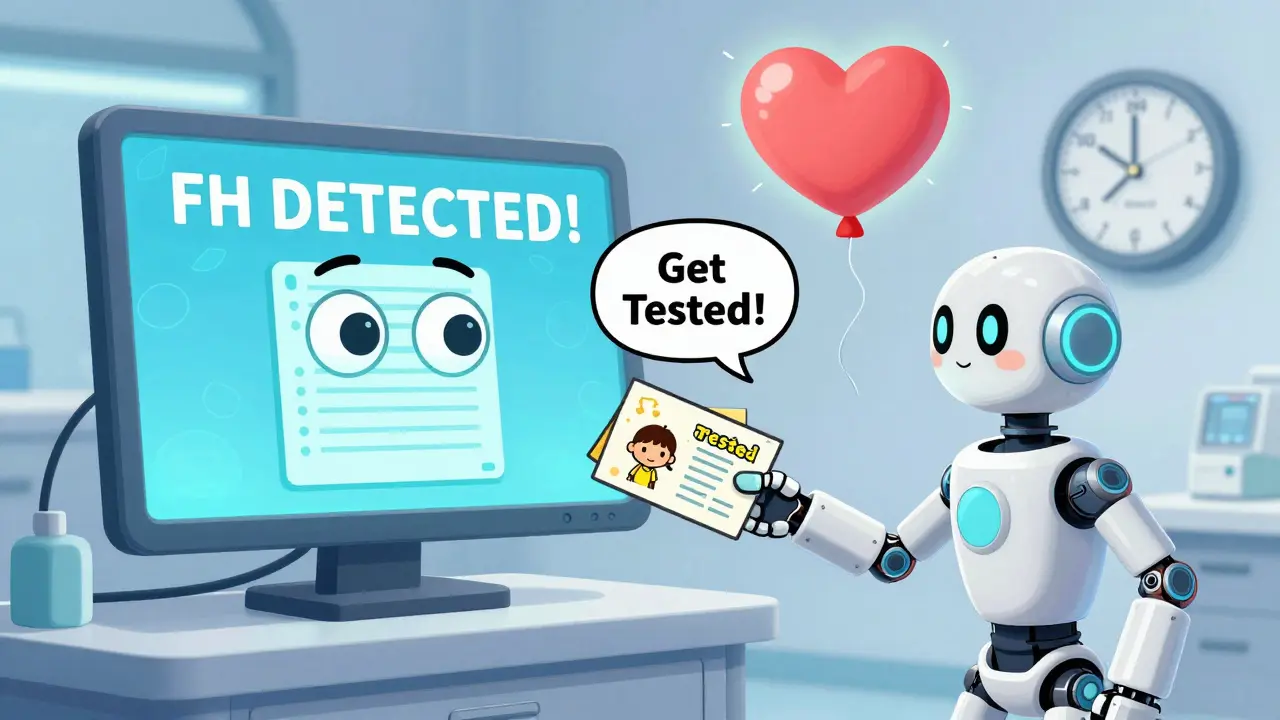
Machine learning is starting to change the game. A 2023 study in the Journal of the American Heart Association showed that AI models analyzing electronic health records - looking at age, sex, LDL levels, family history, and even medication use - could identify FH cases with 92% accuracy. That’s better than any clinical checklist.
Imagine your doctor’s computer flagging you at age 10 because your LDL is 180, your dad had a heart attack at 42, and your uncle took statins since he was 15. No waiting. No guesswork. Just a prompt: "Screen for FH. Refer to lipid specialist. Cascade screen family."
That’s not science fiction. It’s happening in pilot programs now. And it’s the only way we’ll scale this to millions of people.
What You Can Do Right Now
If you or a close relative had a heart attack before age 55 (men) or 60 (women), get tested. If your cholesterol has been high since childhood, get tested. If you have xanthomas or corneal arcus, get tested.
Ask your doctor: "Could this be familial hypercholesterolemia?" If they say no, ask for a referral to a lipid specialist. Don’t take "it’s just high cholesterol" as an answer.
If you have kids, ask for a cholesterol test at age 9-11. Don’t wait for symptoms. Don’t wait for a family member to die first.
FH is not a death sentence. It’s a treatable condition - if caught early. With the right treatment, people with FH can live as long as anyone else. But only if we stop ignoring it.
What Happens If Nothing Changes?
The CDC projects that over the next 10 years, undiagnosed FH will cause 250,000 premature heart attacks and deaths in the U.S. That’s more than the population of Columbus, Ohio. And we could prevent 180,000 of them - just by doing what we already know works: universal screening, cascade testing, and aggressive treatment.
We have the tools. We have the data. We have the will - in some countries. Now we need it everywhere.
Bryan Wolfe
January 10, 2026 AT 16:02This is the kind of post that makes me want to hug my doctor and then yell at them for not testing me sooner. I had a heart scare at 32, and they just told me to eat salad. Turns out? My dad had FH and died at 47. I’m on statins, ezetimibe, and inclisiran now. My LDL dropped from 280 to 78. I’m alive because I kept pushing. Don’t wait for a crisis. Get tested.
Sumit Sharma
January 12, 2026 AT 01:29The data is unequivocal: familial hypercholesterolemia represents a paradigmatic failure of preventive cardiology in resource-constrained settings. The absence of systematic cascade screening protocols in the U.S. constitutes a gross violation of the principle of beneficence. Genetic diagnostics are not luxuries-they are bioethical imperatives. The 92% predictive accuracy of AI-driven EHR analysis, as cited, renders current clinical inertia indefensible.
Prachi Chauhan
January 13, 2026 AT 09:15It’s wild how we treat cholesterol like it’s a personal failure. Like if you just ate less pizza, your genes would listen. But your DNA doesn’t care about your kale smoothie. My cousin was 12 when she got her first statin. She’s 28 now, runs marathons. No one told us it was hereditary until her brother had a stroke. We were just ‘lucky’ she didn’t die.
Katherine Carlock
January 13, 2026 AT 13:47I work in a pediatric clinic and we just started screening at 9-11 last year. One kid had LDL of 310. His mom thought he was just ‘big boned.’ We called a lipid specialist, did cascade screening-turns out THREE of his uncles had heart attacks before 40. We caught it. He’s on meds. He’s fine. But why did it take us THIS long? We’re supposed to be the ones protecting kids.
Sona Chandra
January 15, 2026 AT 12:43Why is no one talking about how the pharmaceutical industry profits off this? Statins? Cheap. PCSK9 inhibitors? $14,000 a year. Insurance won’t cover them unless you’ve already had a heart attack. This isn’t medicine-it’s a money trap. They want you sick, not cured.
Lauren Warner
January 16, 2026 AT 18:34Let’s be real. The ‘aggressive treatment’ narrative is just a cover for overmedicalization. Statins cause muscle pain, diabetes, cognitive fog. You’re treating a genetic condition with a drug that creates new ones. And you call that progress? The real solution is better lifestyle-except nobody wants to admit that because it doesn’t sell pills.
Craig Wright
January 18, 2026 AT 02:12In the United Kingdom, we have had a national FH registry since 2004. Every general practitioner is trained to recognize clinical signs. Cascade screening is mandated by NHS guidelines. We identify 87% of cases. In contrast, the U.S. system is fragmented, underfunded, and culturally dismissive of inherited disease. This is not a medical failure-it is a systemic collapse of public health responsibility.
Lelia Battle
January 18, 2026 AT 20:43I’ve spent years thinking about how we assign blame in health. We blame people for being lazy, for eating wrong, for not exercising enough. But FH? It’s not a choice. It’s not a moral failing. It’s biology. And yet, we treat it like it’s a personal flaw. Maybe the real disease isn’t high cholesterol-it’s our refusal to see genetic truth.
Konika Choudhury
January 19, 2026 AT 11:39Why do Americans make everything so complicated? Just test kids. Give them statins. Done. No need for AI. No need for 10-page posts. Just do it. India does it. Why cant you?
Darryl Perry
January 19, 2026 AT 21:581. FH is real. 2. Screening works. 3. Statins save lives. 4. Stop making excuses. 5. Do your job.
Eileen Reilly
January 20, 2026 AT 18:06ok so i just found out my 8 year old has an ldl of 220 and my mom had a heart attack at 45 and my dad is on 3 pills and now im crying because i thought it was just bad genes but now i think i was just a bad parent for not asking sooner??