 Dec, 18 2025
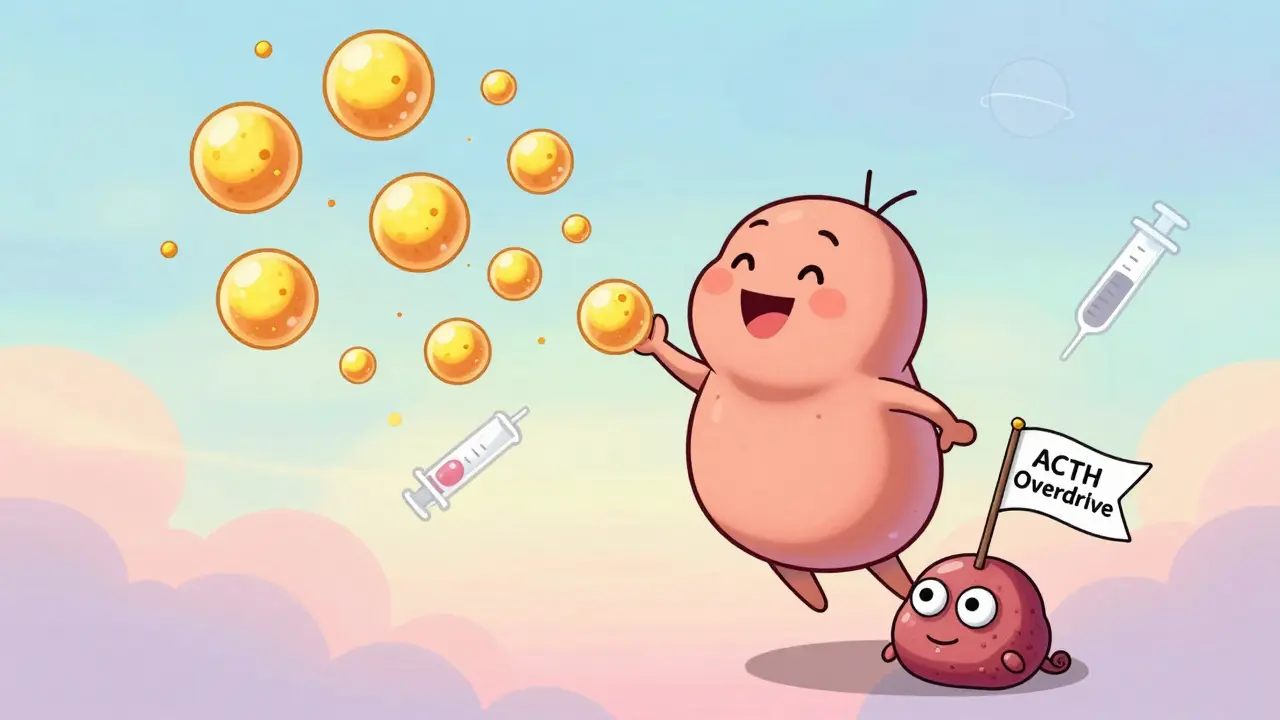
Cushing’s syndrome isn’t just weight gain or a round face. It’s a serious hormonal disorder caused by too much cortisol floating in your bloodstream for months or years. This hormone, made by your adrenal glands, normally helps you handle stress, control blood sugar, and keep your blood pressure steady. But when it’s overproduced-whether from a tumor or long-term steroid use-it starts breaking down your body from the inside. Muscles waste away, bones thin out, blood pressure spikes, and even your immune system gets knocked off balance. Left untreated, Cushing’s can lead to heart attacks, strokes, infections, or death. The good news? If the cause is internal, surgery is often the best shot at a cure.
What Causes Too Much Cortisol?
Most cases of Cushing’s syndrome come from outside the body-about 80% are caused by people taking high-dose steroid medications like prednisone for asthma, arthritis, or autoimmune diseases. That’s called exogenous Cushing’s. But the other 20%? That’s endogenous Cushing’s, where your own body makes too much cortisol. And that’s where surgery comes in. The three main culprits inside the body are:- Pituitary tumors (Cushing’s disease): These benign growths in the pituitary gland at the base of your brain overproduce ACTH, the hormone that tells your adrenal glands to make more cortisol. This is the most common cause of endogenous Cushing’s, making up 60-70% of cases. It’s more common in women between 20 and 50.
- Adrenal tumors: A tumor on one adrenal gland (usually benign) can start pumping out cortisol on its own, ignoring the brain’s signals to slow down. This accounts for 15-20% of cases.
- Ectopic ACTH tumors: Rarely, a tumor in the lungs, pancreas, or thymus starts making ACTH. These are often cancerous and harder to treat.
How Do You Know You Have It?
Cushing’s doesn’t show up on a routine blood test. It needs specific tests because symptoms develop slowly and mimic other conditions. You might notice:- A round, red face (moon facies) - present in about 70% of patients
- A fatty hump between the shoulders (buffalo hump) - seen in 90%
- Wide, purple stretch marks on the abdomen, thighs, or breasts - over 1 cm wide, in 75% of cases
- Weight gain mostly around the middle, while arms and legs stay thin
- High blood pressure (85% of patients)
- Easy bruising and slow wound healing
- Severe fatigue and muscle weakness
- Irregular periods or low libido
- 24-hour urine cortisol: Levels above 50 mcg per day are abnormal (normal is under 25).
- Low-dose dexamethasone suppression test: You take a steroid pill at night. In healthy people, cortisol drops. In Cushing’s, it stays high.
- Late-night salivary cortisol: Cortisol should be near zero at night. If it’s above 0.14 mcg/dL, that’s a red flag.
Why Surgery Is the First Choice
Medications like pasireotide or mifepristone can help lower cortisol, but they rarely cure the problem. They’re used to control symptoms before surgery or if surgery isn’t possible. But for tumors causing Cushing’s, surgery is the only way to remove the source. According to the Endocrine Society’s 2020 guidelines, surgery is the standard first treatment for endogenous Cushing’s. Why? Because it offers the best chance of full recovery-no daily pills, no ongoing side effects, and a real shot at returning to normal life.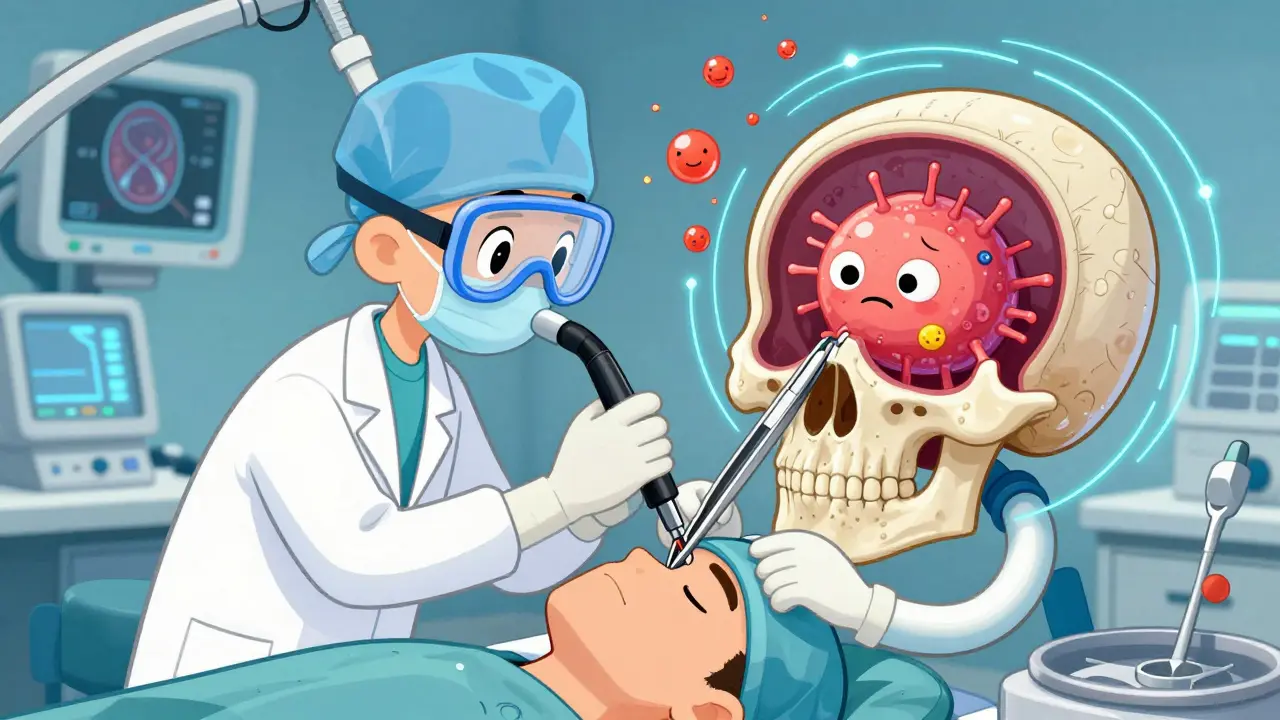
Types of Surgery and What to Expect
The surgery you get depends entirely on where the tumor is.Transsphenoidal Surgery (For Pituitary Tumors)
This is the most common procedure for Cushing’s disease. Surgeons go through the nose or upper lip, using a tiny camera and special tools to reach the pituitary gland. No skull opening is needed.- Success rate: 80-90% for small tumors (microadenomas under 10 mm), 50-60% for larger ones (macroadenomas).
- Procedure time: 2-4 hours.
- Recovery: Hospital stay of 2-5 days. Most people return to work in 4-6 weeks.
- Risks: CSF leak (2-5%), temporary adrenal insufficiency (30-40%), infection (1-3%), or damage to the pituitary gland.
Laparoscopic Adrenalectomy (For Adrenal Tumors)
If the problem is a tumor on one adrenal gland, surgeons remove it through small belly incisions using a camera and instruments.- Success rate: 95% of patients return to normal cortisol levels.
- Procedure time: 1-2 hours.
- Recovery: Often go home in 1-2 days. Back to normal in 2-4 weeks.
- Risks: Bleeding, infection, or injury to nearby organs. Less than 5% chance of complications.
Bilateral Adrenalectomy (Last Resort)
If both adrenal glands are overactive or if pituitary surgery failed, doctors may remove both glands. This cures Cushing’s completely-but you’ll need lifelong hormone replacement for cortisol and aldosterone. There’s also a 40% risk of Nelson’s syndrome: a fast-growing pituitary tumor that can appear years later.What Happens After Surgery?
After removing the tumor, your body doesn’t immediately start making cortisol again. Your adrenal glands have been “asleep” for so long that they need time to wake up.- You’ll need steroid replacement (hydrocortisone) for 3-6 months, sometimes longer.
- Dosing is carefully adjusted based on blood tests and how you feel.
- You must learn to increase your dose during illness, injury, or stress-missing this can lead to adrenal crisis, which is life-threatening.
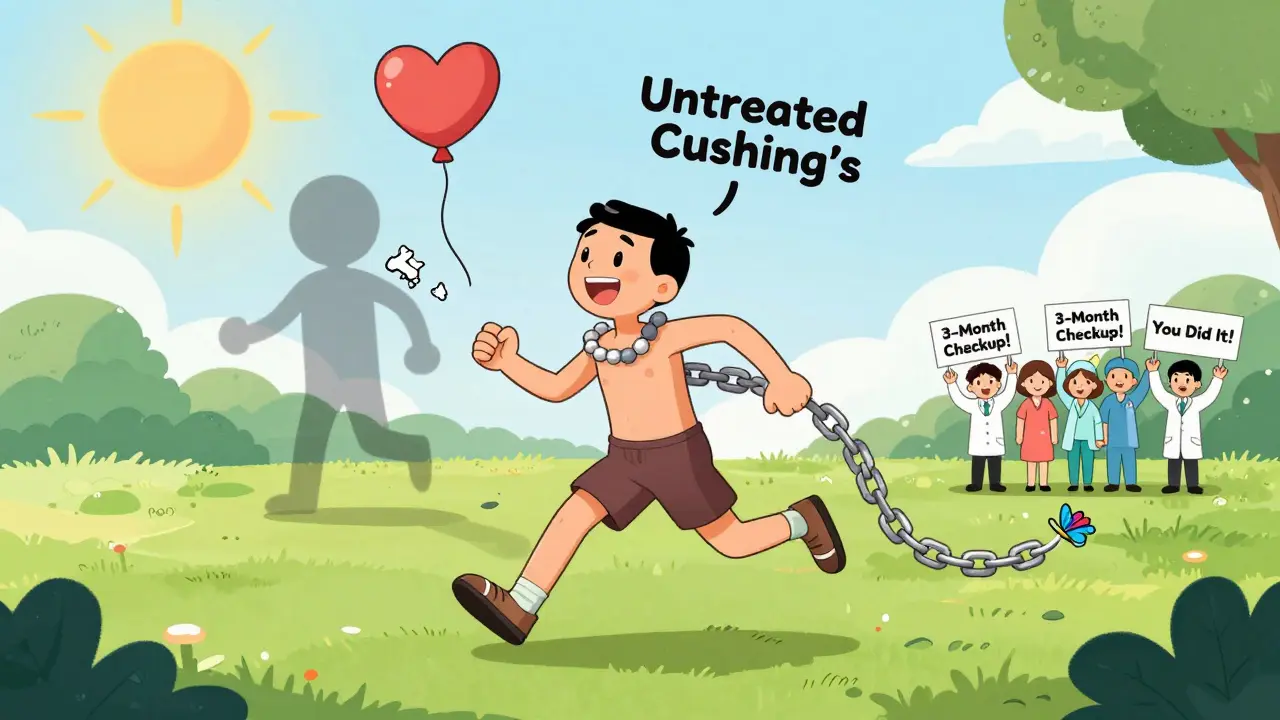
- Follow-ups every 3 months for the first year are standard.
Why Center Matters
Not all hospitals are equal when it comes to Cushing’s surgery. Surgeons who do fewer than 10 pituitary operations a year have remission rates as low as 50-60%. Those at high-volume centers-doing 20 or more per year-see success rates of 80-90%. Dr. Maria Fleseriu, a leading endocrinologist, says: “Transsphenoidal surgery performed by high-volume pituitary surgeons represents the gold standard.” That’s why experts recommend going to a center that specializes in pituitary disorders. These places have teams of neurosurgeons, endocrinologists, radiologists, and nurses who know exactly what to do before, during, and after surgery. They also use advanced imaging like 3T MRI to spot tiny tumors and newer tools like intraoperative cortisol monitors to confirm success right in the OR.The Big Picture: Risks vs. Rewards
Surgery isn’t risk-free. But the risks of leaving Cushing’s untreated are far worse.- Untreated Cushing’s doubles your risk of dying from heart disease or infection.
- Half of patients develop osteoporosis severe enough to cause fractures.
- 70% develop diabetes or pre-diabetes.
What Comes Next?
If you’ve been diagnosed with endogenous Cushing’s, your next step isn’t to panic-it’s to find the right team. Ask your doctor:- How many pituitary or adrenal surgeries do you perform each year?
- Do you have a dedicated Cushing’s care team?
- Can you access advanced imaging and intraoperative cortisol testing?
Can Cushing’s syndrome be cured without surgery?
Medications can control cortisol levels and ease symptoms, but they rarely cure the underlying cause. For tumors producing excess cortisol, surgery is the only treatment that removes the source. Drugs like pasireotide or mifepristone are used before surgery to stabilize patients or if surgery isn’t an option, but long-term success rates are under 30%. Surgery offers the best chance for full recovery.
How long does recovery take after Cushing’s surgery?
Recovery varies. Most people feel better within 3-6 months, but full recovery can take up to a year. Fatigue, mood changes, and hormone adjustments are common. Adrenal insufficiency after surgery means you’ll need steroid replacement for months, sometimes permanently. Returning to work typically takes 4-6 weeks for pituitary surgery and 2-4 weeks for adrenal surgery, but full energy levels take longer.
Is Cushing’s surgery risky?
All surgery carries risks. For pituitary surgery, the main risks are CSF leak (2-5%), temporary adrenal insufficiency (30-40%), and infection (1-3%). For adrenal surgery, bleeding and infection are rare (under 5%). The bigger risk is not treating Cushing’s-untreated, it leads to heart disease, bone fractures, diabetes, and death. When done by experienced surgeons, the benefits far outweigh the risks.
What if the surgery doesn’t work?
If cortisol levels stay high after surgery, you may need a second operation, radiation therapy (like stereotactic radiosurgery), or long-term medication. About 10-25% of patients experience recurrence, especially with larger tumors. Regular follow-ups with blood and urine tests are essential to catch a return early. Some patients benefit from newer treatments like 11C-metomidate PET scans to locate hidden tumors.
Do I need to take hormones for the rest of my life after surgery?
Not always. Most patients need temporary steroid replacement for 3-6 months while their adrenal glands recover. But if both adrenal glands are removed (bilateral adrenalectomy), lifelong hormone replacement is required. Even after single adrenal removal, some people develop adrenal insufficiency permanently-about 5-10% of cases. Regular monitoring by an endocrinologist is key to adjusting doses correctly.
Monte Pareek
December 19, 2025 AT 05:58Look I've seen too many people get misdiagnosed for years because doctors think it's just stress or laziness. Cushing's isn't a lifestyle issue it's a biological bomb ticking inside you. That 95% success rate on adrenal surgery? That's life or death. Don't wait until your bones turn to dust or your heart gives out. Find a specialist now not next year. I've been there and I'm not gonna let anyone else waste time.
holly Sinclair
December 19, 2025 AT 06:53It's fascinating how the body's feedback loops can be so easily hijacked by a tiny tumor. Cortisol isn't just a stress hormone it's the conductor of the entire endocrine orchestra. When it's out of tune the whole symphony collapses. The fact that your adrenal glands go dormant after years of suppression is like a musician forgetting how to play their instrument after decades of silence. And the recovery isn't just physical it's existential. You're not just healing tissue you're relearning how to be human again. I wonder how many people feel like strangers in their own bodies even after the tumor's gone. The hormone replacement isn't just medical it's a philosophical recalibration of self.
Jedidiah Massey
December 20, 2025 AT 23:30Let's be real here the whole Cushing's narrative is built on endocrine hegemony. The medical industrial complex loves to sell you surgery because it's profitable. Why not explore adaptogens cortisol modulators or epigenetic reprogramming? The 80% success rate is statistically skewed by publication bias. I've seen patients on ashwagandha and berberine stabilize for years without a scalpel. The real villain isn't the tumor it's the reductionist biomedical model that refuses to see the whole organism.
Emily P
December 22, 2025 AT 11:13I was diagnosed last year. I didn't know what was happening to me until I saw the stretch marks in the mirror. I thought I was just gaining weight. Now I'm 8 months post-op and still on hydrocortisone. I'm still tired. But I can breathe again. I don't cry over everything anymore. It's slow.
Vicki Belcher
December 24, 2025 AT 04:54Y'all this is so important!! 🙌 I had the transsphenoidal surgery and it changed my life. I lost 50 lbs in 6 months and my blood pressure is normal now 😭 I know recovery takes time but it's SO worth it. Find a high-volume center!! Don't settle!! 💪💖
Kelly Mulder
December 24, 2025 AT 17:24One must question the epistemological foundations of contemporary endocrinological practice. The reliance upon surgical intervention as a panacea reflects a deeply entrenched Cartesian dualism that pathologizes the corporeal while ignoring the phenomenological experience of the patient. The very terminology 'remission' implies a temporary cessation rather than true restoration. One wonders whether the statistical triumphs cited are merely artifacts of selection bias and institutional prestige rather than genuine clinical efficacy.
Alex Curran
December 26, 2025 AT 08:43Been doing this for 15 years and the biggest mistake patients make is waiting too long. The longer cortisol runs wild the harder the recovery. Adrenal glands are like muscles they atrophy. And yes the surgery is scary but the alternative is slower death. Go to a center that does at least 20 cases a year. Ask for the surgeon's personal success rate not the hospital's. And don't trust the first endo you meet. Get a second third fourth opinion if you have to. This isn't a routine procedure it's a life reset.
Lynsey Tyson
December 27, 2025 AT 15:01I get why people are scared of surgery. I was too. But reading Jane_D's story made me feel less alone. I think it's okay to be scared and still choose to go through with it. Healing isn't linear and it's okay to need help along the way. You're not weak for needing meds or therapy or time. You're just human.
Edington Renwick
December 28, 2025 AT 11:15They say surgery is the gold standard but what about the ones who don't make it? The ones who bleed out on the table or get Nelson's syndrome? No one talks about them. They're the ghosts in the data. And what about the people who get cured but never feel like themselves again? The joy is gone. The spark. The life. They give you cortisol pills but they can't give you back the person you were before the disease took you apart piece by piece.