 Dec, 23 2025
What Are Colorectal Polyps?
Colorectal polyps are small growths that stick out from the inner lining of your colon or rectum. They’re common-about 30 to 50% of adults will have at least one by age 60. Most don’t cause symptoms, and many are harmless. But some can turn into cancer over time. That’s why finding and removing them during a colonoscopy is one of the most effective ways to prevent colorectal cancer.
Not all polyps are the same. Two main types carry cancer risk: adenomas and serrated lesions. They look different under the microscope, grow in different ways, and need different follow-up plans. Knowing the difference helps doctors decide how often you need a repeat colonoscopy-and whether you’re at higher risk.
Adenomas: The Classic Precancerous Polyp
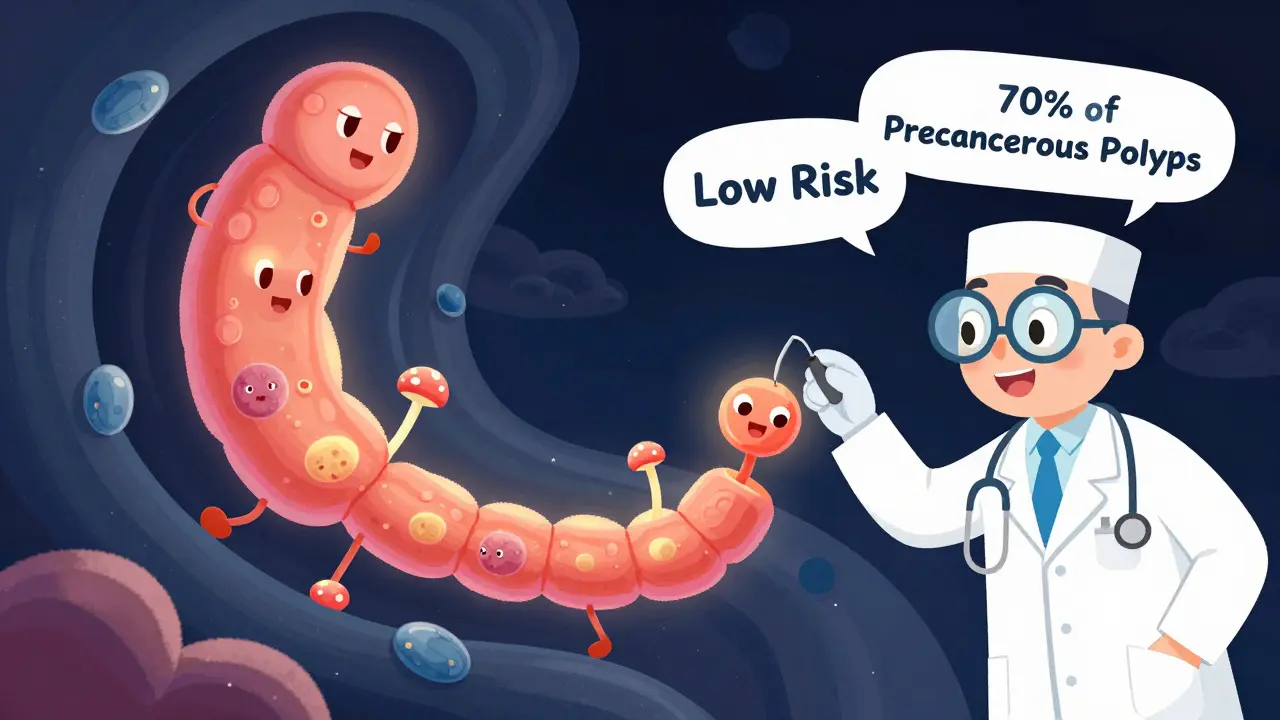
Adenomas make up about 70% of all precancerous polyps. They’re the type most people think of when they hear "polyp." These growths start as small, benign bumps but can slowly turn into cancer if left alone.
There are three subtypes, based on how they grow:
- Tubular adenomas (70% of adenomas): These are the most common and least risky. They’re usually small, round, and grow like tiny tubes. If they’re under half an inch, the chance of cancer is less than 1%.
- Tubulovillous adenomas (15%): These mix tube-like and finger-like growth patterns. They’re more likely to become cancerous than tubular ones, especially if they’re larger than 1 cm.
- Villous adenomas (15%): These are flat, spread out, and harder to remove completely. They carry the highest cancer risk-even a 1 cm villous adenoma has a 10-15% chance of already containing cancer cells.
Size matters. A polyp smaller than 0.5 cm has almost no chance of being cancerous. But once it hits 1 cm or larger, the risk jumps. And if it has villous features, that risk goes up another 25-30% compared to a tubular polyp of the same size.
Serrated Lesions: The Stealthy Path to Cancer
Serrated lesions account for 20-30% of all colorectal cancers, even though they’re less common than adenomas. They’re called "serrated" because under the microscope, their edges look like tiny saw teeth. These polyps are sneaky-they’re often flat, hard to spot during colonoscopy, and tend to hide in the upper part of the colon.
There are three types:
- Hyperplastic polyps: These are usually harmless, especially if they’re small and found in the lower colon. They don’t turn into cancer.
- Sessile serrated adenomas/polyps (SSA/Ps): These are the big concern. They’re flat, often larger than 1 cm, and located in the cecum or ascending colon. About 13% of SSA/Ps already show high-grade dysplasia or early cancer when removed. Their shape makes them easy to miss during colonoscopy-up to 6% of these polyps go undetected.
- Traditional serrated adenomas (TSAs): These are rarer but also precancerous. They often look like small, mushroom-shaped growths and carry a cancer risk similar to adenomas.
Unlike adenomas, which grow slowly over 10-15 years, SSA/Ps can turn into cancer faster-sometimes in just 5-7 years. That’s why finding them early is critical.
Why Detection Is So Hard
Not all polyps are easy to see. The shape and location make a huge difference.
Pedunculated polyps grow on a stalk, like a mushroom. They’re easy to spot and remove.
Sessile polyps sit flat on the colon wall. No stalk. Just a broad base. These are harder to see, especially if they’re small or hidden behind folds in the colon.
Flat polyps are even trickier. They’re flush with the lining-almost invisible unless you’re using high-definition scopes or AI-assisted tools.
SSA/Ps are especially problematic because they’re often in the right side of the colon, where the bowel is wider and more curved. Standard colonoscopy misses them more often than adenomas. Studies show a 2-6% miss rate for sessile polyps, and it’s even higher for flat ones. That’s why newer tools like AI-assisted colonoscopy systems (like GI Genius) are now being used in many clinics-they’ve been shown to boost adenoma detection by 14-18%.

How They Turn Into Cancer
Adenomas and serrated lesions follow different paths to cancer.
Adenomas usually develop through the chromosomal instability pathway. That means they pick up mutations in genes like APC, which controls cell growth. Over time, extra mutations pile up, and the polyp becomes cancerous.
Serrated lesions follow the serrated pathway, also called the CpG island methylator phenotype (CIMP). These polyps have mutations in the BRAF gene and show heavy DNA methylation-essentially, their genes get switched off in the wrong places. This pathway leads to a different type of cancer, often with different features and worse outcomes if not caught early.
Knowing the molecular type isn’t routine yet, but experts predict that within five years, labs will routinely test removed polyps for these markers. That will help doctors tailor surveillance plans to your actual risk-not just the size or shape of the polyp.
What Happens After Removal?
Once a polyp is found, it’s removed during the colonoscopy. For most adenomas under 2 cm, success rates are 95-98%. But for large sessile serrated lesions, especially those over 2 cm, the success rate drops to 80-85% because they’re flat and harder to grab completely.
After removal, the pathologist checks the tissue. The key question: Was it removed fully? And does it show cancer?
If it’s a small tubular adenoma (under 1 cm) with no high-grade dysplasia, you’re usually asked to come back in 5-10 years. But if you had an SSA/P that’s 1 cm or larger, guidelines differ. The U.S. recommends a follow-up colonoscopy in 3 years. Some European guidelines say 5 years, based on lower observed progression rates in their populations.
And if you had any serrated polyp-even a small one-you’re at 1.5 to 2.5 times higher risk of developing colorectal cancer later. That doesn’t mean you will. Most people never do. But it does mean you need to stick to your screening schedule.
Who Needs Screening and When?
Everyone should start regular colorectal cancer screening at age 45, according to the American Cancer Society. But if you’ve had a polyp, your schedule changes.
Here’s a simple breakdown:
- 1-2 small tubular adenomas (<1 cm): Return in 7-10 years.
- 3-10 adenomas, or any adenoma ≥1 cm: Return in 3 years.
- Any SSA/P ≥10 mm: Return in 3 years (U.S. guidelines).
- More than 10 adenomas, or any adenoma with high-grade dysplasia: Return in 1 year.
- Complete removal of a large sessile serrated lesion with clear margins: Return in 5 years.
If you’re unsure, ask your doctor for a written summary of your polyp type, size, and location. That helps when you see a new gastroenterologist or need to explain your risk to family members.

What About Symptoms?
Most polyps cause no symptoms at all. That’s why screening is so important.
But if you notice any of these, get checked:
- Rectal bleeding (30-40% of symptomatic cases)
- Iron deficiency anemia (15-20% of cases)-often from slow, unnoticed bleeding
- Changes in bowel habits lasting more than a few days
- Unexplained abdominal pain or cramping
Don’t wait for symptoms. By the time they appear, the polyp may already be advanced.
What’s Next for Polyp Detection?
Research is moving fast. The 2023 SEER data shows colorectal cancer rates are dropping by 3% per year in people over 55-thanks to better screening and polyp removal. But in people under 50, rates are rising by 2% per year. We don’t fully understand why.
Future tools will include:
- AI-powered colonoscopies that flag missed polyps in real time
- Blood or stool tests that detect molecular signatures of high-risk polyps
- Personalized surveillance based on your polyp’s DNA profile, not just its size
Right now, we’re still using the same tools we’ve had for decades. But in the next five years, your colonoscopy could be followed by a quick molecular test that tells your doctor exactly how often you need to come back.
Bottom Line
Not all polyps are created equal. Adenomas are the classic precancerous growths. Serrated lesions, especially SSA/Ps, are the silent threat-flat, hidden, and fast-growing. Both need to be removed. Both need follow-up.
The good news? If you get screened regularly and your polyps are removed completely, your risk of colorectal cancer drops by 75-90%. You’re not just preventing cancer-you’re stopping it before it starts.
Don’t skip your colonoscopy. Don’t ignore your results. And don’t assume a polyp is harmless just because it’s small. The right follow-up saves lives.
Katie Taylor
December 24, 2025 AT 20:00Finally someone broke this down without sounding like a textbook. I had a sessile serrated polyp removed last year and was terrified. Now I get why my doc wants me back in 3 years - it’s not just being extra, it’s because these things sneak up fast. Seriously, if you’re over 45 and haven’t gotten screened, just do it. Your future self will thank you.
Also, AI-assisted colonoscopy? Yes please. My doc used one and said it caught two things the naked eye totally missed. Science is wild.
Stop waiting for symptoms. There won’t be any until it’s too late.
Isaac Bonillo Alcaina
December 25, 2025 AT 05:23Let’s be clear: if you’re getting a colonoscopy and they don’t use high-definition imaging with chromoendoscopy or AI enhancement, you’re being grossly underserved. The 2–6% miss rate for sessile polyps isn’t a statistic - it’s a public health failure. And don’t get me started on how many gastroenterologists still treat all polyps the same. Tubular? Serrated? Doesn’t matter? Wrong. The molecular pathways are fundamentally different. This isn’t semantics - it’s survival.
Also, ‘small’ isn’t ‘safe’ if it’s serrated. I’ve seen 6mm SSA/Ps with high-grade dysplasia. Stop minimizing risk based on size alone.
niharika hardikar
December 26, 2025 AT 20:28It is imperative to underscore that the neoplastic transformation of colorectal polyps, particularly those of the serrated lineage, constitutes a paradigm shift in oncogenic progression. The CpG island methylator phenotype (CIMP) pathway, mediated by BRAF mutations and epigenetic silencing of tumor suppressor genes, diverges significantly from the adenoma-carcinoma sequence governed by APC/β-catenin dysregulation.
Consequently, surveillance intervals must be stratified not merely by morphology but by molecular biomarkers, which are now empirically validated in prospective cohort studies. Failure to implement such stratification constitutes a deviation from evidence-based clinical practice guidelines as promulgated by the US Multi-Society Task Force on Colorectal Cancer (2020).
Blow Job
December 28, 2025 AT 15:14Man, I used to think colonoscopies were just a weird rite of passage. Then my mom got one and they found a big flat one she didn’t even know about. She’s fine now, but it scared the hell out of us.
Just go. Don’t wait. Don’t make excuses. Your gut doesn’t scream before it breaks. And if your doc doesn’t mention AI tools or the difference between adenomas and serrated polyps? Find a new one.
Also, the prep sucks. But it’s one day of misery for 10 years of peace. Worth it.
EMMANUEL EMEKAOGBOR
December 28, 2025 AT 20:21Thank you for this comprehensive and thoughtful exposition on colorectal polyp pathology. In my country, access to advanced endoscopic techniques remains limited, yet the principles outlined here are universally applicable. I have shared this with several colleagues who are primary care providers - we are now initiating patient education sessions on the importance of early detection and the nuanced differences between polyp types.
It is heartening to witness the integration of molecular diagnostics into routine practice. Such advances reflect a deeper commitment to personalized medicine, and I hope they become accessible to all, regardless of socioeconomic status.
Jillian Angus
December 29, 2025 AT 18:39my doc said i had a little polyp and i was like oh cool
then he said it was serrated and i was like oh shit
now i’m scared to eat anything that isn’t kale
just kidding. sort of.
Bhargav Patel
December 30, 2025 AT 03:00There is a metaphysical dimension to medical screening that often goes unexamined. The colon, as an organ of elimination, becomes a mirror for societal neglect - we ignore its signals until they erupt into crisis. The polyp, then, is not merely a biological anomaly but a symbol of our collective disregard for preventive care.
Adenomas and serrated lesions, though distinct in pathology, both arise from a culture that prioritizes intervention over vigilance. We wait for cancer to announce itself - and then marvel at how advanced it is.
Perhaps the true cure is not the colonoscope, but the decision to use it before fear becomes necessary.
Lu Jelonek
December 30, 2025 AT 05:23As someone who’s had three colonoscopies in five years due to family history, I can say this: the difference between a tubular and a sessile serrated polyp isn’t just academic - it’s life-changing. My last one was a 1.2cm SSA/P. They had to use a special cap and suction to get it all. I didn’t even know they could do that.
Also - if you’re worried about the prep, just do it the night before. Less brutal. And drink the whole thing. No cheating. Trust me.
siddharth tiwari
December 31, 2025 AT 06:19they say serrated polyps are dangerous but what if the whole thing is a scam? what if they just want us to keep getting colonoscopies so the hospitals make money? i heard the prep drink has chemicals that make you sick on purpose so you’ll come back. and ai? that’s just to sell more machines. my cousin’s doc said he had a polyp but then the second doc said it was just a fold. so who’s lying?
maybe we should just eat more fiber and pray.
suhani mathur
January 1, 2026 AT 15:34Oh wow. So the polyp I had removed last year? The one they called ‘benign’? Turns out it was a sneaky little assassin with a saw-tooth edge. Thanks for the heads-up, doc. I’ll be sure to schedule my next one in exactly 3 years… right after I finish this bag of chips.
JK. I’m going. But can we at least get a snack break during the prep? Asking for a friend who’s already crying over the Gatorade.
Diana Alime
January 1, 2026 AT 16:29i had a polyp and now i’m scared to poop
like… what if it grows back while i’m on the toilet?
also the prep was the worst thing ever. i cried. i yelled at my dog. i almost moved to canada.
but hey. at least i’m not dead.
so… thanks i guess?
also can someone explain why the colon is shaped like a question mark? that’s just rude.
Andrea Di Candia
January 2, 2026 AT 22:20I love how medicine is finally catching up to the fact that not all polyps are created equal. It used to be ‘remove it all, check in five’ - but now we’re seeing that the real enemy isn’t the polyp, it’s the assumption that they’re all the same.
It’s like treating every bruise like a broken bone. Some just need ice. Others need an MRI.
And honestly? This kind of nuanced understanding is what makes me hopeful about healthcare. We’re moving from one-size-fits-all to ‘what’s actually going on here?’ And that’s beautiful.
claire davies
January 3, 2026 AT 07:27My granny had a colonoscopy in 1998 and they pulled out three polyps - all tubular, all tiny. She lived to 92. My mum had one last year - big, flat, serrated, in the right side. They had to use a special technique, and now she’s on a 3-year watch. Same body, same age, different polyp, different rules.
It’s wild how far we’ve come. Back then, they didn’t even know about SSA/Ps. Now we’ve got AI spotting what human eyes miss. I’m not saying it’s perfect - but we’re learning. And that’s the point, isn’t it? Medicine isn’t about having all the answers. It’s about asking better questions.
So if you’re 45 or over - go. Don’t wait for a symptom. Don’t wait for your cousin to die. Don’t wait for your doctor to ‘suggest’ it. Just go. You’ve got nothing to lose but fear. And maybe, just maybe, a few years of your life.
Blow Job
January 4, 2026 AT 15:07Just read this again. And yeah - the 13% of SSA/Ps with early cancer? That’s the number that stuck with me.
My doc didn’t even mention that. Just said ‘we got it all’ and moved on.
Guess I’m asking for the pathology report next time. And maybe a second opinion.
Thanks for the wake-up call, everyone.